As an Amazon Associate I earn from qualifying purchases. This post contains affiliate links, which means I may earn a small commission — at no extra cost to you — if you buy through them. I only recommend things I believe are genuinely worth your time.
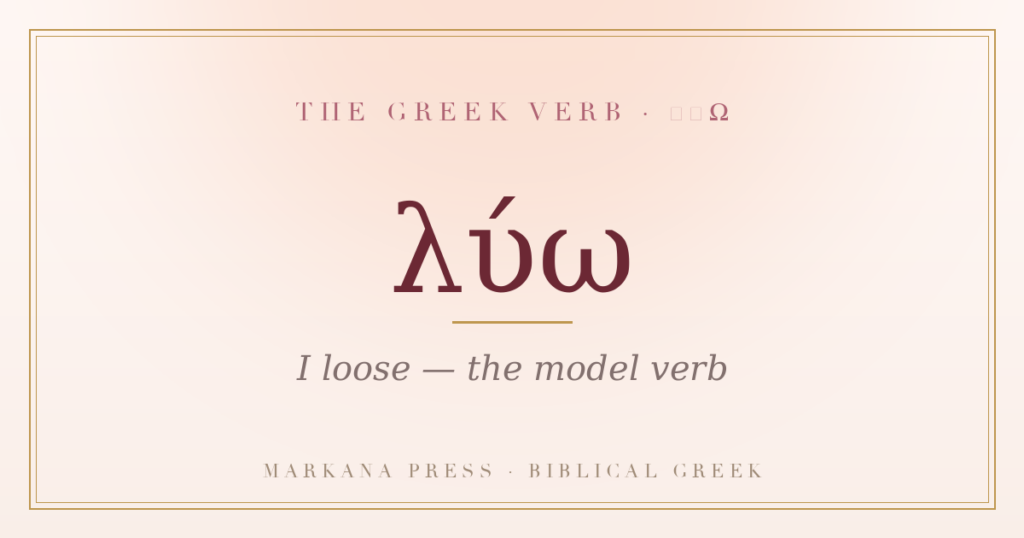
If nouns are the bones of Greek, verbs are its breath. Almost every sentence in the Greek New Testament has at least one verb, and the moment you can read them, the text comes alive. The best place to start is the present tense of the model verb λύω (luō, “I loose” or “I set free”) — the verb every Greek student meets first.
This is where Volume II of my Biblical Greek series picks up, and the single biggest idea is this: a Greek verb tells you who is doing the action inside its own ending.
The verb already contains the subject
In English we need a separate pronoun: I loose, you loose, he looses. Greek folds that pronoun right into the verb’s tail. Watch the ending change while the stem λυ- stays put:
- λύω — I loose
- λύεις — you (one person) loose
- λύει — he, she, or it looses
- λύομεν — we loose
- λύετε — you (plural) loose
- λύουσιν — they loose
So λύω all by itself is a complete sentence: “I loose.” You do not need a separate word for “I” — the -ω ending is “I.” Learn these six endings once and you can read them on a huge number of verbs, because they repeat with beautiful regularity.
What the present tense really means
The Greek present does not just mean “happening now.” At its heart it pictures action as ongoing or repeated — a movie, not a snapshot. So λύει can mean “he looses,” “he is loosing,” or “he keeps loosing.” That flavor of “ongoing-ness” is called aspect, and it is one of the most important ideas in the whole language. I give it its own post — aspect versus tense — because once you see it, dozens of verses gain a dimension the English can only hint at.
Reading the endings like a code you cracked
Here is the payoff. Because the ending carries the subject, Greek can drop pronouns and rearrange words freely, and you can still follow exactly who is doing what. When you see πιστεύομεν you immediately know it is “we believe” — the -ομεν told you. When you see ἀκούει, the -ει says “he/she hears.” You are not translating word-by-word anymore; you are reading a code you have learned to crack.
Why λύω is the perfect first verb
Teachers use λύω for a reason: it is perfectly regular, so it shows the pattern cleanly with no surprises. Once its endings are yours, you have a template to lay over thousands of other verbs — πιστεύω (I believe), ἀκούω (I hear), γράφω (I write), βλέπω (I see). They all take the same endings. That is the quiet generosity of Greek grammar: it teaches you one pattern and then reuses it everywhere.
Your next steps with the verb
From here the verb opens up in three directions, and each is its own short lesson: voice (whether the subject acts or is acted upon), the aorist tense (the backbone of New Testament storytelling), and eventually the six principal parts that unlock every form a verb can take. If you are brand new, start with the alphabet so these forms are easy to sound out, and try reading John 1:1, where the little verb ἦν (“was”) is doing enormous work.
Master λύω, and you have not learned one verb — you have learned the shape of the Greek verb itself. Everything else is variations on a melody you now know.
From Markana Press
Read the New Testament in the language it was written in
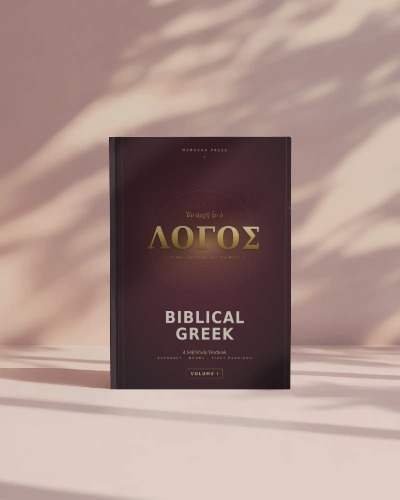
Everything in this post is exactly how I teach it in Biblical Greek: A Self-Study Textbook — a four-volume course I publish through my Christian imprint, Markana Press. It assumes no background in Greek and takes you from the alphabet to reading the Gospels in their original words.
📚 All four volumes are free to read on Kindle Unlimited right now — and also available in paperback and hardcover.
 Free on Kindle Unlimited
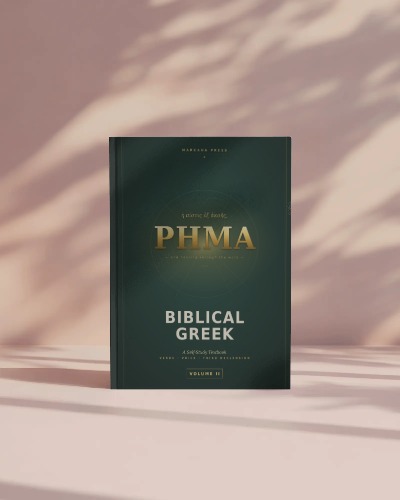
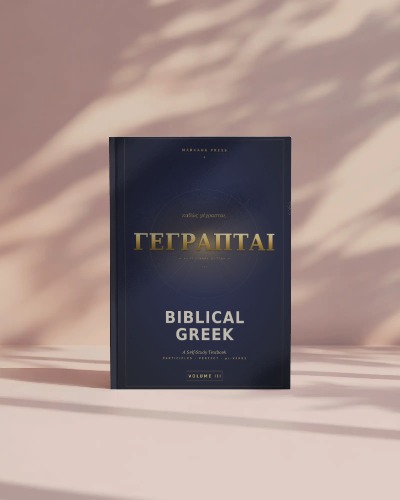
Get the complete four-volume series:
Start with Volume I if you’re new — each volume builds on the one before it.