As an Amazon Associate I earn from qualifying purchases. This post contains affiliate links, which means I may earn a small commission — at no extra cost to you — if you buy through them. I only recommend things I believe are genuinely worth your time.
There is a moment in learning Greek when the verb system stops feeling like an endless ocean of forms and suddenly becomes manageable. That moment usually arrives when you learn about the six principal parts. They are the six “master keys” of a Greek verb — learn them, and you can generate every other form that verb can take. It is one of the highest returns on memory in the whole language.
I build toward the principal parts across Volume II, because they are the bridge from “I can read the present tense” to “I can read anything.”
What a “principal part” is
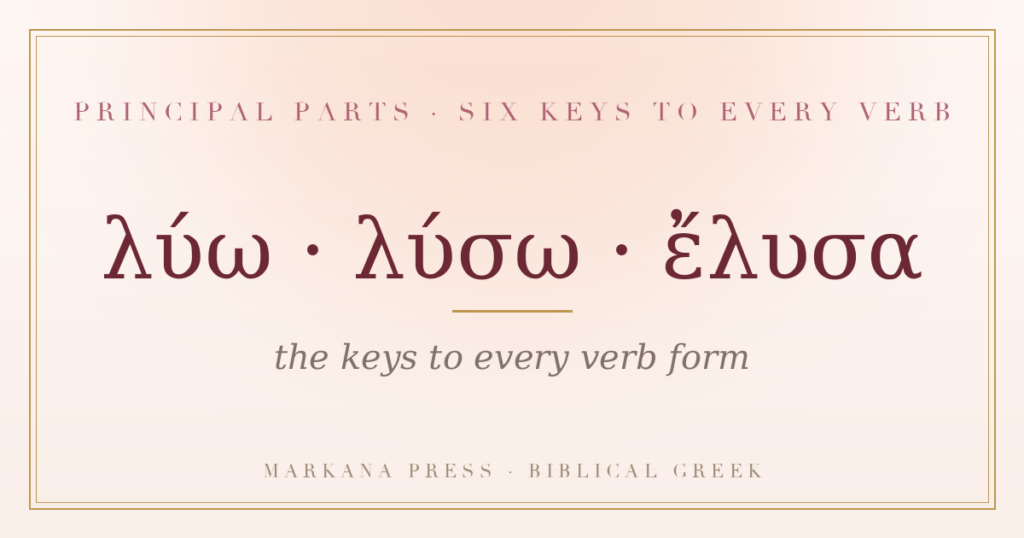
A principal part is the first-person singular form of a verb in each of its major systems. From each one, all the related forms are built. For the model verb λύω, the six parts are:
- λύω — present (“I loose”) → builds present & imperfect
- λύσω — future (“I will loose”) → builds the future
- ἔλυσα — aorist active (“I loosed”) → builds the aorist active & middle
- λέλυκα — perfect active (“I have loosed”) → builds the perfect & pluperfect active
- λέλυμαι — perfect middle/passive → builds the perfect middle/passive
- ἐλύθην — aorist passive (“I was loosed”) → builds the aorist & future passive
Why six, and why these six
Each principal part is the gateway to a whole “neighborhood” of forms. The verb changes its stem in different systems — sometimes a little, sometimes a lot — so you cannot always predict, say, the aorist passive just from the present. But if you know the relevant principal part, every form in that neighborhood falls into place. Six keys, six neighborhoods, the entire verb.
You can even see the verb’s history in them. Notice the λε- repeated at the start of the perfect forms (λέλυκα, λέλυμαι) — that doubling is called reduplication, and it is the perfect tense’s signature. Little clues like that let you read a form’s tense off its shape.
Regular verbs vs. the famous irregulars
For a regular verb like λύω, the six parts are wonderfully predictable. The verbs that make students groan are the ones whose principal parts come from different roots entirely — like the verb “to say,” or “to come,” or “to bear.” English does this too: think “go / went / gone,” where “went” comes from a totally different old verb. Greek’s high-frequency verbs have a handful of these, and the good news is that because they are so common, you learn them quickly just by reading.
How to actually learn them
You do not cram all six parts of every verb at once. You learn the principal parts of the most common verbs gradually, often as a little chant — λύω, λύσω, ἔλυσα, λέλυκα, λέλυμαι, ἐλύθην — until the pattern is automatic, then you recognize the same shapes on new verbs. Many students keep a running sheet of the principal parts of high-frequency verbs and review it a few minutes a day. It compounds fast.
The payoff
Here is why the principal parts are worth every minute: they are the difference between recognizing a few hundred verb forms and recognizing them all. They tie together the present, the future, the aorist, the perfect, and the passive into one connected map. Learn the six keys for the verbs you meet most, and the Greek verb — that supposed ocean — turns out to have a shoreline you can walk. From here you are ready for participles and the perfect tense, where the New Testament really begins to read.
From Markana Press
Read the New Testament in the language it was written in
Everything in this post is exactly how I teach it in Biblical Greek: A Self-Study Textbook — a four-volume course I publish through my Christian imprint, Markana Press. It assumes no background in Greek and takes you from the alphabet to reading the Gospels in their original words.
📚 All four volumes are free to read on Kindle Unlimited right now — and also available in paperback and hardcover.
 Free on Kindle Unlimited
Get the complete four-volume series:
Start with Volume I if you’re new — each volume builds on the one before it.