As an Amazon Associate I earn from qualifying purchases. This post contains affiliate links, which means I may earn a small commission — at no extra cost to you — if you buy through them. I only recommend things I believe are genuinely worth your time.
You have probably heard John 1:1 a hundred times: “In the beginning was the Word, and the Word was with God, and the Word was God.” It is one of the most familiar sentences in the whole Bible. But the first time you slow down and look at it in Greek, word by word, something happens: you realize the English is faithful, yes — but the Greek is carrying even more than the translation can hold in eleven words. Tense, word order, a single missing article — every one of them is preaching.
So let me walk you through John 1:1 the way I teach it in my Biblical Greek series: one word at a time, no Greek background assumed.
The verse, in Greek
Here is the whole sentence, with a transliteration so you can sound it out:
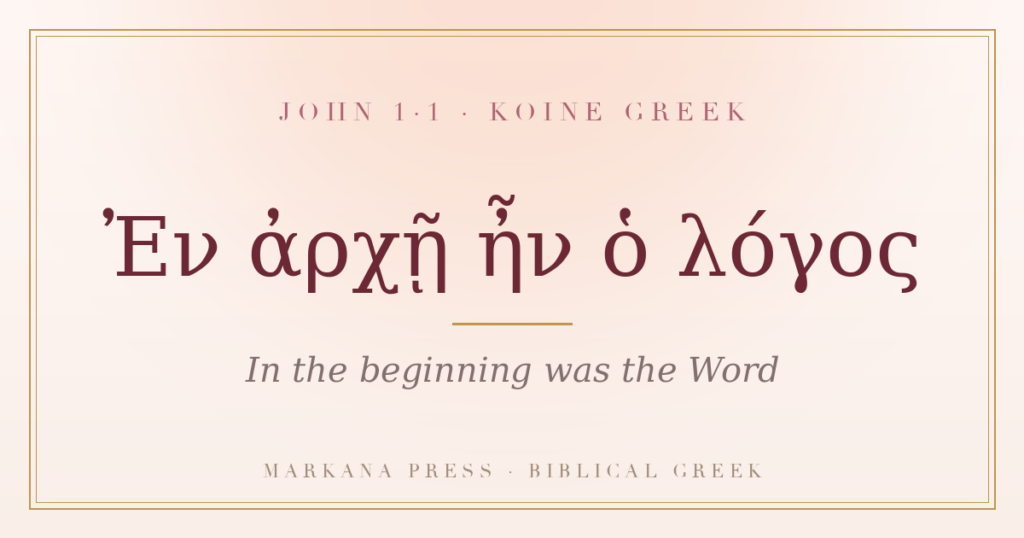
Ἐν ἀρχῇ ἦν ὁ λόγος, καὶ ὁ λόγος ἦν πρὸς τὸν θεόν, καὶ θεὸς ἦν ὁ λόγος.
En archē ēn ho logos, kai ho logos ēn pros ton theon, kai theos ēn ho logos.
Literally: “In beginning was the Word, and the Word was toward God, and God was the Word.”
Don’t worry if the letters look like a wall right now. By the end of this post you’ll recognize several of these words on sight — and that recognition is the whole doorway into reading the New Testament for yourself.
Ἐν ἀρχῇ — “In the beginning”
John opens with the exact same two words the Greek Old Testament uses to open Genesis: Ἐν ἀρχῇ (en archē), “in the beginning.” That is not an accident. John is deliberately echoing “In the beginning God created…” — and then telling you that the Word was already there when that beginning began.
The word ἀρχή (archē) is one you already half-know. It hides inside English words like archetype, architect, and archaeology — all about origins and first things. Here it sits in the dative case after the little preposition ἐν (“in”), which is why the ending shifts to -ῃ. Greek tells you a word’s job in the sentence by its ending, not by its position — the first big idea that unlocks the language.
ἦν — the little verb that means “was, and always had been”
This is the word I most wish every English reader could see. ἦν (ēn) means “was” — but it is specifically the imperfect tense of the verb “to be,” and the imperfect describes continuous, ongoing existence in the past. Not “the Word started,” not “the Word came into being” — but “the Word was, and went on being, with no beginning in view.”
Watch what John does just two verses later. When he talks about created things in verse 3, he switches verbs to ἐγένετο (egeneto), “came to be.” Created things came to be. The Word simply was. One tiny two-letter word draws the line between the Creator and everything He made — the eternal pre-existence of Christ, hiding in plain sight in the grammar.
ὁ λόγος — “the Word”
λόγος (logos) means word, message, reason, account. And notice the little ὁ (ho) in front of it — that is the definite article, “the.” This is not a word floating in the air; it is the Word, a specific someone. John keeps the suspense for thirteen verses and then tells us plainly who it is: “And the Word became flesh and dwelt among us” (John 1:14). The Word is Jesus.
If you have ever done a word study on a single Hebrew or Greek term, you know how much weight one word can carry. Logos may be the heaviest one in the New Testament.
πρὸς τὸν θεόν — “with God,” face to face
We translate πρὸς τὸν θεόν (pros ton theon) as “with God,” and that is right — but the preposition πρός with the accusative carries a sense of motion toward, of being face to face with someone. It is the word you would use for two people turned toward each other in conversation.
So the Word was not merely near God, like a book on a shelf beside another book. The Word was with God in living, face-to-face relationship — before creation, before time. The doctrine of the Trinity is not a later church invention bolted onto Scripture; its roots are right here in a single preposition.
καὶ θεὸς ἦν ὁ λόγος — “and the Word was God”
This is the clause people argue about, and Greek settles it beautifully. Notice the word order: θεὸς (theos, “God”) comes first, and ὁ λόγος (“the Word”) comes last with the article. In Greek, the noun that carries the article is the subject — so the sentence is telling us something about the Word: the Word was God.
You will sometimes hear that because theos here has no “the” in front of it, John only meant the Word was “a god,” something less than fully divine. But that misunderstands how Greek works. When a predicate noun comes before the verb like this, Greek regularly drops the article — and the effect is to stress the nature of the thing: the Word was fully, qualitatively God. The grammar guards two truths at once: the Word is distinct from the Father (He is with God) and yet is fully God (He is God). Take away the Greek and people wobble on this verse. Read the Greek and it stands like iron.
What changes when you can read it yourself
Here is the honest payoff. You do not need Greek to be saved, to love Jesus, or to read your Bible well — English translations are a gift, and a good one. But when you can read John 1:1 in the original, you stop standing on the far side of a translator’s choices. You see the imperfect tense that whispers eternal. You see the article that makes the Word a Person. You see the word order that nails down His deity. The doctrine was always there; now you can see it on the page.
And the wonderful surprise is how reachable it is. Most of the New Testament runs on about a thousand words, the grammar is regular, and a patient adult working twenty minutes a day can get there. That is exactly why I put the series together — for the person who always wondered, could I actually learn this? You can.
From Markana Press
Read the New Testament in the language it was written in
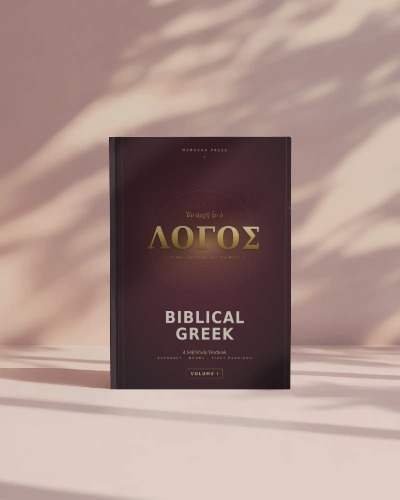
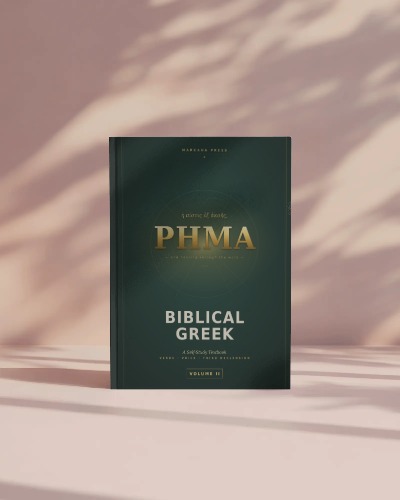
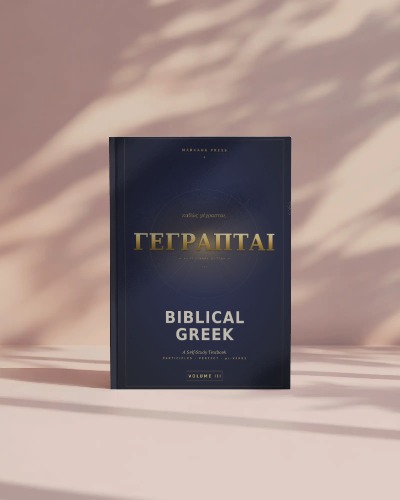
Everything in this post is exactly how I teach it in Biblical Greek: A Self-Study Textbook — a four-volume course I publish through my Christian imprint, Markana Press. It assumes no background in Greek and takes you from the alphabet to reading the Gospels in their original words.
📚 All four volumes are free to read on Kindle Unlimited right now — and also available in paperback and hardcover.
 Free on Kindle Unlimited
Get the complete four-volume series:
Start with Volume I if you’re new — each volume builds on the one before it.
If you want to go deeper on any one word above, a free interlinear like Blue Letter Bible will let you hover over the Greek of John 1:1, and pairing it with a solid commentary as you read through John’s Gospel will take you a long way. But nothing — nothing — compares to the day the letters stop being a wall and start being a voice. In the beginning was the Word. Come and read Him for yourself.