As an Amazon Associate I earn from qualifying purchases. This post contains affiliate links, which means I may earn a small commission — at no extra cost to you — if you buy through them. I only recommend things I believe are genuinely worth your time.
If you have ever wished you could read the New Testament in the language it was actually written in, here is the good news: it starts with twenty-four letters. That is the whole first door. Learn the Greek alphabet — really learn it, so the letters speak to you without effort — and you have done the single hardest thing a beginner ever does. Everything after that is just vocabulary and patterns.
So let me hand you the alphabet the way I lay it out in Volume I of my Biblical Greek series — not as a chart to be afraid of, but as something you can genuinely have down in a week.
Why the alphabet is the whole doorway
Here is the encouraging math. Most of the Greek New Testament runs on about a thousand words, and the grammar is remarkably regular. But none of that opens to you until the letters stop being shapes and start being sounds. The reader who can look at θεός and hear “the-OS” (God) is already reading. The one who still has to decode each letter is not. The alphabet is the difference, and it is a one-time cost.
The 24 letters of the Greek alphabet
Here is the full set, with the name of each letter and the sound it makes (using the standard academic pronunciation most textbooks teach):
| Letter | Name | Sounds like |
|---|---|---|
| Α α | alpha | a in father |
| Β β | beta | b |
| Γ γ | gamma | g in go |
| Δ δ | delta | d |
| Ε ε | epsilon | e in met (short) |
| Ζ ζ | zeta | z / dz |
| Η η | eta | e in obey (long) |
| Θ θ | theta | th in thin |
| Ι ι | iota | i in machine |
| Κ κ | kappa | k |
| Λ λ | lambda | l |
| Μ μ | mu | m |
| Ν ν | nu | n |
| Ξ ξ | xi | x in fox (ks) |
| Ο ο | omicron | o in pot (short) |
| Π π | pi | p |
| Ρ ρ | rho | r (trilled) |
| Σ σ / ς | sigma | s (ς only at word end) |
| Τ τ | tau | t |
| Υ υ | upsilon | u (French u / German ü) |
| Φ φ | phi | ph / f |
| Χ χ | chi | ch in Scottish loch |
| Ψ ψ | psi | ps in lips |
| Ω ω | omega | o in tone (long) |
A few of these you already know in disguise. Δ (delta) is the shape of a river delta. Π (pi) is the math symbol. Φ, Χ, Ψ show up in fraternities and physics class. You are not starting from zero — you are starting from “more familiar than you thought.”
The letters that trip up English speakers
A handful deserve a warning label, because they look like English letters but are not:
- Η η is not an “n” — it is a long e (eta).
- Ρ ρ is not a “p” — it is r (rho).
- Χ χ is not an “x” — it is a throaty ch (chi).
- Ν ν is n, and Υ υ is a u-ish vowel, even though both can look like other things in lowercase.
And one small housekeeping rule that surprises everyone: sigma is written σ in the middle of a word but ς at the very end. Same letter, same sound — it just puts on its “coat” to leave. So “apostle” is ἀπόστολος: σ in the middle, ς at the end.
Vowels, and the marks you will meet next
Seven of the letters are vowels: α, ε, η, ι, ο, υ, ω. Two pairs of them are simply short and long versions of the same sound — epsilon (short e) and eta (long e), omicron (short o) and omega (long o). In fact omicron literally means “little o” and omega means “big o.” That is also why Jesus can say in Revelation, “I am the Alpha and the Omega” (Revelation 22:13) — the first letter and the last, the beginning and the end. The alphabet itself is preaching.
You will also notice little marks sitting over vowels — accents, and the small comma-like “breathing” marks. Those are the very next thing to learn, and I wrote a separate, gentle guide to rough and smooth breathing marks so you can take them one at a time. For now, just notice they exist.
How I’d learn the alphabet this week
You do not memorize the alphabet by staring at it. You learn it by using it out loud. Here is the simple plan I give beginners:
- Days 1–2: Learn the names and order by singing or saying them — alpha, beta, gamma, delta — until the sequence is automatic.
- Days 3–4: Practice writing each lowercase letter while saying its sound. Writing locks it in faster than reading.
- Days 5–7: Sound out real words. Start with ones you half-know: Χριστός (Christ), ἀγάπη (love), λόγος (word), θεός (God), Ἰησοῦς (Jesus). The thrill of reading an actual Greek word is the best motivation there is.
Twenty minutes a day, and by the weekend you will look at a line of Greek and, slowly, hear it. That moment — when the wall of letters becomes a voice — is the one every reader remembers.
Where the alphabet leads
Once the letters are yours, the next steps come quickly: the little word ὁ (“the”) and its many forms, the way Greek nouns change their endings to do different jobs, and your first real verse. I walk through each of those in their own posts — the Greek definite article and the four noun cases — and you can already try reading John 1:1 in Greek, word by word. If you like to study with help close at hand, pairing your reading with a good commentary works beautifully.
The alphabet is the doorway. Walk through it, and the New Testament starts to open in your own two hands.
From Markana Press
Read the New Testament in the language it was written in
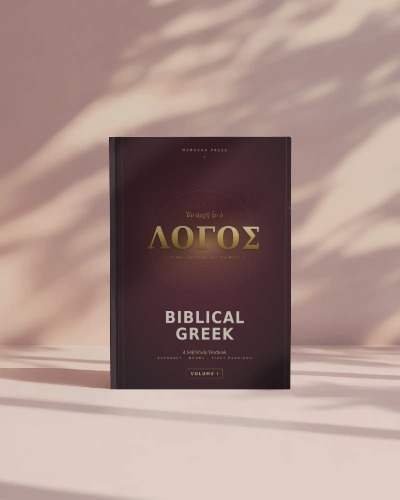
Everything in this post is exactly how I teach it in Biblical Greek: A Self-Study Textbook — a four-volume course I publish through my Christian imprint, Markana Press. It assumes no background in Greek and takes you from the alphabet to reading the Gospels in their original words.
📚 All four volumes are free to read on Kindle Unlimited right now — and also available in paperback and hardcover.
 Free on Kindle Unlimited
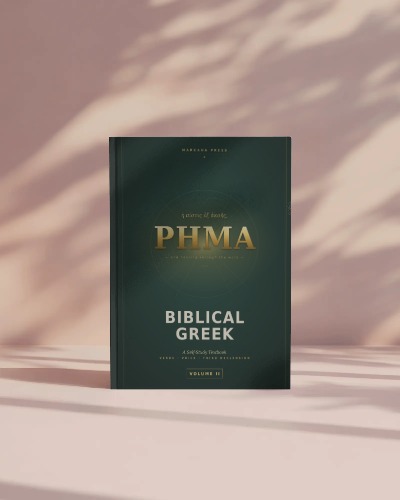
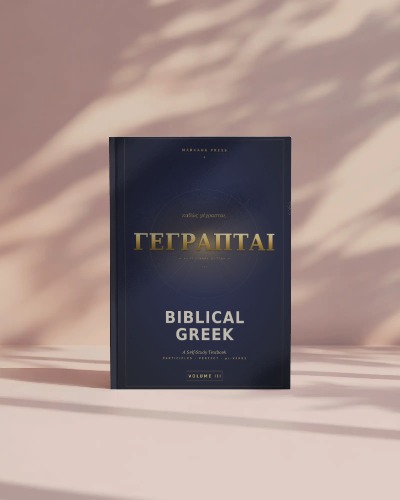
Get the complete four-volume series:
Start with Volume I if you’re new — each volume builds on the one before it.