As an Amazon Associate I earn from qualifying purchases. This post contains affiliate links, which means I may earn a small commission — at no extra cost to you — if you buy through them. I only recommend things I believe are genuinely worth your time.
English has two voices. Active: “I loose.” Passive: “I am loosed.” Greek has three — and the extra one, the middle voice, is a little window into how Greek-speakers saw the world. It has no exact English equivalent, which is precisely why it is worth learning.
I introduce all three together in Volume II, because once you can tell them apart, you stop guessing about who is doing what to whom.
The three voices at a glance
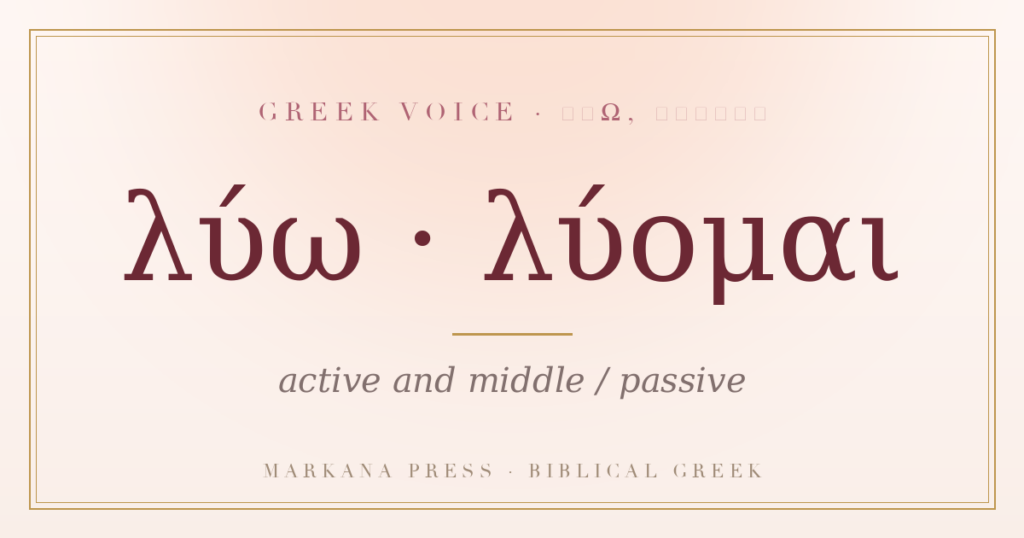
- Active — the subject does the action. λύω — “I loose” (I do the loosing to something else).
- Passive — the subject receives the action. λύομαι — “I am being loosed” (someone else looses me).
- Middle — the subject acts on, for, or in the interest of itself. λύομαι — “I loose myself” or “I get [something] loosed for my own benefit.”
You will notice the middle and passive look identical in the present tense (λύομαι does double duty), and context tells you which is meant. That is not laziness in the language — it is an invitation to read closely.
What the middle voice is really doing
The middle voice puts the spotlight back on the subject. Think of the difference between “I wash the car” (active) and “I wash up” / “I wash myself” (middle). The action loops back to involve the doer. Greek uses this constantly for personal, self-involved actions — getting dressed, choosing for oneself, praying. When you meet a middle verb, ask: how is the subject personally wrapped up in this action? The answer is often where the richness lives.
Deponent verbs: middle in form, active in meaning
Here is a quirk that confuses beginners until someone names it. Some very common Greek verbs only ever appear in the middle/passive form, but they carry an active meaning. We call these deponent verbs. The classic example is ἔρχομαι — it looks middle, but it simply means “I come” or “I go.” Likewise γίνομαι (“I become”) and πορεύομαι (“I travel”). Once you know deponents exist, they stop being a stumbling block and become a small, learnable list.
Why voice changes how you read Scripture
Voice can quietly carry theology. When Scripture says a believer “was saved,” the passive matters — it points away from our effort to God as the one who saves. When Paul tells us to “work out” our salvation, the voice and grammar shape exactly how we understand the cooperation between God’s work and ours. You do not need Greek to hold these truths, but reading the voice yourself lets you see where the emphasis falls instead of taking it on trust. It pairs well with studying alongside a good commentary.
Where voice fits in the bigger picture
Voice is one of three things every Greek verb tells you at once: person/number (from the present endings), voice (here), and tense/aspect (which you will meet in the aorist). Learn to read all three off a single verb and you can parse most of the New Testament. The middle voice, especially, rewards the patient reader — it is one of those features that makes you feel you are finally hearing Greek on its own terms rather than through an English filter.
From Markana Press
Read the New Testament in the language it was written in
Everything in this post is exactly how I teach it in Biblical Greek: A Self-Study Textbook — a four-volume course I publish through my Christian imprint, Markana Press. It assumes no background in Greek and takes you from the alphabet to reading the Gospels in their original words.
📚 All four volumes are free to read on Kindle Unlimited right now — and also available in paperback and hardcover.
 Free on Kindle Unlimited

Get the complete four-volume series:
Start with Volume I if you’re new — each volume builds on the one before it.