As an Amazon Associate I earn from qualifying purchases. This post contains affiliate links, which means I may earn a small commission — at no extra cost to you — if you buy through them. I only recommend things I believe are genuinely worth your time.
John 3:16 may be the best-known verse on earth. And precisely because we know the English so well, the Greek has a few surprises waiting that can refresh the whole verse. Let me walk through it the way I did with John 1:1 — slowly, word by word — and you will see how much the original is carrying.
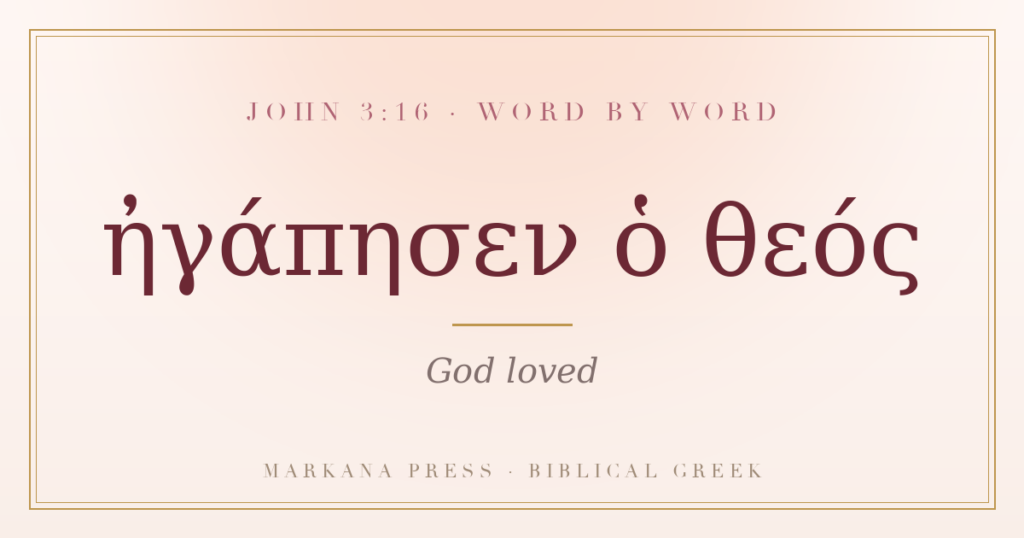
Οὕτως γὰρ ἠγάπησεν ὁ θεὸς τὸν κόσμον, ὥστε τὸν υἱὸν τὸν μονογενῆ ἔδωκεν, ἵνα πᾶς ὁ πιστεύων εἰς αὐτὸν μὴ ἀπόληται ἀλλ’ ἔχῃ ζωὴν αἰώνιον.
Οὕτως — “so,” but not the “so” you think
We read “God so loved” and hear “so much.” But the Greek οὕτως (houtōs) almost always means “in this way” or “thus” — it points to manner, not quantity. John is not mainly saying God loved the world so much; he is saying God loved the world like this — and then he shows you how: by giving His Son. The love is defined by the gift that follows.
ἠγάπησεν — He loved (and it was a definite act)
ἠγάπησεν is the aorist of ἀγαπάω, the verb of self-giving love (ἀγάπη). The aorist presents the love as a single, decisive act — pointing straight at the cross. Not a vague sentiment, but a love that did something at a moment in history.
τὸν μονογενῆ — the “one and only” Son
The Son is called μονογενῆ (monogenē) — from monos (“only”) and a root for “kind” or “begotten.” It means the unique, one-of-a-kind Son — there is no other like Him. Older translations say “only-begotten”; the heart of it is uniqueness.
ἔδωκεν — He gave
ἔδωκεν is the aorist of δίδωμι, “to give” — one of the μι-verbs. Again the aorist: a finished act of giving. This is the way οὕτως pointed to — this is how God loved: He gave.
ἵνα … μὴ ἀπόληται ἀλλ’ ἔχῃ — the purpose that holds everything
Now comes the subjunctive purpose clause: ἵνα (“so that”) plus two subjunctive verbs — μὴ ἀπόληται (“should not perish”) and ἔχῃ ζωὴν αἰώνιον (“may have eternal life”). This is why God gave: the rescue of everyone who believes. And notice πᾶς ὁ πιστεύων — “everyone believing,” a substantival participle: not a one-time decision only, but the one who goes on trusting. The grammar opens the door as wide as the word “whoever.”
Why reading it in Greek refreshes it
Put the pieces together and the famous verse breathes again: This is how God loved the world — He gave His one and only Son — so that everyone who keeps trusting in Him would not perish but have life that lasts forever. Every grammatical choice — the manner-word, the aorists of love and giving, the purpose clause — is preaching the gospel. That is the joy of reading the New Testament in its own language, and it is exactly what the four-volume series below is built to give you. Try the John 1:1 walkthrough next, and read these two cornerstone verses side by side.
From Markana Press
Read the New Testament in the language it was written in
Everything in this post is exactly how I teach it in Biblical Greek: A Self-Study Textbook — a four-volume course I publish through my Christian imprint, Markana Press. It assumes no background in Greek and takes you from the alphabet to reading the Gospels in their original words.
📚 All four volumes are free to read on Kindle Unlimited right now — and also available in paperback and hardcover.
 Free on Kindle Unlimited
Get the complete four-volume series:
Start with Volume I if you’re new — each volume builds on the one before it.