As an Amazon Associate I earn from qualifying purchases. This post contains affiliate links, which means I may earn a small commission — at no extra cost to you — if you buy through them. I only recommend things I believe are genuinely worth your time.
Up to now, most of the verbs you have met have been in the indicative mood — the mood of plain fact: “this is happening,” “this happened.” But Greek has other moods, and the most important of them is the subjunctive — the mood of purpose, possibility, and intention. It is the verb behind some of the most beloved “so that” promises in the New Testament.
Volume IV moves from the indicative into these other moods, and the subjunctive is the gateway.
From “what is” to “what may be”
If the indicative states reality, the subjunctive steps one degree back into what is intended, hoped, or possible. English uses it too, though we barely notice — “I suggest that he be here” (not “is”), “if I were you.” Greek uses it constantly and clearly, marked by long connecting vowels in the verb endings. The model verb λύω in the present subjunctive runs λύω, λύῃς, λύῃ, λύωμεν, λύητε, λύωσιν — notice the lengthened vowels that signal “this is subjunctive.”
The ἵνα clause: Greek’s great “so that”
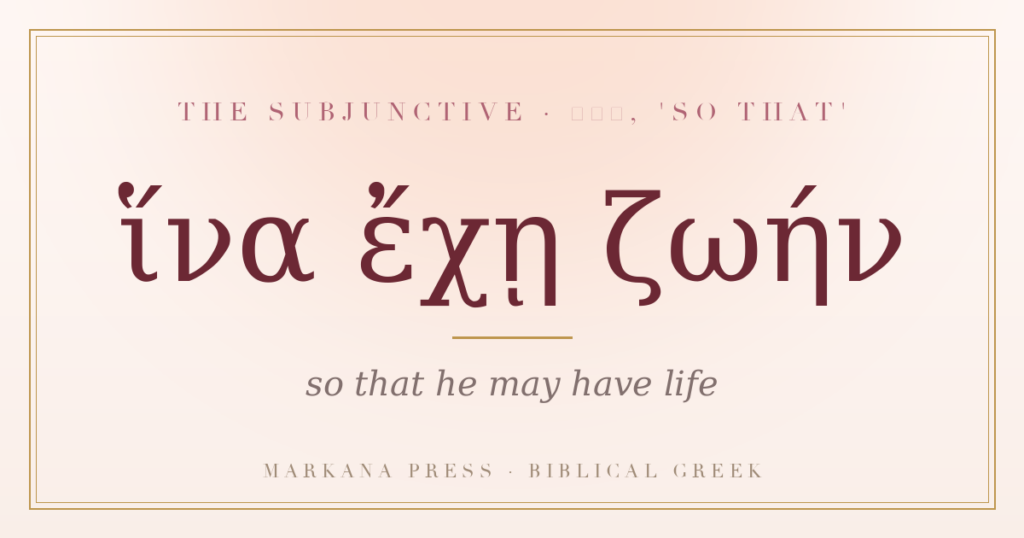
By far the most common home of the subjunctive is the ἵνα (hina) clause, which expresses purpose — “in order that,” “so that.” And no verse shows it better than John 3:16: “…whoever believes in Him should not perish but ἵνα have eternal life” — ἵνα … ἔχῃ ζωὴν αἰώνιον, “so that he may have eternal life.” The verb ἔχῃ (“may have”) is subjunctive, because it expresses the purpose of God’s giving, not a bare fact. The whole saving aim of the gospel sits in that little purpose clause.
Three uses worth knowing
Beyond the purpose clause, the subjunctive shows up in a few recognizable ways:
- Hortatory (“let us”): ἀγαπῶμεν ἀλλήλους — “let us love one another” (1 John 4:7). The speaker urges action including himself.
- Deliberative (a real or rhetorical question): “What shall we say, then?” — asking about what should be, not what is.
- Prohibitions with μή: “do not” in certain forms uses the subjunctive to forbid an action as a whole.
Why aspect still matters here
The subjunctive keeps the aspect distinction you already know. A present subjunctive views the action as ongoing (“that he may keep having life”), while an aorist subjunctive views it as a whole. So the mood tells you it is purpose-or-possibility, and the tense tells you how the action is pictured. Two layers of meaning, both readable once you know what to look for.
The takeaway
The subjunctive is the mood that carries intention and hope — and it is where some of Scripture’s tenderest purposes are expressed: so that you may believe, so that your joy may be full, so that he may have life. Learn to spot ἵνα plus a long-voweled verb, and you will read those purposes in the original. From here, the conditional sentences build directly on the subjunctive, and the imperative rounds out the moods of the verb.
From Markana Press
Read the New Testament in the language it was written in
Everything in this post is exactly how I teach it in Biblical Greek: A Self-Study Textbook — a four-volume course I publish through my Christian imprint, Markana Press. It assumes no background in Greek and takes you from the alphabet to reading the Gospels in their original words.
📚 All four volumes are free to read on Kindle Unlimited right now — and also available in paperback and hardcover.
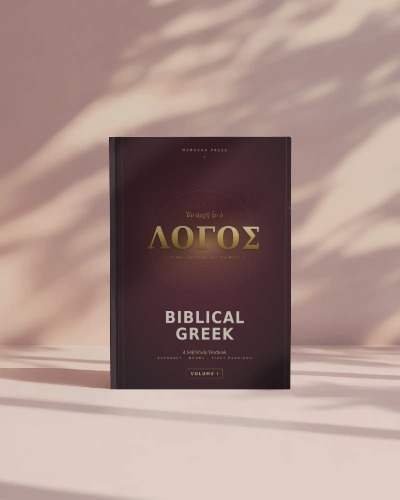 Free on Kindle Unlimited

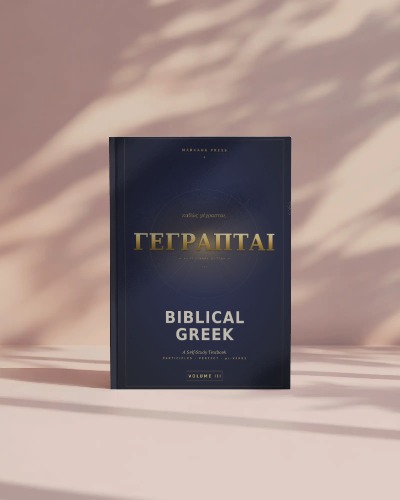
Get the complete four-volume series:
Start with Volume I if you’re new — each volume builds on the one before it.