As an Amazon Associate I earn from qualifying purchases. This post contains affiliate links, which means I may earn a small commission — at no extra cost to you — if you buy through them. I only recommend things I believe are genuinely worth your time.
English has one word for love, and it has to stretch from “I love tacos” to “God is love.” Greek is richer here: it has several distinct words, and when the New Testament reaches for one rather than another, the choice often carries real meaning. Understanding these words is one of the most rewarding little word studies a Bible reader can do.
The Greek words for love
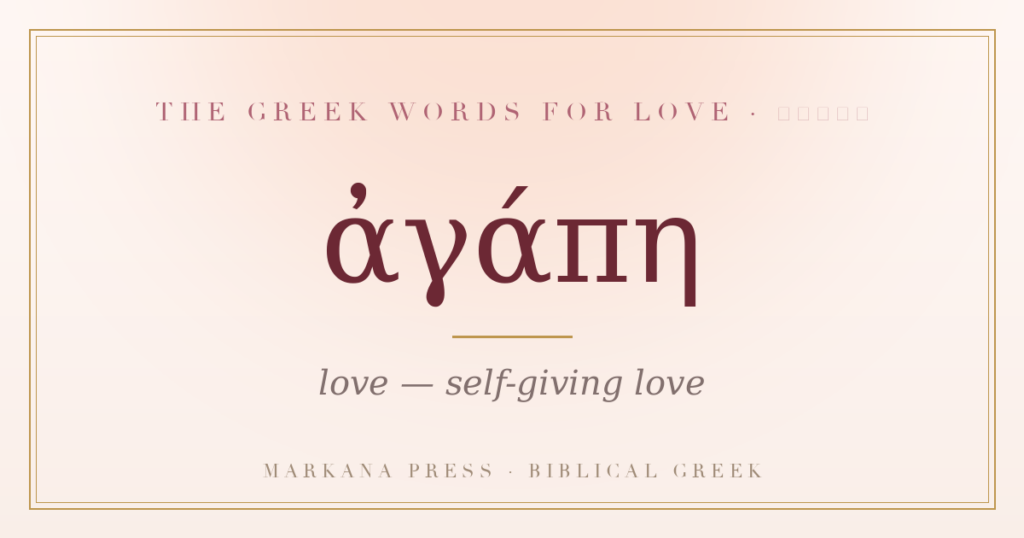
- ἀγάπη (agapē) — self-giving, committed, choosing love. The love that seeks the good of the other regardless of return. This is the New Testament’s great word, and the love that describes God Himself.
- φιλία / φιλέω (philia / phileō) — the warm love of friendship and affection, the fondness between people who are dear to each other. (It is the phil- in “Philadelphia,” the city of brotherly love.)
- στοργή (storgē) — natural family affection, the bond between parents and children. The New Testament uses its root mostly in compound words.
- ἔρως (erōs) — romantic or desirous love. This word does not actually appear in the New Testament, though the love between husband and wife is honored elsewhere in Scripture.
Why 1 Corinthians 13 chooses ἀγάπη
When Paul writes the famous “love chapter,” every single “love” is ἀγάπη. That is deliberate. The love that “is patient, is kind… bears all things, believes all things, hopes all things, endures all things” is not a feeling that comes and goes — it is a chosen, self-giving love, the kind God shows us and calls us to show one another. If it were merely warm affection (φιλία) or attraction (ἔρως), the chapter would not make sense; you cannot command a feeling. But you can choose ἀγάπη. (For the verse-by-verse study, see my walk through 1 Corinthians 13.)
The conversation by the sea: ἀγαπάω and φιλέω
One of the most discussed moments in the Gospels turns on these words. After the resurrection, Jesus asks Peter three times, “Do you love me?” In John 21, the first two times Jesus uses ἀγαπάω, and Peter answers with φιλέω; the third time Jesus meets Peter where he is and uses φιλέω too. Greek readers have pondered that exchange for centuries. Whatever weight you place on the shift, it is invisible in English — and visible the moment you can read the Greek. (Both words, by the way, are contract verbs.)
Love that defines itself by giving
The deepest reason ἀγάπη matters is that it is how God loves. “God so loved (ἠγάπησεν) the world that He gave…” — the love is defined by the gift. ἀγάπη is not first an emotion we feel but a self-giving we receive from God and then extend to others. That is why the New Testament can command it: “love one another.”
A small word study with a big payoff
You do not need Greek to obey the command to love. But seeing which word the New Testament chooses — almost always ἀγάπη — sharpens what that love actually is: chosen, durable, self-giving, like God’s love for us. That is the kind of insight that makes learning even a little Greek so worthwhile, and it is exactly the approach the series below is built around — meaning, one word at a time.
From Markana Press
Read the New Testament in the language it was written in
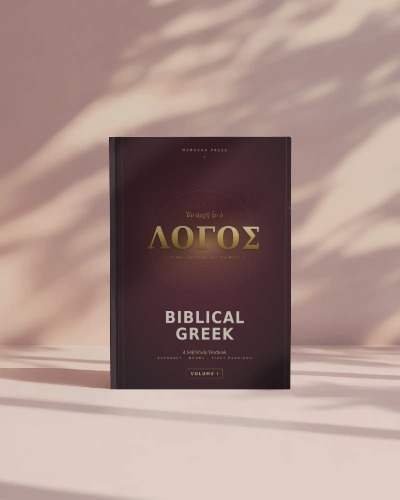
Everything in this post is exactly how I teach it in Biblical Greek: A Self-Study Textbook — a four-volume course I publish through my Christian imprint, Markana Press. It assumes no background in Greek and takes you from the alphabet to reading the Gospels in their original words.
📚 All four volumes are free to read on Kindle Unlimited right now — and also available in paperback and hardcover.
 Free on Kindle Unlimited


Get the complete four-volume series:
Start with Volume I if you’re new — each volume builds on the one before it.