As an Amazon Associate I earn from qualifying purchases. This post contains affiliate links, which means I may earn a small commission — at no extra cost to you — if you buy through them. I only recommend things I believe are genuinely worth your time.
The first time you look closely at Greek, you notice tiny marks sitting over the vowels — little commas and apostrophes that seem to float there. Most beginners quietly panic and hope they are optional. They are not optional, but they are friendly, and one of them holds a delightful secret: it is where the English letter “h” comes from. These are the breathing marks, and there are only two of them.
In Volume I I introduce them right after the alphabet, because every Greek word that begins with a vowel has one — so you meet them immediately, and they are easy once someone simply explains them.
The two breathing marks
Every word that starts with a vowel (and every word starting with ρ) carries one of two marks:
- Smooth breathing (᾿) — looks like a little apostrophe or backwards comma. It means nothing extra: just say the vowel. Example: ἀπό (apo, “from”).
- Rough breathing (῾) — looks like a little forward comma. It adds an “h” sound before the vowel. Example: ἡμέρα (hēmera, “day”).
That is the whole system. One mark is silent; the other says “h.” They sit over the first vowel of the word — or, in a diphthong (a two-vowel team), over the second vowel: οὐρανός (ouranos, “heaven”) takes its smooth breathing on the υ.
Where English ‘h’ words come from
Here is the part I love, because it makes the marks stick. The rough breathing is the ancestor of a whole family of English words. When Greek words came into English, that rough “h” came along:
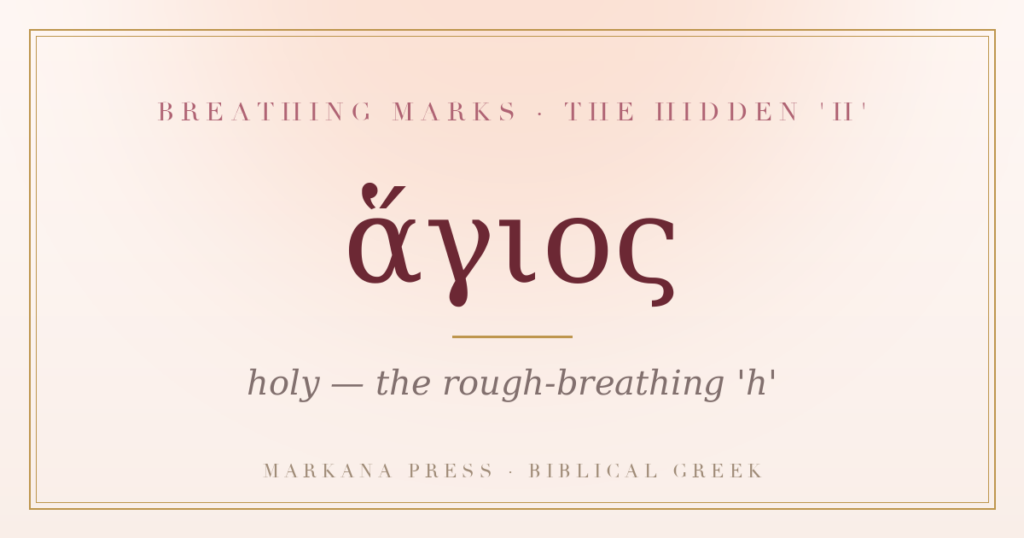
- ἅγιος (hagios, “holy”) → hagiography, writing about the holy.
- ἡμέρα (hēmera, “day”) → ephemeral, lasting only a day.
- ὕδωρ (hydōr, “water”) → hydrate, hydrogen.
- ὅλος (holos, “whole”) → holistic.
See the rough breathing, hear the “h,” and an English cousin often appears. That is not a coincidence — it is the breathing mark doing its job across three thousand years.
One rule worth remembering
Two letters are always rough. The vowel υ at the start of a word always takes a rough breathing (so it is always “hy-”: hydōr, hymnos). And the consonant ρ at the start of a word takes a rough breathing too — which is why we transliterate it “rh,” as in rhythm and rhetoric. The Greek word for “word/saying,” ῥῆμα, is a perfect example: rhēma.
Why the little marks actually matter
It would be easy to dismiss breathing marks as decoration, but they can change a word’s identity. The classic pair is ὁ with a rough breathing — the word “the” — versus a smooth-breathing look-alike. The marks are part of how the word is spelled and recognized. Reading carefully means reading the breathing, the same way you would not ignore the dot on an “i.” I cover their close cousins, the accent marks, as the next small step after this one.
Don’t let them slow you down
Here is my honest encouragement: do not let two tiny marks intimidate you out of learning Greek. You will absorb them naturally as you sound out words, because every vowel-initial word simply has one. Start with the Greek alphabet, add the breathings as you go, meet the little word “the” (which wears a rough breathing), and before long you will read right past these marks without a second thought — hearing the “h” exactly where it belongs. Then a verse like John 1:1 is genuinely within reach.
From Markana Press
Read the New Testament in the language it was written in
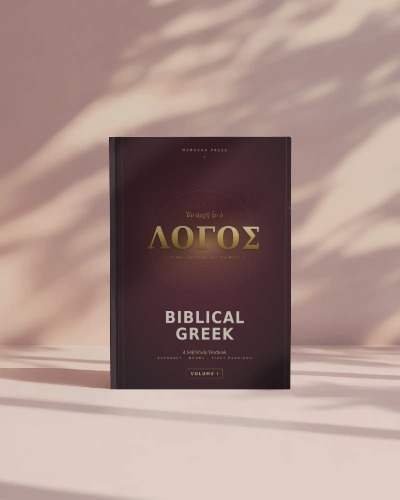
Everything in this post is exactly how I teach it in Biblical Greek: A Self-Study Textbook — a four-volume course I publish through my Christian imprint, Markana Press. It assumes no background in Greek and takes you from the alphabet to reading the Gospels in their original words.
📚 All four volumes are free to read on Kindle Unlimited right now — and also available in paperback and hardcover.
 Free on Kindle Unlimited
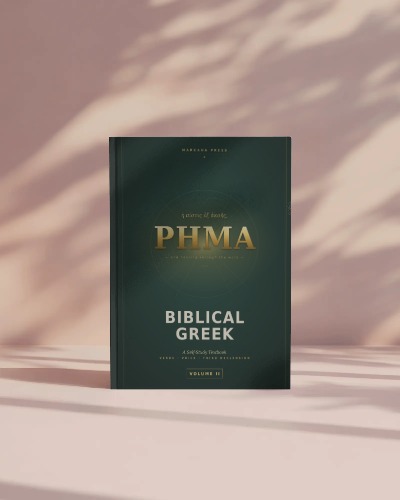

Get the complete four-volume series:
Start with Volume I if you’re new — each volume builds on the one before it.