As an Amazon Associate I earn from qualifying purchases. This post contains affiliate links, which means I may earn a small commission — at no extra cost to you — if you buy through them. I only recommend things I believe are genuinely worth your time.
The most common word in the entire Greek New Testament is not “God,” or “Jesus,” or “love.” It is the little word the. In Greek that word is ὁ (and its many cousins), and it shows up roughly twenty thousand times. If you are going to read Greek, you will see the article constantly — so it is the very first word worth truly mastering. The wonderful part is that it also teaches you the endings you will see on everything else.
This is exactly where I start the grammar in Volume I, because the article is a tiny, friendly map of the whole language.
One word, three genders
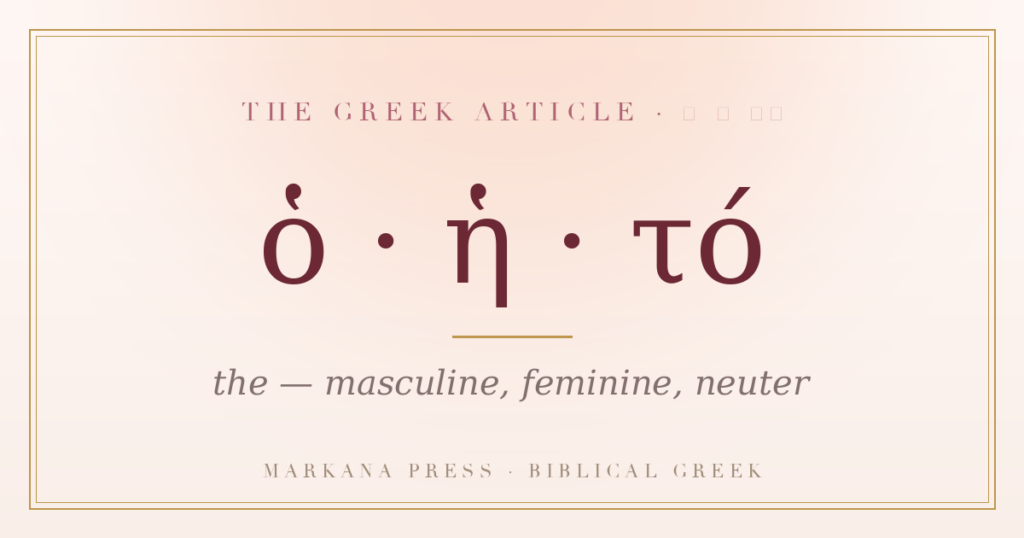
English has one form of “the.” Greek has a different form depending on the gender of the noun it goes with — masculine, feminine, or neuter:
- ὁ (ho) — “the” with a masculine noun: ὁ λόγος, the word.
- ἡ (hē) — “the” with a feminine noun: ἡ ἀγάπη, the love.
- τό (to) — “the” with a neuter noun: τὸ ἔργον, the work.
Gender in Greek is grammatical, not biological — a word can be feminine without being “female.” You simply learn each noun together with its article, the way you might learn le or la in French.
The article changes its ending to match the job
Here is the part that does double duty. The article does not just mark gender; it also changes its ending to show the noun’s job in the sentence (its case). Watch the masculine forms shift:
- ὁ — the (as the subject): ὁ λόγος, the word [does something]
- τοῦ — of the: τοῦ λόγου, of the word
- τῷ — to/for the: τῷ λόγῳ, to the word
- τόν — the (as the object): τὸν λόγον, [I heard] the word
Once you know these four little words — ὁ, τοῦ, τῷ, τόν — you have basically met the endings of the entire second declension. That is why I tell students the article is the best investment in all of beginning Greek: learn this one word well, and a hundred other words suddenly look familiar. I break the endings down further in my post on the four Greek noun cases.
When the article is there — and when it isn’t
Greek uses the article in places English never would. It often puts “the” in front of names (the Jesus, the Paul), and even in front of abstract nouns (the love, the truth). So you learn not to translate every single ὁ woodenly as “the.”
But the truly important lesson is the opposite one: when the article is missing, that often means something. The most famous example in the whole New Testament is the last clause of John 1:1 — καὶ θεὸς ἦν ὁ λόγος, “and the Word was God.” The word for God here, θεὸς, has no article, while ὁ λόγος (the Word) keeps its article. That little difference is exactly how Greek tells you which noun is the subject — and how it affirms that the Word is fully God without confusing Him with the Father. I unpack that whole verse slowly in John 1:1 in Greek, word by word.
Why this matters for reading your Bible
You do not need Greek to be a faithful reader of Scripture — a good English translation is a gift. But the presence or absence of one tiny word can carry real weight, and translators have to make a choice you cannot see in English. When you can read the article yourself, you get to see those choices on the page: where Greek is pointing at the specific thing, and where it is describing a quality. It is a small word that opens a surprisingly large window.
Your next step
If you have not yet, start with the Greek alphabet so the forms above are easy to sound out, then move on to the noun cases, where these same endings do their work. The article is small, common, and friendly — and it is the thread that, once you pull it, starts to unravel the whole beautiful system of Greek in the best possible way.
From Markana Press
Read the New Testament in the language it was written in
Everything in this post is exactly how I teach it in Biblical Greek: A Self-Study Textbook — a four-volume course I publish through my Christian imprint, Markana Press. It assumes no background in Greek and takes you from the alphabet to reading the Gospels in their original words.
📚 All four volumes are free to read on Kindle Unlimited right now — and also available in paperback and hardcover.
 Free on Kindle Unlimited
Get the complete four-volume series:
Start with Volume I if you’re new — each volume builds on the one before it.