As an Amazon Associate I earn from qualifying purchases. This post contains affiliate links, which means I may earn a small commission — at no extra cost to you — if you buy through them. I only recommend things I believe are genuinely worth your time.
When you first meet Greek, the accent marks over the words look like one more thing to worry about. Here is the reassuring truth and the important exception, both at once: most of the time, accents just guide pronunciation and you can read right past them — but in a few important cases, the accent is the only thing distinguishing two completely different words. Knowing which is which saves you from real confusion.
What the accents are
Greek has three accent marks: the acute (´), the grave (`), and the circumflex (˜). Originally they marked musical pitch; by the New Testament era they mostly marked stress, like the accent in English “REC-ord” versus “re-CORD.” For everyday reading, they tell you which syllable to emphasize — helpful, but rarely meaning-changing.
The famous exception: τίς vs. τις
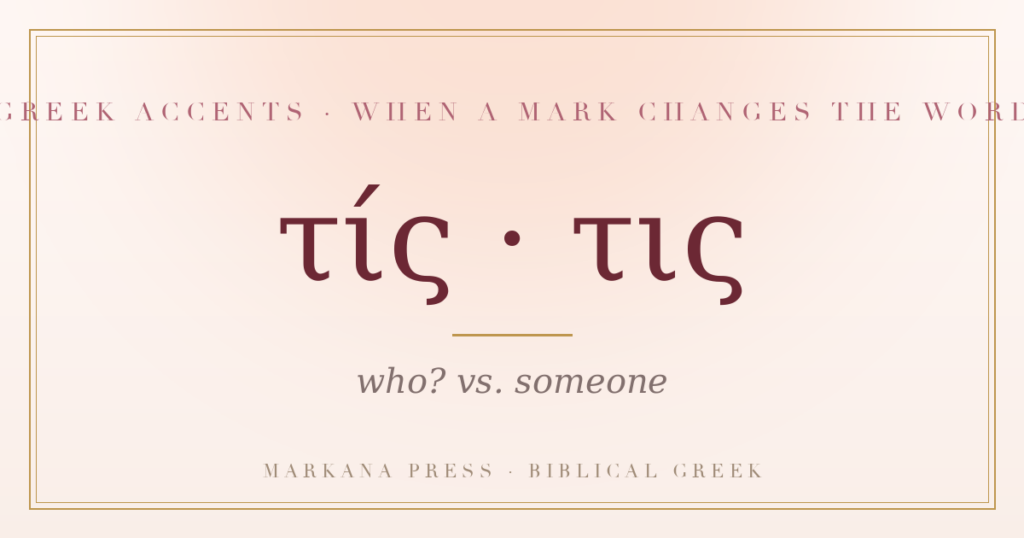
Now the case every student learns. These two little words are spelled with the same letters and differ only by an accent:
- τίς (with the accent) — the question word: “who? which? what?”
- τις (no accent on it — it “leans” on the word before it) — the indefinite: “someone, a certain person, anyone.”
So τίς ἐστιν; means “Who is it?” while ἄνθρωπός τις means “a certain man.” Same three letters; the accent is the whole difference between asking a question and pointing at “someone.” You can see why the marks are not just decoration.
A few other meaning-bearing accents
τίς/τις is the headline, but there are a handful of similar pairs. The accent or breathing can distinguish, for example, the relative pronoun from other small words, or mark which form of a verb you are looking at. The point is not to memorize a long list now, but to know that when two words look identical, the accent is often the tiebreaker — so you do not ignore it.
How much should a beginner worry?
My honest advice: do not let accents slow your reading or scare you off. Learn the letters and breathing marks first, read for meaning, and let the accents mostly guide your pronunciation. Just keep the one famous pair in the back of your mind — τίς (“who?”) versus τις (“someone”) — and you will avoid the most common beginner mix-up. As you grow, the other meaningful accents will settle in naturally through reading.
The takeaway
Accents are mostly your friendly pronunciation guide — and occasionally the hinge a word’s whole meaning turns on. Respect them, learn the τίς/τις pair, and otherwise let them help rather than intimidate. It is one more small piece of reading Greek with care, the same care that makes a verse like John 1:1 open up in the original.
From Markana Press
Read the New Testament in the language it was written in
Everything in this post is exactly how I teach it in Biblical Greek: A Self-Study Textbook — a four-volume course I publish through my Christian imprint, Markana Press. It assumes no background in Greek and takes you from the alphabet to reading the Gospels in their original words.
📚 All four volumes are free to read on Kindle Unlimited right now — and also available in paperback and hardcover.
 Free on Kindle Unlimited
Get the complete four-volume series:
Start with Volume I if you’re new — each volume builds on the one before it.