As an Amazon Associate I earn from qualifying purchases. This post contains affiliate links, which means I may earn a small commission — at no extra cost to you — if you buy through them. I only recommend things I believe are genuinely worth your time.
Of the four Greek cases, the one that does the most jobs with a single ending is the dative. New readers sometimes find it slippery precisely because it is so versatile — but once you know its handful of uses, the dative becomes one of the most useful cases to read well. Think of it as the Swiss army knife of Greek nouns.
The core idea
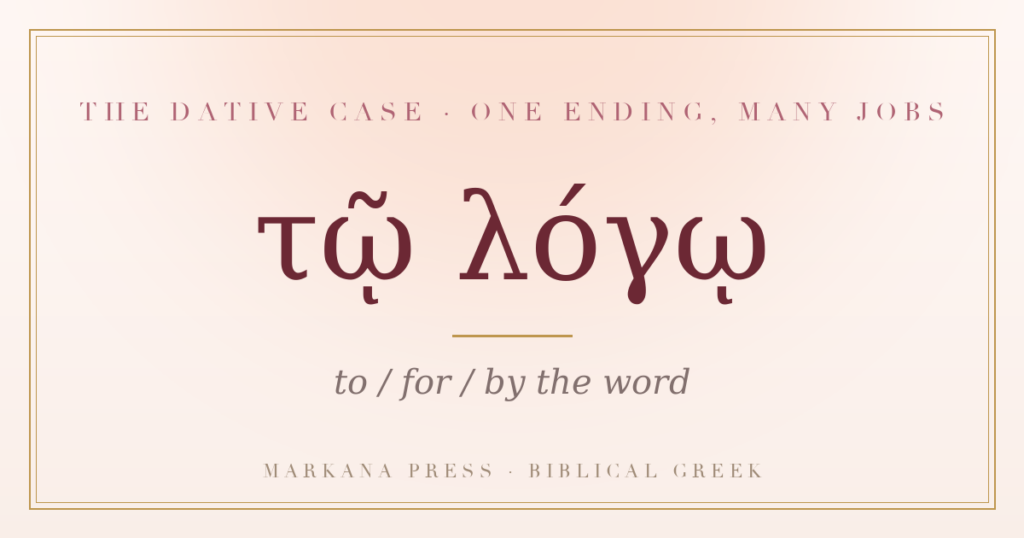
The dative most basically answers “to whom?” or “for whom?” — it is the case of the indirect object. In “she gave the book to the man,” “the man” would be dative. The article and noun take the dative ending — τῷ λόγῳ, “to/for the word.” From that center, the dative spreads out into several related uses.
The five main jobs of the dative
- Indirect object (to/for): “he said to them.” The basic use.
- Means or instrument (by/with): “saved by grace” — τῇ χάριτι. The dative tells you the means by which something happens.
- Location / sphere (in): “rich in faith,” “rejoice in the Lord.” The dative marks the realm in which something is true.
- Time (at / on): “on the third day,” “on the Sabbath.” A point in time often goes in the dative.
- Reference / respect (with respect to): “dead to sin but alive to God” — the dative narrows the frame to which a statement applies.
How to tell which job it is
You read the dative the way you read any flexible word — from context, and often from a little preposition that pins it down. When you see ἐν (“in”) plus a dative, it is location or sphere. With no preposition, a dative right after a verb of giving or speaking is usually the indirect object; a dative thing (rather than a person) is often means or instrument. With a bit of practice, the right sense comes almost automatically.
Why it rewards close reading
The dative carries some precious theology. “By grace you have been saved” — the dative τῇ χάριτι tells you grace is the means, not something we add to. “Reckon yourselves dead to sin but alive to God” — those datives set the two spheres of the Christian’s identity. Reading the dative lets you see exactly how a sentence is relating its parts: by what means, in what sphere, for whose benefit.
The takeaway
Do not be put off by a case that does many things; be encouraged that one ending can carry so much. Learn the dative’s handful of jobs — to/for, by/with, in, at, with respect to — and ask which fits as you read. It is a small investment that pays off on nearly every page, and it rounds out your command of the Greek case system. Keep the article handy as your case label, and the dative will quickly feel like a friend.
From Markana Press
Read the New Testament in the language it was written in
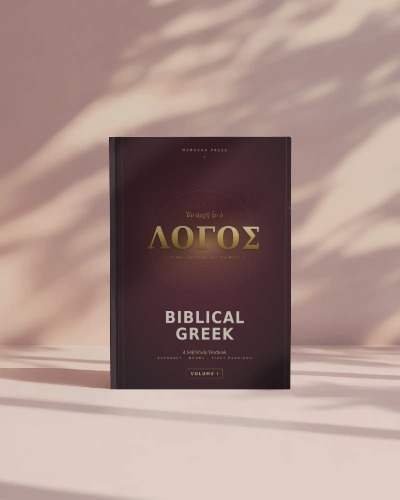
Everything in this post is exactly how I teach it in Biblical Greek: A Self-Study Textbook — a four-volume course I publish through my Christian imprint, Markana Press. It assumes no background in Greek and takes you from the alphabet to reading the Gospels in their original words.
📚 All four volumes are free to read on Kindle Unlimited right now — and also available in paperback and hardcover.
 Free on Kindle Unlimited


Get the complete four-volume series:
Start with Volume I if you’re new — each volume builds on the one before it.