As an Amazon Associate I earn from qualifying purchases. This post contains affiliate links, which means I may earn a small commission — at no extra cost to you — if you buy through them. I only recommend things I believe are genuinely worth your time.
The word “if” does a lot of quiet work in the New Testament — “if you love me,” “if Christ has not been raised,” “if anyone is in Christ.” In English we have one “if” and we lean on tone and context. Greek is more precise: it has four classes of conditional sentence, each built differently, each saying something distinct about how the speaker views the “if.” Knowing them apart is one of the most rewarding pieces of syntax in Volume IV.
How a Greek conditional is built
Every conditional has two halves: the “if” part (the protasis) and the “then” part (the apodosis). Greek signals which class you are in by the word it uses for “if” (εἰ or ἐάν) and by the mood and tense of the verbs. Once you learn the four recipes, you can read the speaker’s stance straight off the grammar.
The four classes
- First class — εἰ + the indicative. Treated as true for the sake of argument: “if (and let’s assume it is so)…” Paul: “If Christ has been raised” — assuming the reality to build on it.
- Second class — εἰ + a past indicative, usually with ἄν in the “then” half. Contrary to fact: “if this were true (but it isn’t)…” “If you had been here, my brother would not have died.”
- Third class — ἐάν + the subjunctive. A probable or general future: “if this happens (and it well might)…” “If we confess our sins, He is faithful…”
- Fourth class — εἰ + the optative. A remote possibility: “if this were somehow to happen…” It is rare and never appears complete in the New Testament, but it is good to recognize.
Why the difference matters
Consider how much the class changes the tone. A first-class “if” can mean “since,” granting the point — when the devil says to Jesus, “If you are the Son of God,” it is first class: “since you are.” A third-class “if” opens a genuine future possibility — “if we confess.” Read the wrong class into a verse and you can misjudge the speaker’s confidence. Read the right one and the sentence’s whole posture comes into focus.
The most famous conditional of all
First Corinthians 15 is a cascade of conditionals: “if there is no resurrection of the dead, then not even Christ has been raised. And if Christ has not been raised, then our preaching is in vain…” Paul is reasoning with conditional logic, and seeing the classes lets you follow the force of his argument step by step. It is theology built on grammar.
How to learn them
Do not memorize them as abstractions; learn each by its signal. See εἰ + indicative? First class — assumed true. See ἐάν + subjunctive? Third class — possible future. The little word for “if” plus the verb’s mood is all you need to classify it. A handful of real examples and it sticks. Then the New Testament’s many “if” statements stop being flat and start carrying the exact shade the author intended. Next, the optative (the verb of that rare fourth class) is worth meeting on its own.
From Markana Press
Read the New Testament in the language it was written in
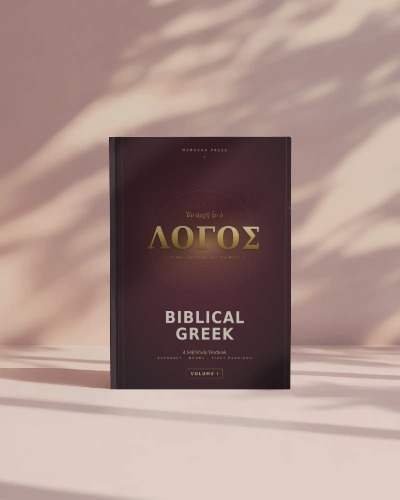
Everything in this post is exactly how I teach it in Biblical Greek: A Self-Study Textbook — a four-volume course I publish through my Christian imprint, Markana Press. It assumes no background in Greek and takes you from the alphabet to reading the Gospels in their original words.
📚 All four volumes are free to read on Kindle Unlimited right now — and also available in paperback and hardcover.
 Free on Kindle Unlimited


Get the complete four-volume series:
Start with Volume I if you’re new — each volume builds on the one before it.