As an Amazon Associate I earn from qualifying purchases. This post contains affiliate links, which means I may earn a small commission — at no extra cost to you — if you buy through them. I only recommend things I believe are genuinely worth your time.
When Jesus says “Follow me,” “Do not be afraid,” “Repent,” or “Take heart,” He is speaking in the imperative mood — the mood of command, exhortation, and request. It is one of the most direct and personal moods in Greek, and it hides a layer of meaning English commands simply do not have: aspect. Volume IV gives it a careful look, because the difference between two kinds of command can be quietly profound.
More than barking orders
First, a gentle correction: the imperative is not only for stern commands. In Greek it covers a whole range — a general’s order, a teacher’s exhortation, even a polite request or a prayer. “Give us this day our daily bread” is an imperative; so is “Hallowed be your name.” We are commanding nothing of God — we are asking. So when you meet an imperative, read the relationship, not just the grammar.
The big idea: present vs. aorist commands
Here is where Greek out-says English. A command can be given in the present or the aorist, and the difference is one of aspect, not time:
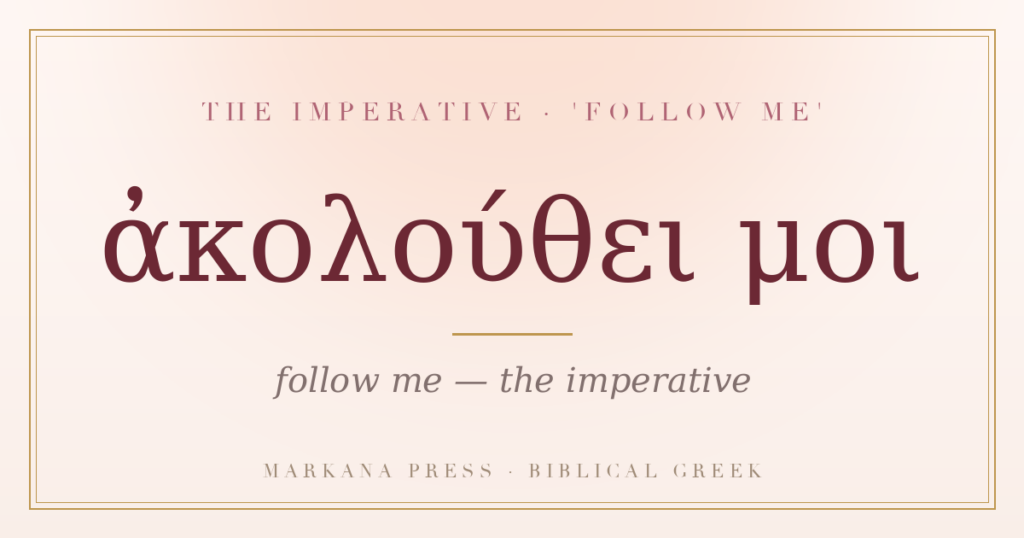
- Present imperative — pictures the action as ongoing or habitual: “keep on doing this,” “make this your practice.” When Jesus says ἀκολούθει μοι (“follow me”) in the present, it carries “keep following me, continually.”
- Aorist imperative — pictures the action as a whole: “do this, as a single decisive act.”
So “keep on asking, keep on seeking, keep on knocking” (present imperatives) calls for persistent prayer, while an aorist command can call for one decisive step. The mood says “do it”; the aspect says how.
Prohibitions: how Greek says “don’t”
The aspect contrast gets especially beautiful in negative commands with μή (“not”):
- μή + present imperative often means “stop doing something you’re already doing” — or “don’t make a habit of it.” “Stop being afraid.”
- μή + aorist subjunctive often means “don’t start — don’t ever do it.”
That nuance can be pastorally precious. When the angel or the Lord says “Do not be afraid,” reading whether it is “stop the fear you’re feeling” versus “never fear” adds a layer of comfort the English flattens.
How to read commands well
When you meet an imperative, ask two questions: Who is speaking to whom (command, exhortation, or prayer?), and what is the aspect (a continual practice, or a single act?). Those two questions turn a flat “do this” into the living, specific call the author wrote. With the imperative added to the subjunctive, you now know the major moods — and the verbs of Scripture’s commands and prayers open up in the original.
From Markana Press
Read the New Testament in the language it was written in
Everything in this post is exactly how I teach it in Biblical Greek: A Self-Study Textbook — a four-volume course I publish through my Christian imprint, Markana Press. It assumes no background in Greek and takes you from the alphabet to reading the Gospels in their original words.
📚 All four volumes are free to read on Kindle Unlimited right now — and also available in paperback and hardcover.
 Free on Kindle Unlimited


Get the complete four-volume series:
Start with Volume I if you’re new — each volume builds on the one before it.