As an Amazon Associate I earn from qualifying purchases. This post contains affiliate links, which means I may earn a small commission — at no extra cost to you — if you buy through them. I only recommend things I believe are genuinely worth your time.
Once you can recognize a participle, the next question is what it is doing — and the most common, most rewarding answer is that it is working as an adverb, describing the circumstances of the main verb. A single Greek participle can carry the force of an entire English clause: when something happened, because of it, or although it was true. Learning to tell those uses apart is one of the most practical reading skills in all of Greek.
This is one of my favorite lessons in Volume III, because it is where participle study suddenly makes whole paragraphs readable.
One participle, many possible relationships
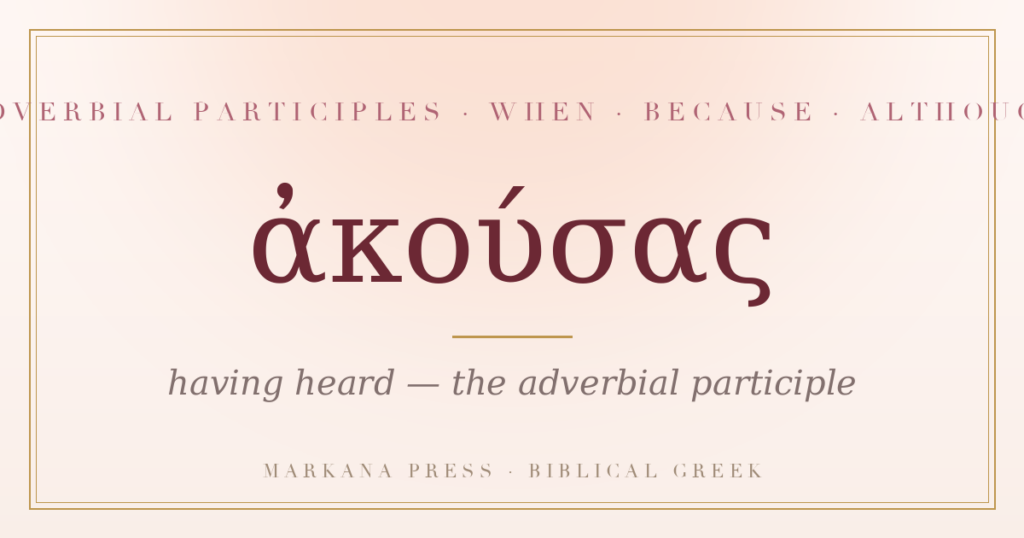
An adverbial participle does not announce its job with a label — it leaves you to read the relationship from context. The same form, like ἀκούσας (“having heard”), could mean several things depending on the sentence:
- Temporal (when / after / while): “After hearing this, he left.”
- Causal (because / since): “Because he heard this, he left.”
- Concessive (although / even though): “Although he heard this, he stayed.”
- Conditional (if): “If one hears this…”
- Means / manner (by / by way of): “he encouraged them by speaking.”
Greek trusts the reader to feel which relationship fits. That is not vagueness — it is the same flexibility that lets a good writer in any language imply more than they spell out.
Timing comes from aspect
The participle’s aspect usually tells you the timing relative to the main verb. A present participle points to action going on at the same time (“while teaching, he said…”). An aorist participle usually points to action before the main verb (“after he had taught, he left”). So ἀκούσας (aorist) leans toward “having heard,” while a present participle would lean toward “while hearing.” That single clue resolves most sentences.
A worked example
Think of a verse like, “And rising early in the morning, He went out and prayed” (cf. Mark 1:35). That “rising” is an adverbial participle: after He rose, He went out. The participle sets the scene and the main verbs carry the action — a tight, vivid construction that English has to stretch into two or three words. Reading it in Greek, you feel how compact and immediate the original is.
How to read them with confidence
Here is the habit to build. When you meet an adverbial participle, ask two quick questions: (1) What is its aspect — same time as the main verb, or before it? and (2) Which relationship makes sense here — when, because, although, if, or by? Try the most natural fit, read on, and adjust if the sentence pushes back. With a little practice this becomes instant, and the dense, participle-heavy style of writers like Luke and Paul turns from a thicket into a clear path.
Where this leaves you
With the adverbial participle in hand, you have the single most useful reading tool in Koine Greek. Combined with the genitive absolute and a solid grasp of the perfect and μι-verbs, you can read long stretches of the Gospels without stopping at every turn. This is the point where, for many students, Greek stops being a puzzle to decode and becomes a voice to listen to.
From Markana Press
Read the New Testament in the language it was written in
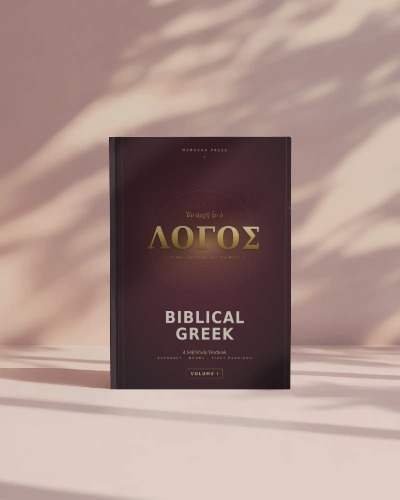
Everything in this post is exactly how I teach it in Biblical Greek: A Self-Study Textbook — a four-volume course I publish through my Christian imprint, Markana Press. It assumes no background in Greek and takes you from the alphabet to reading the Gospels in their original words.
📚 All four volumes are free to read on Kindle Unlimited right now — and also available in paperback and hardcover.
 Free on Kindle Unlimited


Get the complete four-volume series:
Start with Volume I if you’re new — each volume builds on the one before it.