As an Amazon Associate I earn from qualifying purchases. This post contains affiliate links, which means I may earn a small commission — at no extra cost to you — if you buy through them. I only recommend things I believe are genuinely worth your time.
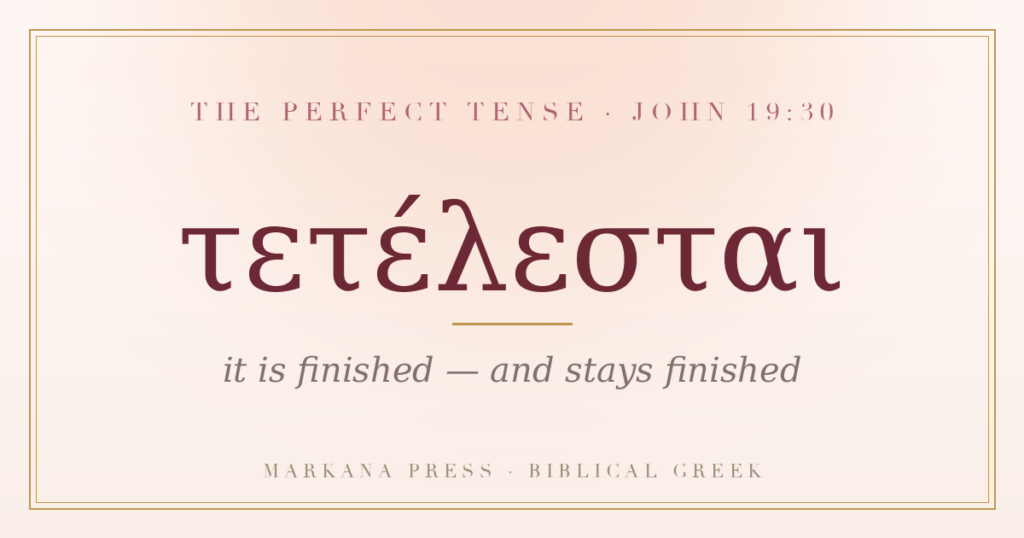
Of all the Greek tenses, the perfect may be the one that most rewards the reader of Scripture — because it carries a meaning English can only approximate. The Greek perfect describes a past action whose results still stand in the present. Not just “it happened,” but “it happened, and the effect remains.” And the most famous perfect in the New Testament is a single word Jesus spoke from the cross: τετέλεσται — “It is finished” (John 19:30).
I save the perfect for Volume III, after the present and aorist, because it builds on both — and because it is worth the wait.
Completed action, continuing result
Compare the tenses you already know. The present sees action as ongoing. The aorist sees it as a simple whole — “it happened.” The perfect adds something neither has: the action is complete, and its result is still in force. The English “I have written” gets close — it implies the letter is now written and sitting there. That standing, present-tense result is the whole point of the Greek perfect.
Why τετέλεσται is so powerful
When Jesus says τετέλεσται, He is not merely reporting “I finished a task” (which would suit an aorist). The perfect declares: it has been brought to completion, and it stands completed — forever. The work of redemption is done, and it stays done. Nothing more needs to be added; nothing can be taken away. The whole gospel of grace is hiding in the tense of that one word. This is exactly the kind of place where reading the Greek yourself — or studying with a good commentary — deepens worship.
How to spot a perfect: reduplication
The perfect wears an unmistakable badge on the front of the word, called reduplication: the first consonant is doubled with an ε. Watch it:
- λύω → perfect λέλυκα (“I have loosed”) — see the λε-
- γράφω → perfect γέγραπται (“it is written / it stands written”) — see the γε-
- τελέω → perfect τετέλεσται (“it is finished”) — see the τε-
That doubled syllable at the start is your flag: when you see it, think “perfect — completed with lasting result.”
The perfect that confronts and comforts
Notice γέγραπται too — “it stands written.” When Jesus answered every temptation with “it is written,” the perfect tense underlines that God’s word is not just something that was written long ago, but something that stands, fixed and binding, right now. The same tense that comforts at the cross (“it is finished”) also anchors us in the wilderness (“it stands written”). The grammar is pastoral.
The takeaway
The perfect tense is short to summarize and deep to ponder: a completed action whose result continues. Reduplication on the front, “done and still done” in your mind. Once you can read it, certain verses will never sound flat again — because you will hear the permanence the Greek built into them. From here, the small but mighty family of μι-verbs rounds out the core of the Greek verb system.
From Markana Press
Read the New Testament in the language it was written in
Everything in this post is exactly how I teach it in Biblical Greek: A Self-Study Textbook — a four-volume course I publish through my Christian imprint, Markana Press. It assumes no background in Greek and takes you from the alphabet to reading the Gospels in their original words.
📚 All four volumes are free to read on Kindle Unlimited right now — and also available in paperback and hardcover.
 Free on Kindle Unlimited
Get the complete four-volume series:
Start with Volume I if you’re new — each volume builds on the one before it.