As an Amazon Associate I earn from qualifying purchases. This post contains affiliate links, which means I may earn a small commission — at no extra cost to you — if you buy through them. I only recommend things I believe are genuinely worth your time.
Some Greek constructions sound far scarier than they are, and the genitive absolute is the champion of that category. The name alone makes people nervous. But it is really just Greek’s tidy way of saying “meanwhile” or “once that happened” — a little background clause tucked into a sentence. Learn its one signature, and you will spot it instantly.
I devote a focused lesson to it in Volume III, because once you can read it, a huge amount of Gospel narration opens up.
What it is: a noun + a participle, both genitive
A genitive absolute is a small phrase made of two parts that are both in the genitive case:
- a noun or pronoun (the “subject” of the little phrase), and
- a participle agreeing with it.
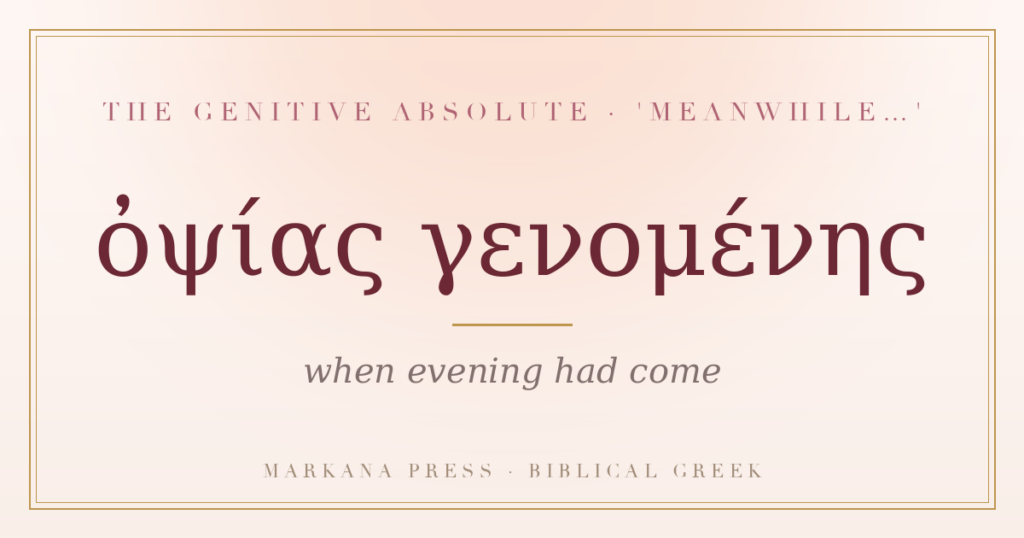
The classic example is ὀψίας γενομένης — literally “evening having come,” which we render “when evening had come.” Both words are in the genitive, and together they set the scene for the main sentence that follows.
Why “absolute”?
The word “absolute” here means “loosened” — the phrase is grammatically independent from the rest of the sentence (it comes from the same Latin root as “absolve”). Its subject is usually someone different from the subject of the main verb. So you get sentences like: “While they were going [genitive absolute], Jesus said…” The “they” of the side phrase and the “Jesus” of the main clause are different people — and that mismatch is exactly the signal that you are looking at a genitive absolute.
How to spot it in a half-second
Here is the practical rule. When you see a participle and a noun sitting together, both in the genitive, usually near the start of a sentence and set off by a comma — that is a genitive absolute. Translate it as a “when / while / after / since” clause and then read on to the main sentence. The tense of the participle tells you the timing: a present participle means “while X was happening,” an aorist participle means “after X had happened.”
Why the Gospel writers love it
The genitive absolute is a storyteller’s tool. It lets a writer set a scene economically — “when evening had come,” “while he was still speaking,” “after the Sabbath had passed” — without breaking the flow into separate sentences. Mark and Matthew use it constantly to move you through a scene. Once you can read it, you feel the pace of the narrative the way the author intended, instead of meeting it pre-chopped in English.
The encouragement
Do not let an intimidating grammatical name rob you of an easy win. The genitive absolute is one of those topics where a single clear explanation does the whole job: a noun and a participle, both genitive, forming a background “when/while” clause with its own subject. Master the participle first, keep the genitive case fresh, and this construction becomes one of the most satisfying things to recognize on the page — a whole clause hiding in two little words.
From Markana Press
Read the New Testament in the language it was written in
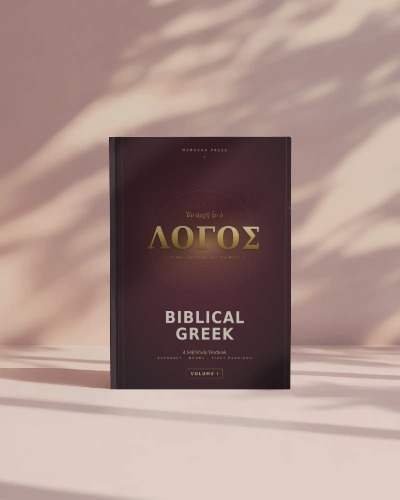
Everything in this post is exactly how I teach it in Biblical Greek: A Self-Study Textbook — a four-volume course I publish through my Christian imprint, Markana Press. It assumes no background in Greek and takes you from the alphabet to reading the Gospels in their original words.
📚 All four volumes are free to read on Kindle Unlimited right now — and also available in paperback and hardcover.
 Free on Kindle Unlimited

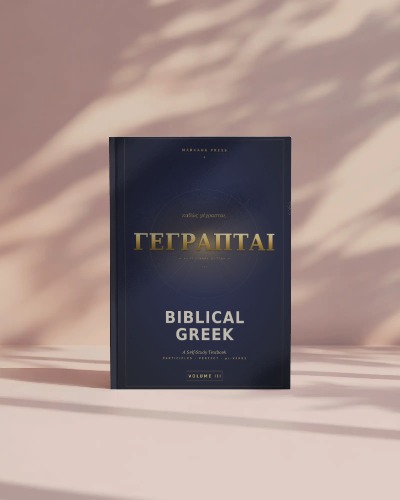
Get the complete four-volume series:
Start with Volume I if you’re new — each volume builds on the one before it.