As an Amazon Associate I earn from qualifying purchases. This post contains affiliate links, which means I may earn a small commission — at no extra cost to you — if you buy through them. I only recommend things I believe are genuinely worth your time.
Romans 8:28 is a verse people cling to in the hardest seasons. Reading it in Greek does not change its comfort — it deepens it, because the original makes clear who is at work and for whom. Here is the heart of the verse, word by word.
οἴδαμεν δὲ ὅτι τοῖς ἀγαπῶσιν τὸν θεὸν πάντα συνεργεῖ εἰς ἀγαθόν.
…we know that for those who love God, all things work together for good.
οἴδαμεν — “we know”
The verse opens with οἴδαμεν, “we know” — from οἶδα, one of the special verbs of knowing. This is not “we hope” or “we feel”; it is settled knowledge. And what follows is reported by ὅτι (“that”) — a clause of indirect discourse, telling us the content of what we know.
τοῖς ἀγαπῶσιν τὸν θεόν — “for those who love God”
Here is a beautiful detail. “Those who love God” is τοῖς ἀγαπῶσιν — a substantival participle in the dative case (“for those loving”). The promise is not addressed to everyone in general; it is for those who love God. The participle quietly marks out the people to whom this assurance belongs — and the dative says the “good” works out for their benefit.
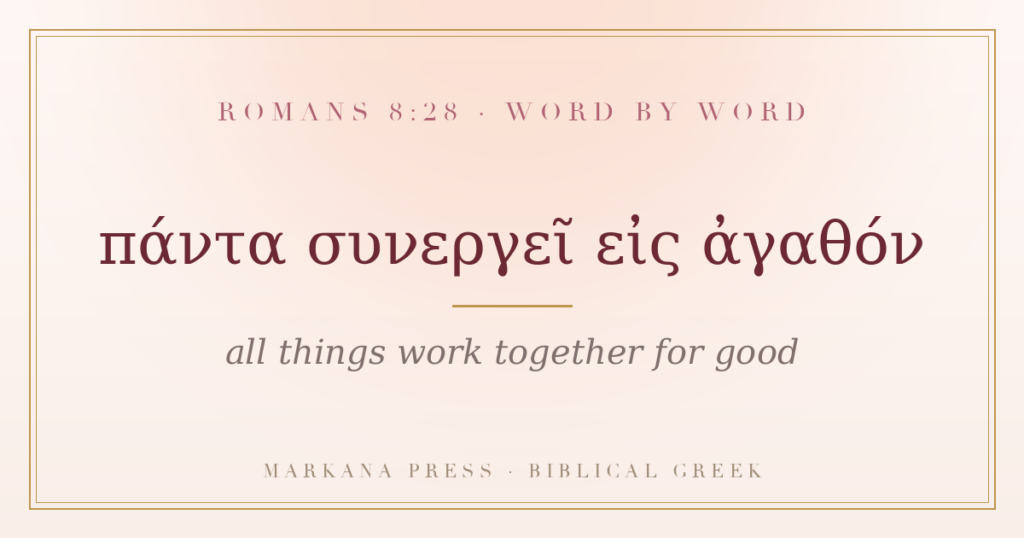
πάντα συνεργεῖ — “all things work together”
πάντα means “all things” — everything, not just the pleasant things. And συνεργεῖ (synergei) is where we get the English word “synergy”: syn- (“together”) + ergon (“work”). The things do not each work well on their own; they work together toward an end. There is also a treasured manuscript tradition that names the worker explicitly — “God works all things together” — and either way the sense is the same: this is not blind fate but purposeful working. Notice too that συνεργεῖ is singular, even with “all things,” which is normal Greek grammar and gently points to one guiding hand behind the many things.
εἰς ἀγαθόν — “for good”
The goal is εἰς ἀγαθόν, “toward good.” The next verses define that good as being “conformed to the image of His Son” — so the “good” is not necessarily ease or comfort, but our being made like Christ. That reframes everything: God is weaving even the hard things toward the best possible end.
Why the Greek strengthens the comfort
Read together: we know — with settled confidence — that for those who love God, He works all things, even the painful ones, together toward good. The participle marks the people, the verb names the working-together, and the goal is our likeness to Christ. None of that is invented by the Greek; it is simply clearer in the Greek. That clarity is the gift of reading the New Testament in its own words — which is exactly what the series below was written to make possible, even for an absolute beginner.
From Markana Press
Read the New Testament in the language it was written in
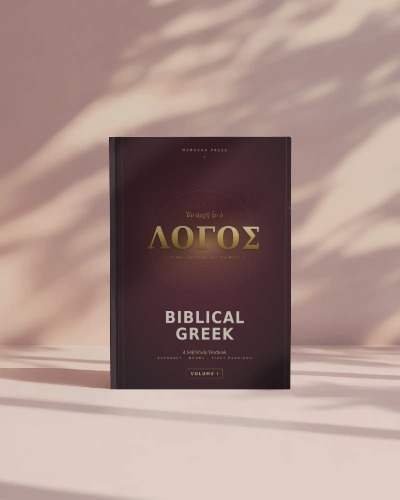
Everything in this post is exactly how I teach it in Biblical Greek: A Self-Study Textbook — a four-volume course I publish through my Christian imprint, Markana Press. It assumes no background in Greek and takes you from the alphabet to reading the Gospels in their original words.
📚 All four volumes are free to read on Kindle Unlimited right now — and also available in paperback and hardcover.
 Free on Kindle Unlimited


Get the complete four-volume series:
Start with Volume I if you’re new — each volume builds on the one before it.