
As an Amazon Associate I earn from qualifying purchases. This post contains affiliate links, which means I may earn a small commission — at no extra cost to you — if you buy through them. I only recommend things I believe are genuinely worth your time.
A huge amount of the New Testament is reported speech and thought: “He said that…,” “they believed that…,” “she knew that…” The way Greek handles this is called indirect discourse, and it has one feature that delights careful readers: Greek usually keeps the tense of the original words, where English shifts them. Once you know that, reported speech in Greek becomes vivid in a way the translation can blur. It is a fitting capstone for Volume IV.
Direct vs. indirect
Direct discourse quotes the exact words: He said, “I am going.” Indirect discourse reports them: He said that he was going. Greek has three main ways to build the indirect version, and learning to recognize them is the whole task.
The three constructions
- ὅτι + indicative — the most common, especially in the Gospels. The word ὅτι (“that”) introduces the reported statement, with the verb staying in the indicative: εἶπεν ὅτι…, “he said that…”
- The infinitive — common after verbs of saying, thinking, or commanding: “they supposed him to be in the company,” where Greek uses an infinitive where English uses a “that” clause.
- The participle — used especially after verbs of perception and knowing: “we saw him coming,” “I know him to be faithful.”
So whether you meet a ὅτι clause, an infinitive, or a participle after a verb of saying/thinking/perceiving, you are likely looking at indirect discourse.
The feature English loses: retained tense
Here is the gem. In English, when we report past speech, we “backshift” the tense: he says “I am going” becomes “he said he was going.” Greek usually does not do this — it keeps the tense of the speaker’s original words. So a Greek sentence might literally say “he said that he is going,” preserving the freshness of the moment. When you read the Greek, you are often hearing the reported words in their original tense, almost as if quoted — a subtle immediacy that English translation has to smooth away.
Why it matters for reading the Gospels
The Gospels are full of indirect discourse — people reporting what Jesus said, what the crowds believed, what the disciples understood or failed to understand. Reading these constructions directly lets you feel the reporting voice and the retained tense, and sometimes it clarifies who is claiming what. Pairing your reading with a good commentary helps when a reported statement is doing heavy lifting in an argument.
The takeaway
Indirect discourse is how Scripture relays the words and thoughts of its many voices. Learn its three signals — ὅτι + indicative, the infinitive, and the participle — and watch for Greek’s habit of keeping the original tense. With this last piece, you have walked through the entire grammar of New Testament Greek, from the alphabet to reported speech — and the New Testament is now a book you can read in its own words.
From Markana Press
Read the New Testament in the language it was written in
Everything in this post is exactly how I teach it in Biblical Greek: A Self-Study Textbook — a four-volume course I publish through my Christian imprint, Markana Press. It assumes no background in Greek and takes you from the alphabet to reading the Gospels in their original words.
📚 All four volumes are free to read on Kindle Unlimited right now — and also available in paperback and hardcover.
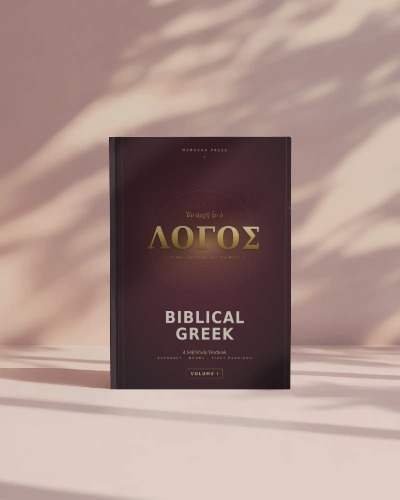 Free on Kindle Unlimited


Get the complete four-volume series:
Start with Volume I if you’re new — each volume builds on the one before it.