As an Amazon Associate I earn from qualifying purchases. This post contains affiliate links, which means I may earn a small commission — at no extra cost to you — if you buy through them. I only recommend things I believe are genuinely worth your time.
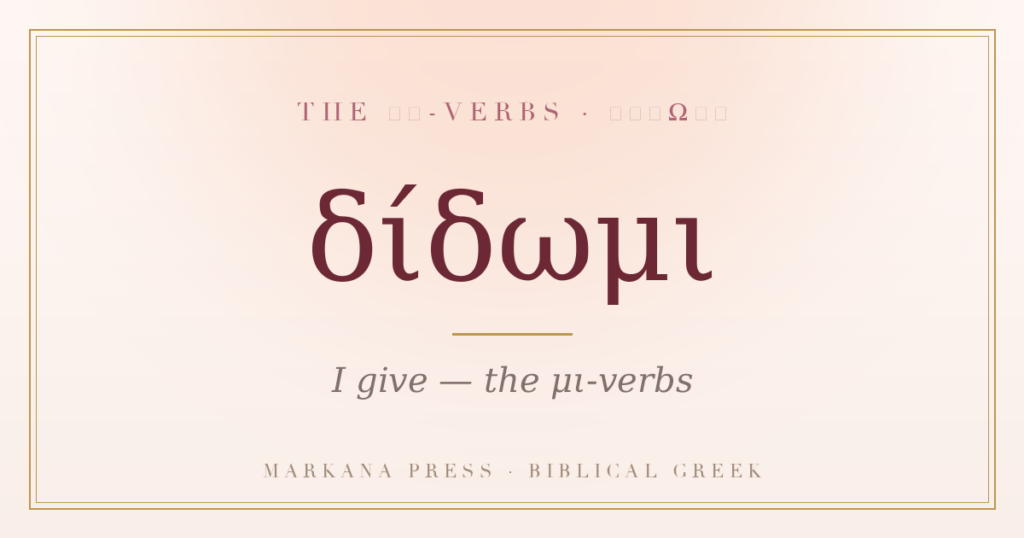
Most Greek verbs end in -ω in their dictionary form, like λύω. But a small, ancient family ends in -μι instead — and although there are not many of them, they include some of the most theologically loaded words in the entire New Testament. So you cannot afford to skip the μι-verbs; the good news is that there are only a handful that really matter.
I give them a dedicated lesson in Volume III, because a little focused attention here pays off on nearly every page of the Gospels.
The verbs you absolutely meet
Here are the five core μι-verbs, the ones worth knowing cold:
- δίδωμι — “I give.” (As in “God so loved the world that He gave.”)
- τίθημι — “I put, I place, I lay down.” (“The good shepherd lays down his life.”)
- ἵστημι — “I stand, I set, I cause to stand.”
- ἀφίημι — “I forgive, I release, I let go.” (The word behind “forgive us our debts.”)
- οἶδα — “I know” (a special perfect-form verb, hugely common).
Just from that list you can see the problem with skipping them: give, lay down, forgive, know — these are the verbs of the gospel itself.
Why they look different
The μι-verbs are older than the -ω verbs, and they form the present tense a bit differently — they often reduplicate at the front with an iota. That is why “I give” is δί-δωμι and “I place” is τί-θημι: that little repeated syllable is built into the present stem. Once you know to expect it, the forms stop looking random and start looking patterned.
The reassuring part
Here is what keeps the μι-verbs from being a nightmare: they are mostly irregular only in the present and imperfect. In the other tenses — the future, the aorist, the perfect — they behave much more like normal verbs. So you are not learning a whole second language of verbs; you are learning a handful of present-tense quirks for about five very common words. That is a very manageable assignment.
How to learn them
Because there are so few, the best approach is simple repeated exposure. Learn the present forms of δίδωμι first (δίδωμι, δίδως, δίδωσιν…), then τίθημι, then the others, and review them a couple of minutes a day. Since these words appear constantly, you will reinforce them naturally just by reading the Gospels. Within a couple of weeks, “He gave,” “He laid down,” “He forgives” will read as smoothly as any -ω verb.
The payoff
The μι-verbs are a small investment with an outsized return. Five core words, a couple of present-tense patterns, and suddenly the verses about God’s giving, Christ’s laying down His life, and our being forgiven read in the original. With the μι-verbs in hand, you have covered the core of the Greek verb — and the New Testament really does begin to read. Next, the adverbial participle is where all your participle work pays its richest dividends.
From Markana Press
Read the New Testament in the language it was written in
Everything in this post is exactly how I teach it in Biblical Greek: A Self-Study Textbook — a four-volume course I publish through my Christian imprint, Markana Press. It assumes no background in Greek and takes you from the alphabet to reading the Gospels in their original words.
📚 All four volumes are free to read on Kindle Unlimited right now — and also available in paperback and hardcover.
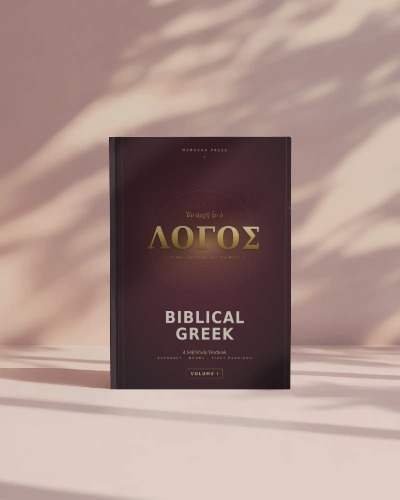 Free on Kindle Unlimited
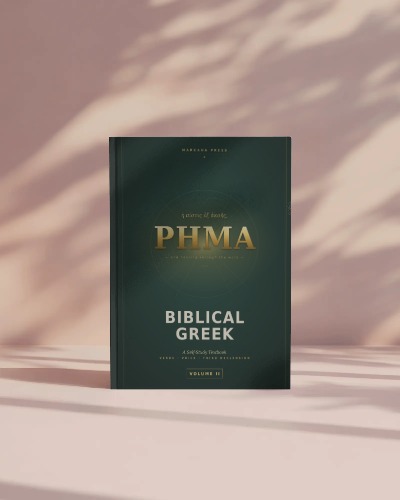
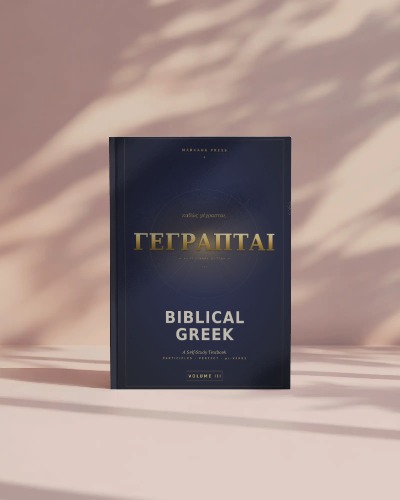
Get the complete four-volume series:
Start with Volume I if you’re new — each volume builds on the one before it.