As an Amazon Associate I earn from qualifying purchases. This post contains affiliate links, which means I may earn a small commission — at no extra cost to you — if you buy through them. I only recommend things I believe are genuinely worth your time.
Here is the idea that, once it clicks, makes the whole Greek verb system feel elegant instead of overwhelming: in Greek, the tenses are not mainly about when something happens. They are about aspect — how the speaker chooses to view the action. Time matters too, but aspect is the deeper engine, and English speakers almost always underrate it.
I give aspect its own lesson in Volume II because it quietly reshapes how you read every verb in the New Testament.
Two ways to see the same action
Imagine watching a parade. You can describe it two ways. You can stand in the middle of it and narrate it as ongoing — “the floats are going by, the band is playing.” Or you can watch from a helicopter and describe it as a single whole — “the parade happened.” Same event, two viewpoints. Greek builds those two viewpoints right into its verbs:
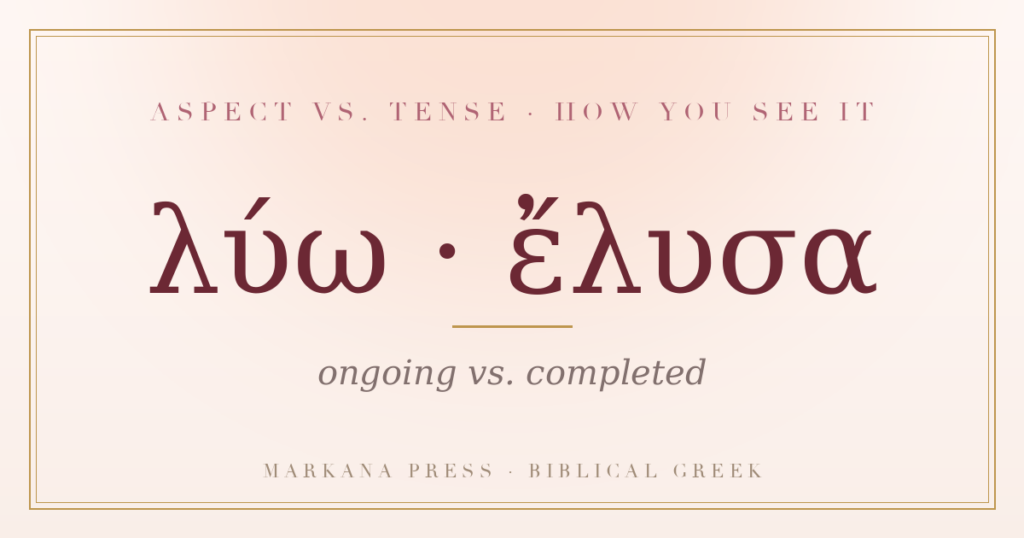
- Imperfective aspect (the present and imperfect): action seen as ongoing, in progress, like a movie. λύω — “I am loosing.”
- Perfective aspect (the aorist): action seen as a complete whole, like a snapshot. ἔλυσα — “I loosed.”
Why this is not the same as English “tense”
In English, “tense” is mostly about time: past, present, future. Greek cares about time too, but its first question is aspect: do you want me to see this action unfolding, or to see it as done? That is why the same English word — “he prayed” — could be an imperfect in Greek (“he was praying, he kept praying”) or an aorist (“he prayed,” as one completed act). The Greek author chose, and the choice carries meaning.
Aspect in action: a verse comes alive
Take Jesus’s words, “Ask, and it will be given to you; seek, and you will find; knock, and it will be opened” (Matthew 7:7). Those commands are in the present — imperfective aspect — which carries the sense of keep on asking, keep on seeking, keep on knocking. The aspect turns a single request into persistent prayer. That nuance is right there in the Greek verb, and reading it changes how the verse lands.
How aspect ties the verb together
Once you think in aspect, the tenses stop being a random list to memorize and become a tidy system: present and imperfect show action in progress; the aorist shows it as a whole; and the perfect (which you will meet later) shows a completed action with ongoing results. Three viewpoints, cleanly divided. That is genuinely beautiful design, and it is the kind of thing that makes learning Greek feel less like memorizing and more like discovering.
The takeaway
Whenever you meet a Greek verb, add one question to your reading: not just when, but how am I being asked to see this? Ongoing, or whole? That single habit will deepen your reading more than almost anything else, and it is why aspect, not time, is the heart of the Greek verb. From here, the principal parts show you how one verb produces all of these forms.
From Markana Press
Read the New Testament in the language it was written in
Everything in this post is exactly how I teach it in Biblical Greek: A Self-Study Textbook — a four-volume course I publish through my Christian imprint, Markana Press. It assumes no background in Greek and takes you from the alphabet to reading the Gospels in their original words.
📚 All four volumes are free to read on Kindle Unlimited right now — and also available in paperback and hardcover.
 Free on Kindle Unlimited
Get the complete four-volume series:
Start with Volume I if you’re new — each volume builds on the one before it.