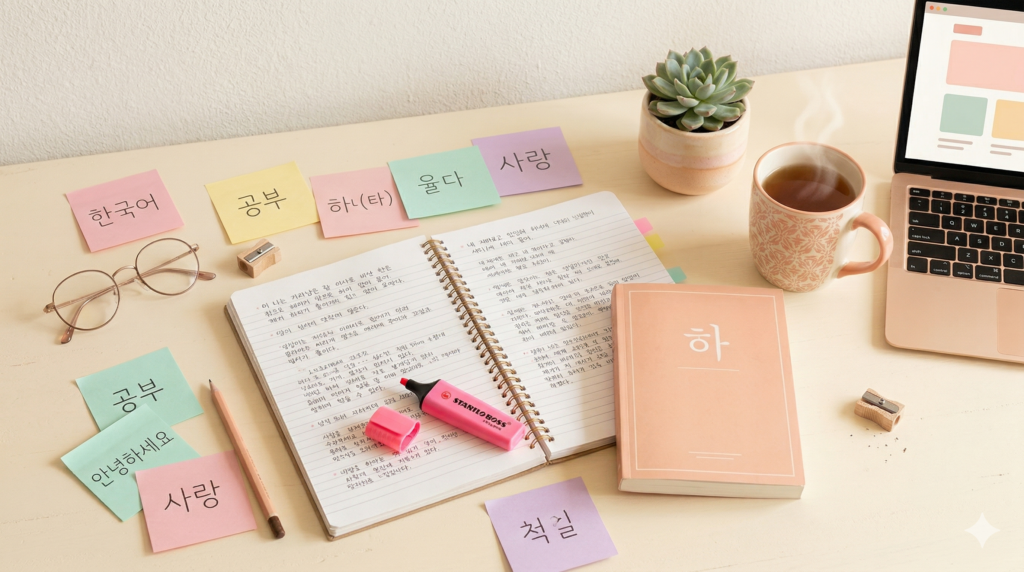
If you’re ready to start learning Korean but feel overwhelmed by where to begin, you’re not alone. Creating a Korean study schedule is one of the most effective ways to transform vague intentions into tangible progress. The difference between learners who succeed and those who give up often comes down to structure—having a clear plan that tells you exactly what to study each day removes decision fatigue and builds momentum. This comprehensive 3-month roadmap will guide you through your first 90 days of Korean learning with specific daily commitments, realistic goals, and proven strategies that work.
Understanding Your Korean Study Schedule Foundation
Before diving into the daily details, you need to understand what makes a beginner Korean roadmap effective. The most successful study plans balance four core components: reading and writing (Hangul mastery), grammar structures, vocabulary acquisition, and active speaking practice. Each element builds on the others, which is why jumping randomly between topics without structure rarely produces results.
Your first consideration is time commitment. This Korean study schedule is designed around 30-60 minutes of daily study, which research shows is the sweet spot for adult language learners. Studying for shorter periods consistently beats cramming for hours once or twice a week because language acquisition relies on repetition and regular exposure. If you can only commit to 20 minutes daily, that’s fine—just extend the timeline from 3 months to 4 or 5 months instead.
The second key principle is progressive overload. Just like building muscle, you need to gradually increase difficulty rather than staying comfortable. This plan starts with the alphabet and basic phrases in Month 1, moves to fundamental grammar patterns in Month 2, and introduces conversational practice in Month 3. Each phase prepares you for the next, creating a logical progression that prevents both boredom and overwhelm.
Month 1: Hangul Mastery and Core Foundation
Your first month focuses almost entirely on the Korean alphabet (Hangul) and establishing consistent study habits. Many beginners make the mistake of rushing through Hangul to get to “real” Korean, but this foundation is crucial. The good news is that Hangul is remarkably logical and can be learned in just a few hours—the challenge is building reading fluency.
Week 1-2: Alphabet Intensive
Dedicate your first two weeks to Hangul exclusively. Spend 15-20 minutes daily learning the characters using a structured course or app, then another 20-30 minutes practicing reading. Start with the 14 basic consonants and 10 basic vowels, then move to compound vowels and double consonants. By the end of Week 2, you should be able to read any Korean text slowly, even if you don’t understand the meaning. Practice by reading street signs, product labels, or Korean social media posts out loud—accuracy matters more than speed at this stage.
Week 3-4: Reading Speed and Basic Phrases
Continue reading practice but now aim to increase speed and add basic vocabulary. Learn 5-10 essential phrases per day focusing on greetings, self-introduction, and survival phrases. Write each phrase by hand three times—the physical act of writing reinforces memory far better than typing. Create flashcards for your first 100 words, prioritizing high-frequency vocabulary like numbers, days of the week, family terms, and common verbs (to go, to eat, to do, to be).
By the end of Month 1, you should comfortably read Hangul at a moderate pace, know 100-150 words, and be able to introduce yourself with basic information. This might seem modest, but you’ve built the critical foundation that everything else depends on. You can explore additional Korean learning resources to supplement your studies with cultural context that makes the language more meaningful.
Month 2: Building Your Korean Study Plan with Grammar Patterns
Month 2 shifts focus to grammar structures while continuing vocabulary expansion. Korean grammar operates very differently from English—verbs come at the end of sentences, and the language uses particles to show relationships between words. Rather than memorizing abstract rules, you’ll learn through sentence patterns that you can immediately use.
Week 5-6: Present Tense and Basic Sentence Structure
Learn the basic sentence structure (Subject + Object + Verb) and how to conjugate verbs into present tense. Focus on the informal polite form (해요 style) first, as it’s appropriate in most everyday situations. Study 3-4 new grammar patterns per week, creating at least 10 example sentences for each pattern. Key patterns for these weeks include topic particles (은/는), object particles (을/를), location particles (에/에서), and basic present tense conjugation.
Your daily Korean study plan during these weeks should include: 15 minutes reviewing grammar patterns, 20 minutes creating practice sentences, 15 minutes adding new vocabulary (aiming for 10-15 words daily), and 10 minutes reviewing previous material. This might feel slower than Month 1, but grammar requires more processing time than alphabet learning.
Week 7-8: Past Tense and Question Forms
Add past tense conjugations and learn how to form questions. Korean questions often use the same structure as statements with rising intonation or question words (what, where, when, who, why, how). Practice converting statements to questions and past tense forms. Start reading very simple Korean content—children’s books, webtoon dialogues, or beginner-level reading materials. You won’t understand everything, but you’ll start recognizing the patterns you’ve studied in real context.
By Month 2’s end, you should know 300-400 words, construct basic sentences in present and past tense, and understand fundamental particles. You’re transitioning from learning about Korean to actually using it, which is when language study becomes genuinely exciting.
How Long Does It Take to Learn Korean as a Beginner?
Learning Korean to a conversational level typically takes 600-800 hours of dedicated study for English speakers, which translates to about 1-2 years with consistent daily practice. However, you can achieve basic communication skills—understanding simple conversations, reading common signs, and expressing everyday needs—within 3-6 months following a structured plan. The key factor isn’t just time but consistency and quality of practice.
The Foreign Service Institute classifies Korean as a Category IV language, meaning it’s among the most challenging for English speakers due to significant linguistic differences. But don’t let this discourage you. The logical writing system, regular grammar patterns, and lack of tones (unlike Chinese or Vietnamese) make certain aspects easier than other Asian languages. Your progress speed depends heavily on several factors: your daily study time, whether you practice speaking with native speakers, your exposure to Korean media, and how effectively your study methods match your learning style.
Setting a 3-month goal isn’t about fluency—it’s about building sustainable habits and reaching a milestone where you can have very basic conversations and understand simple written Korean. This creates the momentum needed for long-term success and proves to yourself that Korean is achievable with the right approach.
Month 3: Implementing How to Study Korean Daily with Active Practice
Month 3 introduces the most challenging but rewarding element: active output through speaking and writing. Many learners postpone speaking until they “know enough,” but this perfectionism actually slows progress. Your goal isn’t to speak perfectly—it’s to start building the neural pathways that transform passive knowledge into active communication skills.
Week 9-10: Speaking Foundations
Start speaking from Day 1 of Month 3, even if it feels uncomfortable. Use language exchange apps to find conversation partners, or simply talk to yourself in Korean throughout the day. Narrate your activities: “I’m making coffee now” (지금 커피를 만들어요), “I’m going to the store” (가게에 가요), “This is delicious” (이거 맛있어요). Record yourself reading simple texts or having imaginary conversations, then listen back to identify pronunciation issues.
These weeks should also introduce future tense and connectors (and, but, so, because) that allow more natural conversation flow. Your vocabulary should reach 500-600 words by Week 10. Focus on thematic vocabulary clusters—learn all the words related to food together, all location words together, all time expressions together. This clustering helps memory retention better than random word lists.
Week 11-12: Integration and Real-World Application
The final two weeks focus on integration—bringing together everything you’ve learned into practical application. Watch Korean content with Korean subtitles (not English), even if you only catch 20-30% of it. Your brain will start connecting spoken sounds with written words and meanings. Try writing a simple journal entry daily in Korean, even just 3-4 sentences about your day.
Find authentic ways to use Korean beyond study sessions. Order from a Korean restaurant using Korean phrases, change your phone’s language setting to Korean for an hour each day, or join online Korean learning communities where you can ask questions and practice. The goal is making Korean part of your daily life rather than something confined to study time.
By the end of Month 3, you should comfortably read Korean at normal speed, know 600-800 words, construct sentences using multiple tenses, and hold very basic conversations about familiar topics. More importantly, you’ve established a sustainable study habit that you can continue beyond these initial 90 days.
Adjusting Your Korean Study Schedule for Different Intensity Levels
The beauty of this framework is its flexibility. Not everyone can commit an hour daily, and some learners want to push harder. Here’s how to adjust the plan for different situations while maintaining effectiveness.
Low Intensity (20-30 minutes daily): Extend the 3-month plan to 5-6 months. Focus on just one new grammar pattern per week instead of 3-4, and aim for 5 new vocabulary words daily instead of 10-15. Prioritize Hangul reading and basic grammar over speaking practice initially—you’ll get to conversation skills later. The trade-off is slower progress, but you’ll still achieve the same endpoints without burning out.
Medium Intensity (45-60 minutes daily): This is the baseline plan described above. It offers the best balance between progress and sustainability for most adult learners with work and family commitments. Stick to the weekly milestones and don’t be tempted to rush ahead—language learning requires processing time between new concepts.
High Intensity (90+ minutes daily): If you can dedicate more time, compress the timeline to 6-8 weeks instead of 3 months, or add supplementary materials. Increase vocabulary acquisition to 20-25 words daily, add listening comprehension practice with podcasts designed for learners, and start speaking practice from Week 4 instead of Week 9. Join structured courses or work with a tutor for personalized feedback. Just be aware that sustainable consistency beats intense bursts followed by burnout.
The most important factor isn’t intensity but consistency. Someone studying 20 minutes every single day will progress further than someone cramming 3 hours on weekends only. Your brain needs regular exposure to form the connections that make language stick.
Essential Resources for Your Beginner Korean Roadmap
Having a study plan is crucial, but you also need quality resources. Here are specific, tested recommendations for each stage of your journey.
For Hangul (Month 1): Use “Learn Hangul in 90 Minutes” or similar YouTube tutorials for initial learning, then practice reading with apps like “Korean Alphabet” or websites like How to Study Korean. Physical workbooks like “Korean Made Simple: Hangeul Workbook” provide valuable writing practice that apps can’t replace.
For Grammar (Month 2): “Korean Grammar in Use: Beginning” is the gold standard textbook, offering clear explanations and abundant exercises. Online, the “How to Study Korean” website provides free, comprehensive grammar lessons organized by difficulty. Apps like LingoDeer offer structured courses specifically designed for Korean learners, with superior grammar explanations compared to Duolingo.
For Vocabulary (All Months): Anki is the most effective spaced repetition system for memorization—download pre-made Korean decks or create your own. Supplement with thematic vocabulary lists from TTMIK (Talk To Me In Korean). Physical flashcards work well for kinesthetic learners who benefit from the tactile element of flipping cards.
For Speaking (Month 3): HelloTalk and Tandem connect you with native Korean speakers for language exchange. iTalki offers affordable tutoring sessions (often $10-15 per hour) for structured conversation practice with feedback. Shadowing exercises using YouTube videos of native speakers talking at normal speed help pronunciation and rhythm.
For Listening (Month 3): “Korean Listening Practice for Absolute Beginners” on YouTube provides slow, clear audio with transcripts. K-dramas with Korean subtitles (not English) offer authentic listening once you reach intermediate stages. TTMIK’s podcast series is specifically designed for learners at various levels.
Don’t try using everything at once—resource overwhelm causes paralysis. Pick one primary resource for each category and stick with it through the full 3 months before switching. Consistency with adequate materials beats constantly searching for the “perfect” resource.
Tracking Progress and Staying Motivated Throughout Your Plan
Even with a perfect learn Korean in 3 months study plan, motivation will fluctuate. Building accountability systems and tracking mechanisms makes the difference between completing the plan and abandoning it halfway through.
Create a simple tracking system—this can be a spreadsheet, a habit tracker app, or even checkmarks on a printed calendar. Track three metrics daily: whether you studied, how long you studied, and one specific thing you learned. This creates visible momentum and makes you accountable. When you see a 30-day streak, you’ll be motivated to maintain it.
Set micro-goals for each week rather than focusing only on the 3-month endpoint. Week 1’s goal might be “read all basic Hangul consonants and vowels fluently.” Week 5’s goal might be “construct 20 present tense sentences independently.” Small wins maintain motivation better than distant, abstract goals like “become conversational.”
Join a community of Korean learners—online forums, Reddit’s r/Korean, Discord servers, or local meetup groups. Sharing struggles and victories with others on the same journey provides encouragement during difficult weeks. You’ll also discover tips and resources you might have missed.
When motivation drops (and it will), focus on identity over outcomes. Instead of “I want to learn Korean,” shift to “I am a Korean learner.” People who integrate learning into their identity maintain consistency more easily than those chasing external goals. Missing a day doesn’t mean failure—it means you’re human. Just resume the next day without guilt or the need to “make up” for lost time.
Consider connecting your language learning with other interests. If you enjoy cooking, learn Korean through recipe videos and food vocabulary. If you’re interested in faith and spirituality, you might explore how Korean Christian communities express theological concepts. Learners who connect Korean to existing passions maintain motivation more naturally than those treating it as pure academic study.
Moving Forward After Your First 90 Days
Completing this Korean study schedule is an accomplishment worth celebrating, but it’s just the beginning of your language journey. After three months, you’ll have the foundation to continue learning independently with much less structure. The skills that feel difficult now—reading Hangul, constructing basic sentences, recognizing grammar patterns—will become automatic, freeing your mental energy for more advanced concepts.
Your next steps depend on your goals. If you’re learning for travel, focus on situational vocabulary and listening comprehension. If you’re interested in consuming Korean media, prioritize listening skills and colloquial expressions that textbooks often skip. If you want business-level Korean, invest in formal register and professional vocabulary. The beauty of having a solid foundation is that you can now customize your path based on personal interests rather than following a one-size-fits-all curriculum.
The most crucial lesson from these 90 days isn’t what you’ve learned—it’s that you’ve proved you can maintain consistent study habits and make measurable progress in a challenging language. That consistency is the real skill you’ve developed, and it’s what will carry you from beginner to intermediate to advanced over the coming months and years. Korean is absolutely learnable for English speakers; it just requires structure, patience, and daily commitment. Start with Day 1 of Month 1 tomorrow, trust the process, and you’ll be amazed at where you are 90 days from now.