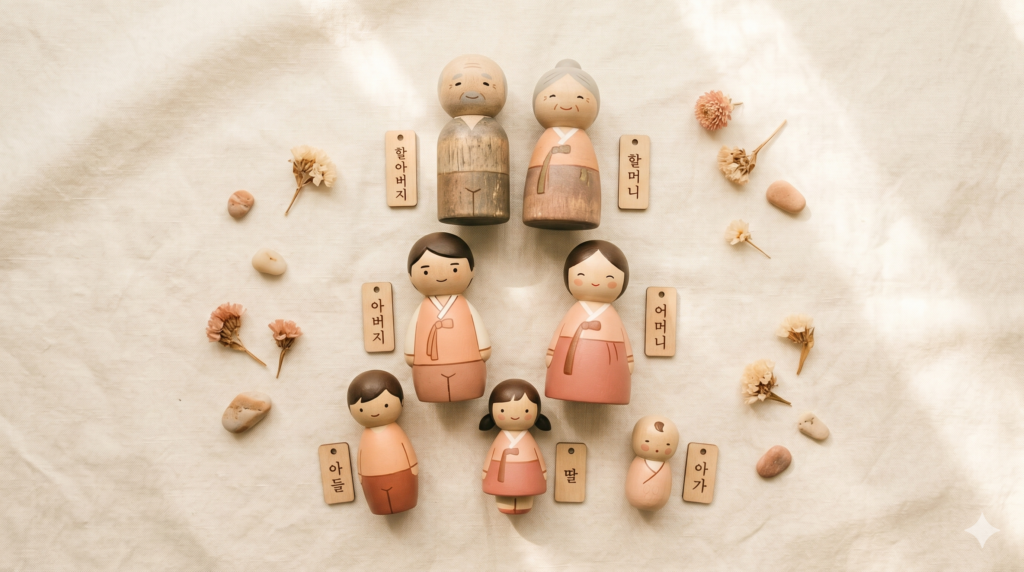
Korean family vocabulary is one of the most eye-opening parts of learning the language. In English, “brother” covers any male sibling regardless of age. In Korean, there are separate words depending on whether the sibling is older or younger, and whether you are male or female. This isn’t an exception — it’s how the entire family vocabulary works, and it reflects how deeply age and hierarchy are woven into Korean culture.
Immediate Family Members in Korean
Let’s start with the core family terms everyone learns first:
- 아버지 (abeoji) — Father (respectful)
- 아빠 (appa) — Dad (casual, like “daddy”)
- 어머니 (eomeoni) — Mother (respectful)
- 엄마 (eomma) — Mom (casual)
- 부모님 (bumonim) — Parents (honorific)
- 아들 (adeul) — Son
- 딸 (ttal) — Daughter
Notice that 아빠/엄마 (appa/eomma) are the casual forms — equivalent to “dad/mom” — while 아버지/어머니 are more formal and respectful. When talking to or about someone else’s parents, always use the respectful forms or add 님 (nim) as an honorific suffix.
How Do You Say Brother and Sister in Korean?
Korean sibling terms change based on your gender and whether the sibling is older or younger. This is the part that surprises most English speakers — there’s no single word for “brother” or “sister.”
If you are female:
- 오빠 (oppa) — Older brother (when you’re female)
- 언니 (eonni) — Older sister (when you’re female)
If you are male:
- 형 (hyeong) — Older brother (when you’re male)
- 누나 (nuna) — Older sister (when you’re male)
Regardless of your gender:
- 남동생 (namdongsaeng) — Younger brother
- 여동생 (yeodongsaeng) — Younger sister
- 동생 (dongsaeng) — Younger sibling (gender-neutral)
Yes, this means a woman and a man standing next to the same older brother would call him by different names — she’d say 오빠, he’d say 형. This system seems complicated at first but becomes second nature quickly.
Grandparents and Extended Family
- 할아버지 (harabeoji) — Grandfather
- 할머니 (halmeoni) — Grandmother
- 외할아버지 (oe-harabeoji) — Maternal grandfather
- 외할머니 (oe-halmeoni) — Maternal grandmother
- 삼촌 (samchon) — Uncle (father’s brother)
- 외삼촌 (oe-samchon) — Uncle (mother’s brother)
- 이모 (imo) — Aunt (mother’s sister)
- 고모 (gomo) — Aunt (father’s sister)
- 사촌 (sachon) — Cousin
Notice the pattern: 외 (oe) means “maternal” or “outside” — it marks relatives on the mother’s side. Korean distinguishes between maternal and paternal relatives at every level. There’s even a different word for your father’s older brother (큰아버지, keunabeoji) vs your father’s younger brother (작은아버지, jagunabeoji).
Marriage and In-Law Terms
- 남편 (nampyeon) — Husband
- 아내 (anae) — Wife
- 시어머니 (si-eomeoni) — Mother-in-law (husband’s mother)
- 시아버지 (si-abeoji) — Father-in-law (husband’s father)
- 장모님 (jangmonim) — Mother-in-law (wife’s mother)
- 장인어른 (jangin-eoreun) — Father-in-law (wife’s father)
Even in-laws have different terms depending on which side of the family they’re on. Korean vocabulary makes absolutely sure you know exactly who someone is in relation to you.
Using Family Words with Non-Family Members
Here’s something beautiful about Korean culture: family words are used with people who aren’t actually your family. This is extremely common and completely normal:
- 오빠/형 — used for any close older male (friends, colleagues, even K-pop idols)
- 언니/누나 — used for any close older female
- 아줌마 (ajumma) — middle-aged woman (used for restaurant ladies, market vendors)
- 아저씨 (ajeossi) — middle-aged man
- 할머니/할아버지 — used affectionately for any elderly person
Calling an older friend 오빠 or 언니 isn’t weird or overly intimate — it’s standard social glue in Korean. It signals warmth, closeness, and respect for the age relationship.
Practice Tips
Family vocabulary sticks best when you connect it to real people. Try mapping these words onto your own family — who would be your 오빠 or 형? Your 이모? Draw a family tree with Korean labels. This turns abstract vocabulary into something personal and memorable.
For more essential vocabulary, the 50 basic Korean phrases guide covers the everyday expressions you’ll use alongside these family words. And these free learning resources include courses that teach vocabulary in context.