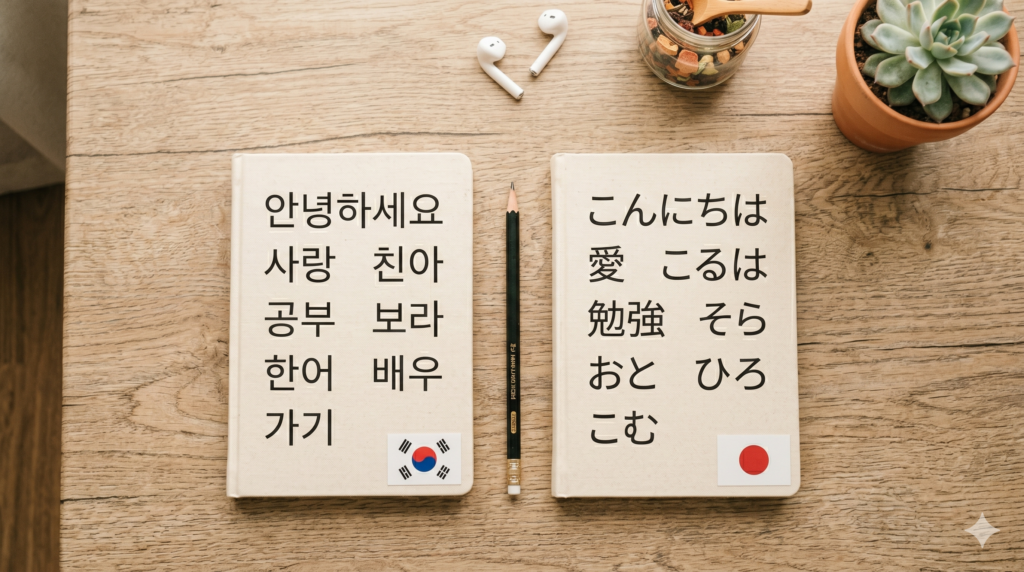
“Should I learn Korean or Japanese?” is one of the most common questions people ask when they’re drawn to East Asian languages. Both are fascinating, both have booming pop culture pull (K-pop and K-dramas for Korean, anime and manga for Japanese), and both are considered among the hardest languages for English speakers. So which language should you learn first?
The honest answer is: it depends on your why. But here’s a practical, side-by-side breakdown to help you decide.
Writing System: Korean Is Dramatically Easier
Korean has one alphabet (Hangul) with 24 letters that can be learned in a day. Hangul was specifically designed in the 1440s to be easy for common people to learn — it’s one of the most logical writing systems ever created. Each character represents a sound, and syllable blocks are assembled predictably from consonants and vowels.
Japanese, by contrast, uses three writing systems simultaneously: hiragana (46 characters), katakana (46 characters), and kanji (thousands of Chinese characters — you need roughly 2,000 to read a newspaper). Learning to read Japanese is a multi-year project. Learning to read Korean takes an afternoon.
This is the single biggest practical difference. If you want to start reading and typing in your target language quickly, Korean has a massive head start. For a visual walkthrough, the Hangul chart guide shows exactly how the alphabet works.
Grammar: Surprisingly Similar
Korean and Japanese grammar are remarkably alike — far more similar to each other than either is to English. Both use:
- Subject-Object-Verb word order (the verb goes at the end)
- Particles to mark grammatical relationships (subject, object, topic, etc.)
- Honorific speech levels — formality is baked into the grammar, not just word choice
- Agglutinative verb conjugation — meaning is built by stacking suffixes onto verb stems
- Topic-comment structure — both languages emphasize what’s being talked about, not just who’s doing what
If you learn one, the grammar of the other will feel familiar. Many learners report that picking up the second language is noticeably easier because the grammatical logic transfers directly.
Is Korean or Japanese Harder to Pronounce?
Japanese pronunciation is generally easier for English speakers. Japanese has only 5 vowel sounds and a very consistent phonetic system — what you see is almost always what you say. Korean has more vowel sounds (including several that don’t exist in English), plus distinctions between aspirated, tensed, and plain consonants that take significant ear training to distinguish and produce.
That said, “harder” doesn’t mean impossible — Korean pronunciation clicks with practice, and having Hangul (where spelling is phonetic) makes it more approachable than learning Japanese kanji readings, where a single character might have five different pronunciations depending on context.
Vocabulary and Shared Roots
Both Korean and Japanese borrowed heavily from Chinese, so they share a large pool of Sino-Korean and Sino-Japanese vocabulary with similar pronunciations. For example:
- “Library” — Korean: 도서관 (doseo-gwan) / Japanese: 図書館 (tosho-kan)
- “Promise” — Korean: 약속 (yaksok) / Japanese: 約束 (yakusoku)
- “Family” — Korean: 가족 (gajok) / Japanese: 家族 (kazoku)
Neither language borrows much from English compared to, say, Spanish or French — so there are fewer free vocabulary wins from your existing English knowledge. Both will require serious memorization effort.
Career and Travel Value
Both languages have strong career value, but in different areas:
- Japanese has historically been more in-demand for business, especially in automotive, technology, and gaming industries. Japan’s economy is the third largest in the world.
- Korean has surged in demand thanks to the “Korean Wave” (hallyu) — K-pop, K-dramas, K-beauty, and Korean tech companies like Samsung, LG, and Hyundai. Korean is increasingly valuable in entertainment, beauty, technology, and international business.
For travel, both countries are incredible destinations. South Korea is compact and easy to navigate; Japan is larger with more varied regions to explore. Both are extremely safe and welcoming to tourists.
Community and Learning Resources
Japanese has had a longer presence in Western language-learning circles, so there are slightly more textbooks, courses, and learning communities available. But Korean resources have exploded in the last five years — there are now excellent free Korean learning resources covering every level from absolute beginner to advanced.
Both languages have massive online communities of learners sharing tips, study methods, and motivation.
The Bottom Line: Follow Your Motivation
The language you’ll actually stick with is the one you’re most excited about. Both Korean and Japanese require 2,200+ hours of study for proficiency (according to the US Foreign Service Institute), so motivation is the single biggest factor in success.
- Choose Korean if: You love K-pop, K-dramas, or Korean food culture. You want to start reading quickly (Hangul is fast to learn). You’re interested in Korean beauty, tech, or modern pop culture.
- Choose Japanese if: You love anime, manga, or Japanese gaming. You’re drawn to traditional Japanese culture (tea ceremony, martial arts, calligraphy). You want slightly easier pronunciation as a starting point.
- Can’t decide? Start with Korean. The alphabet is faster to learn, so you get early wins that keep you motivated. And because the grammar is so similar, everything you learn about Korean sentence structure will directly help if you decide to add Japanese later.
Whichever you choose — commit to it for at least 3 months before evaluating. The first few weeks of any language feel slow. The magic happens when you stick with it long enough for the patterns to click.