As an Amazon Associate I earn from qualifying purchases. This post contains affiliate links, which means I may earn a small commission — at no extra cost to you — if you buy through them. I only recommend things I believe are genuinely worth your time.
The very first verb most Greek students learn is also one of the most important words in all of Scripture: εἰμί (eimi), the verb “to be” — “I am.” It is irregular, it is everywhere, and it stands behind some of the most stunning claims Jesus ever made. Volume I introduces it early, because you cannot build a single sentence without “is.”
Why “to be” comes first
Almost every other verb you have met — λύω and its family — describes an action. εἰμί describes existence or identity: it links a subject to what it is. “God is love,” “the Word was God.” That little linking verb is the hinge of countless statements of truth, so it earns its place at the front of the course.
The present tense of εἰμί
It is irregular, so you simply learn it as its own small song:
- εἰμί — I am
- εἶ — you are
- ἐστίν — he, she, or it is
- ἐσμέν — we are
- ἐστέ — you (plural) are
- εἰσίν — they are
You met one of its past-tense forms already in John 1:1 — ἦν, “was.” And because εἰμί is a linking verb, the words on both sides of it stay in the same (nominative) case, which is a small but important reading clue.
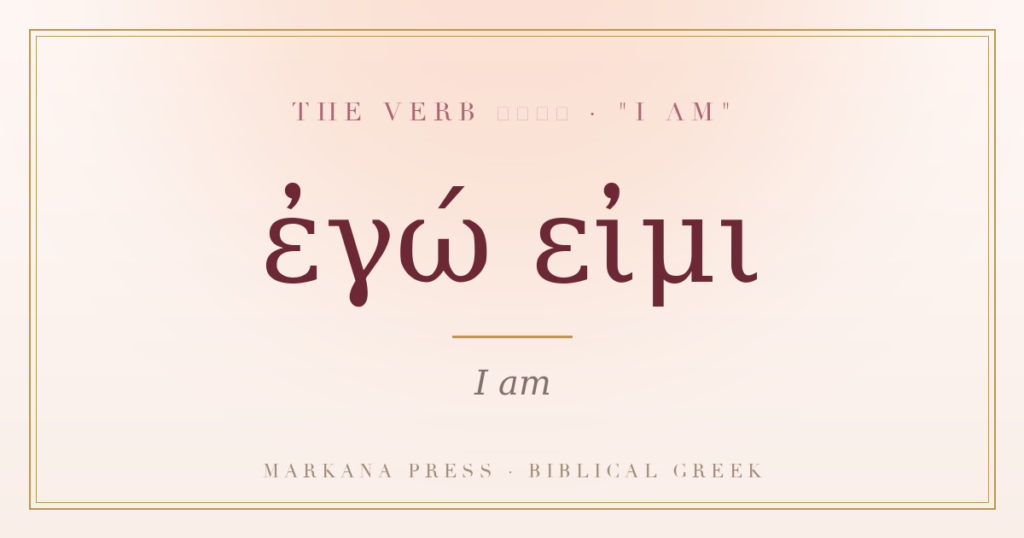
ἐγώ εἰμι — “I AM”
Now the weighty part. The phrase ἐγώ εἰμι simply means “I am.” But ἐγώ (“I”) is already built into the verb εἰμί, so adding the separate word “I” is emphatic — like underlining it. And that emphatic “I AM” is exactly the phrase the Greek Old Testament uses when God reveals His name to Moses: “I AM who I AM” (Exodus 3:14). So when Jesus says, “Before Abraham was, ἐγώ εἰμι” (John 8:58), He is not making a grammar slip — He is taking the divine name onto His own lips. His hearers understood exactly what He claimed, which is why they picked up stones.
The “I AM” sayings
John’s Gospel gives us a whole series of ἐγώ εἰμι sayings: “I am the bread of life,” “I am the light of the world,” “I am the good shepherd,” “I am the way, the truth, and the life,” “I am the resurrection and the life.” Each one quietly echoes that divine “I AM,” presenting Jesus as the very God of the burning bush, now come in the flesh. The simple verb “to be” carries the highest claim in the Bible.
The takeaway
Learn εἰμί first because it is the verb of being and identity — and stay with it because it leads straight to the heart of who Jesus is. From “the Word was God” to “before Abraham was, I AM,” the humble little verb “to be” keeps carrying the weight of glory. It is a perfect example of why even a beginner’s Greek can deepen your worship — and exactly what the four-volume series below is written to open up for you.
From Markana Press
Read the New Testament in the language it was written in
Everything in this post is exactly how I teach it in Biblical Greek: A Self-Study Textbook — a four-volume course I publish through my Christian imprint, Markana Press. It assumes no background in Greek and takes you from the alphabet to reading the Gospels in their original words.
📚 All four volumes are free to read on Kindle Unlimited right now — and also available in paperback and hardcover.
 Free on Kindle Unlimited
Get the complete four-volume series:
Start with Volume I if you’re new — each volume builds on the one before it.