As an Amazon Associate I earn from qualifying purchases. This post contains affiliate links, which means I may earn a small commission — at no extra cost to you — if you buy through them. I only recommend things I believe are genuinely worth your time.
If there is one form that separates people who have “studied a little Greek” from people who can actually read the New Testament, it is the participle. It is everywhere — the Gospels and Paul lean on it constantly — and it is the form beginners most often find slippery. But the participle is not hard once you grasp the one idea behind it: it is a verbal adjective, half verb and half adjective, doing both jobs in a single word.
This is the heart of Volume III, and the moment it clicks, long sentences that used to feel tangled start to fall open.
Half verb, half adjective
An English participle is a word like “running” or “broken.” It comes from a verb, but it can describe a noun like an adjective: the running water, the broken cup. Greek does the same thing, but its participles carry far more information. A single Greek participle tells you, all at once:
- its verbal side: tense/aspect and voice (is the action ongoing or complete? active or passive?)
- its adjective side: gender, number, and case, so it agrees with the noun it describes
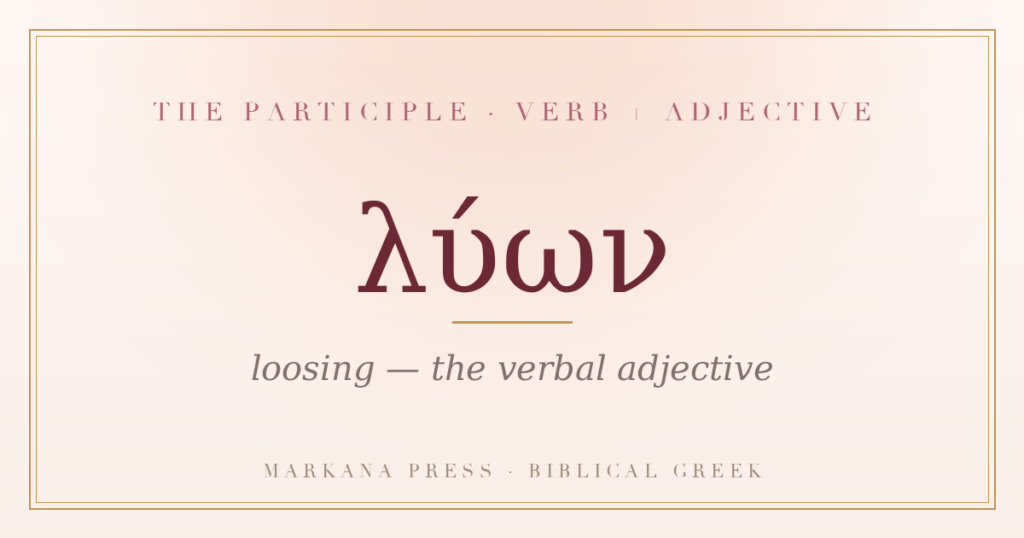
Take λύων — “loosing” or “while loosing.” It is built on the verb λύω, so it carries ongoing aspect; and it has an adjective-style ending so it can match a masculine subject. One word, two jobs.
Tense in a participle is about aspect, not time
Here is the single most important thing to know, and it trips up everyone at first. In a participle, the “tense” is not mainly about when — it is about aspect, how the action is viewed relative to the main verb:
- Present participle (λύων) — action ongoing, usually happening at the same time as the main verb: “while loosing.”
- Aorist participle (λύσας) — action as a whole, usually completed before the main verb: “after loosing” / “having loosed.”
So when you read “having heard this, he went,” the aorist participle tells you the hearing came first. The participle quietly builds the timeline of the sentence.
The three jobs a participle does
Greek participles do three main things, and learning to ask “which job?” is the whole skill:
- Adjectival — describing a noun: “the man who is speaking.”
- Substantival — standing in for a noun, often with the article: ὁ πιστεύων, “the one who believes,” “the believer.”
- Adverbial — describing the circumstances of the main verb (when, because, although…). This one is so important I gave it its own post.
That little phrase ὁ πιστεύων — “the believing one” — is all over John’s Gospel: whoever believes in Him shall not perish. It is a participle doing the work of a whole clause.
Why the participle is worth the effort
Because Greek loves participles, English translations constantly have to unpack them into clauses (“when he had come,” “the one who believes”). When you can read the participle directly, you see the sentence the way the author shaped it — compact, layered, with the main action and its circumstances bundled together. It is genuinely one of the most elegant things about the language.
How to tackle it
Do not try to swallow every participle form at once. Learn the present active first (λύων, λύουσα, λῦον), get comfortable spotting participles in the text, and for each one ask three questions: What aspect? What voice? What job — adjective, noun, or adverb? Within a few weeks that becomes second nature, and the densest verses in Paul start to feel readable. From here, two specific participle constructions are worth their own look: the adverbial participle and the elegant genitive absolute.
From Markana Press
Read the New Testament in the language it was written in
Everything in this post is exactly how I teach it in Biblical Greek: A Self-Study Textbook — a four-volume course I publish through my Christian imprint, Markana Press. It assumes no background in Greek and takes you from the alphabet to reading the Gospels in their original words.
📚 All four volumes are free to read on Kindle Unlimited right now — and also available in paperback and hardcover.
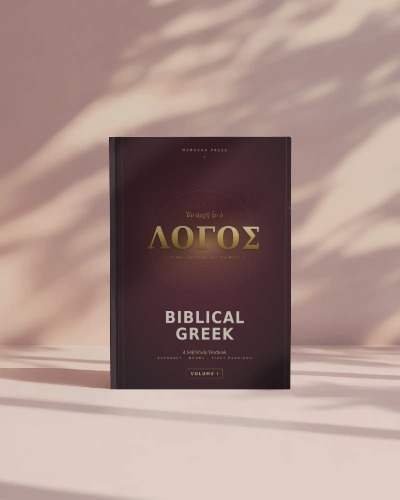 Free on Kindle Unlimited
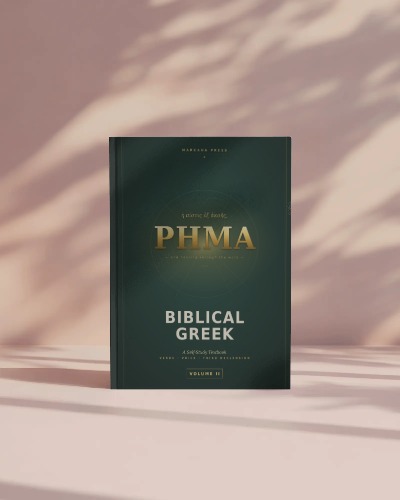
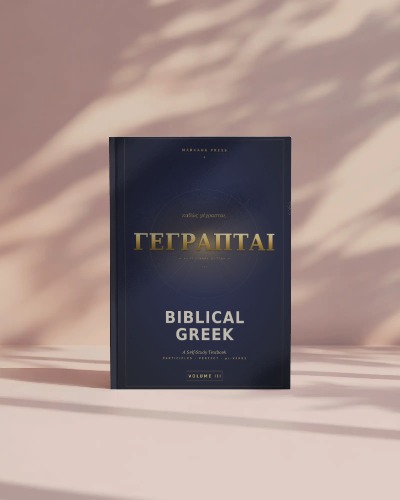
Get the complete four-volume series:
Start with Volume I if you’re new — each volume builds on the one before it.