As an Amazon Associate I earn from qualifying purchases. This post contains affiliate links, which means I may earn a small commission — at no extra cost to you — if you buy through them. I only recommend things I believe are genuinely worth your time.
Ask a room of Greek students where they first struggled, and a lot of them will say the same words: the third declension. The first two declensions are tidy and predictable. The third looks, at first, like a pile of exceptions. But it is not — it follows one clear trick, and once you know it, the “hard” declension becomes the interesting one.
I take the third declension slowly in Volume II, stem-type by stem-type, because getting it solid is what lets you parse essentially every noun in the New Testament.
Why it looks intimidating
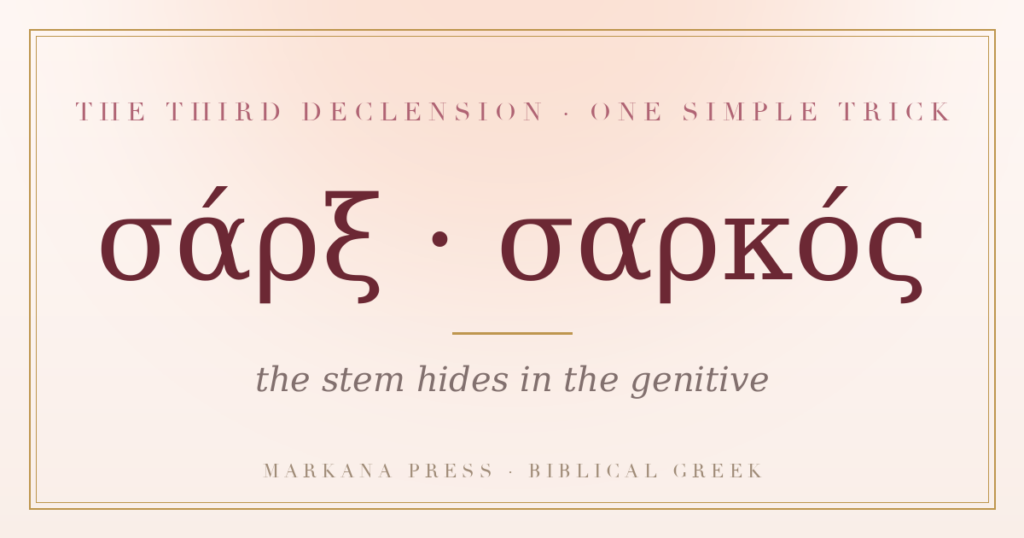
In the first two declensions, the form you look up in the dictionary (the nominative) shows you the stem clearly. In the third declension, the nominative often disguises the stem, because sounds collide and change at the end of the word. Take σάρξ (“flesh”). You would never guess from σάρξ what its real stem is. It looks like a dead end.
The one trick: look at the genitive
Here is the secret that unlocks the whole declension. The genitive form reveals the true stem. That is why dictionaries always list a third-declension noun with its genitive: σάρξ, σαρκός. Drop the genitive ending -ος, and the real stem appears: σαρκ-. Now every other form makes sense, because they are all built on σαρκ-, not on the misleading nominative.
Watch it work with other key words:
- χάρις, χάριτος (“grace”) → stem χαριτ-
- ὄνομα, ὀνόματος (“name”) → stem ὀνοματ-
- πατήρ, πατρός (“father”) → stem πατ(ε)ρ-
- ἐλπίς, ἐλπίδος (“hope”) → stem ἐλπιδ-
So the moment you learn a third-declension noun, you learn it as a pair — nominative and genitive together — and you are never stuck again.
Why it’s worth the effort
The third declension is not some rare corner of the language. It is home to enormously important words: χάρις (grace), πίστις (faith), σάρξ (flesh), πνεῦμα (spirit), σῶμα (body), βασιλεύς (king). You cannot read Paul on grace and faith, or John on Spirit and flesh, without meeting the third declension on nearly every line. Master it and the heart of New Testament vocabulary opens up.
How to practice it
Do not try to memorize giant charts cold. Instead, learn each noun as its nominative-genitive pair, find the stem, and then notice that the endings you add are remarkably consistent across all third-declension nouns. The variety is in the stems, not the endings. A few minutes a day pairing words — σάρξ, σαρκός; χάρις, χάριτος — and the pattern becomes second nature.
The encouragement
If the third declension is the wall people warn you about, the genitive is the door in it. One trick — find the stem in the genitive — turns the scariest part of Greek nouns into something genuinely satisfying. And once your nouns (all three declensions) and your verbs are solid, you are ready for the parts of the language where the New Testament really starts to sing. Keep the four cases close as you go.
From Markana Press
Read the New Testament in the language it was written in
Everything in this post is exactly how I teach it in Biblical Greek: A Self-Study Textbook — a four-volume course I publish through my Christian imprint, Markana Press. It assumes no background in Greek and takes you from the alphabet to reading the Gospels in their original words.
📚 All four volumes are free to read on Kindle Unlimited right now — and also available in paperback and hardcover.
 Free on Kindle Unlimited
Get the complete four-volume series:
Start with Volume I if you’re new — each volume builds on the one before it.