One of the things I love about learning Korean is how the language keeps leading me into these unexpected cultural rabbit holes. I will be studying a vocabulary word and suddenly I am three hours deep into a topic I never knew I cared about. That is exactly how I ended up researching Korean games — traditional ones, modern ones, drinking ones, and the ones that went globally viral thanks to a certain Netflix show.
Korean games are genuinely fascinating. Some of them are thousands of years old and still played today. Some are so creative and social that they make American party games look kind of boring by comparison. And some of them — well, some of them you might already recognize without knowing they were Korean.
Here is everything I have learned about Korean games, from ancient board games to the ones you play after a few rounds of soju.
Traditional Korean Games: Centuries of Play
Korea has a rich tradition of folk games, many of which date back centuries and are still played today — especially during holidays like Seollal (설날, Korean Lunar New Year) and Chuseok (추석, Korean harvest festival). These are not museum relics. They are living traditions.
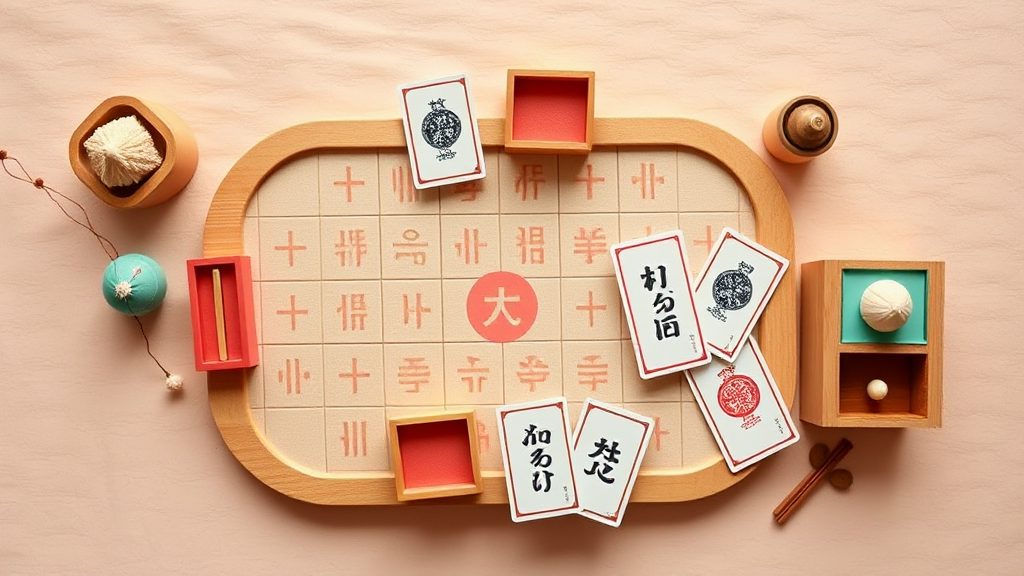
윷놀이 (Yutnori) — This is probably the most iconic traditional Korean game. Yutnori is a board game that uses four wooden sticks instead of dice. You throw the sticks in the air, and depending on how they land (flat side up or rounded side up), you move your game pieces along a cross-shaped board. The goal is to get all four of your pieces around the board before your opponent does.
What makes Yutnori special is the energy. This is not a quiet, contemplative game. Korean families play Yutnori during Lunar New Year, and it gets loud. People cheer, strategize, trash-talk, and celebrate. There is a team element to it — you can choose to move pieces strategically to block opponents or carry your own pieces together for faster movement. It is deceptively simple in its rules but surprisingly strategic in practice.
I watched a family play Yutnori in a Korean vlog once, and the level of chaos and joy was incredible. The grandma was absolutely dominating, and the grandkids were losing their minds. It reminded me of how my own family gets during card games — that universal energy of competitive love.
공기놀이 (Gonggi) — Korean jacks. If you played jacks as a kid in America, you already know the basic concept, but Gonggi uses small, colorful plastic stones instead of a ball and metal jacks. You toss one stone in the air and try to pick up the others from the ground before catching the tossed one. Each round gets harder — pick up one at a time, then two, then three, then all of them.
🫙 Fermenting at home? the airtight jars I use for kimchi →
As an Amazon Associate I earn from qualifying purchases.
Gonggi is one of those games that looks simple until you try it and realize it requires serious hand-eye coordination and speed. Korean kids are incredibly fast at this game. There are videos online of children playing Gonggi at a speed that makes it look like a magic trick.
제기차기 (Jegi Chagi) — Think of this as Korean hacky sack, but with a different kind of projectile. A jegi is traditionally made from a coin wrapped in paper or cloth with a tassel-like tail. You kick it in the air and try to keep it aloft using only your feet. The goal is to keep it going as long as possible without letting it hit the ground.
Jegi chagi has been played in Korea for centuries and is another game that is particularly popular during holiday celebrations. It requires balance, coordination, and a lot of practice. Watching skilled players is mesmerizing — they can keep the jegi going for dozens of kicks without breaking a sweat.
팽이치기 (Paengi Chigi) — Korean top spinning. Players spin a wooden top and then keep it spinning by whipping it with a string or stick. Competitive top spinning was a popular children’s game, especially during winter months. The tops are beautifully crafted, and skilled players can keep them spinning for impressively long periods.
Korean Drinking Games: Where Things Get Interesting
If you have ever watched a K-drama that features a group dinner scene with soju, you have probably seen Korean drinking games in action. Korea has an incredibly creative and social drinking culture, and the games reflect that. These are not just “chug and spin” type games — they require wit, speed, rhythm, and reading the room.
눈치게임 (Nunchi Game) — The Nunchi Game is beautifully simple and hilariously stressful. Everyone starts seated. One person stands up and says “one.” Then another person stands up and says “two.” Then “three,” and so on. The catch? There is no assigned order. Anyone can stand up at any time. If two people stand up simultaneously and call the same number, they both have to drink. The last person left sitting also has to drink.
The name comes from 눈치 (nunchi), the Korean concept of social awareness — reading the room, sensing what others are about to do. This game is basically a test of your nunchi. Can you sense when someone else is about to stand? Can you time your move perfectly? It sounds silly, but it gets genuinely tense and funny, especially as the numbers get higher and the remaining players stare each other down.
소주 병뚜껑 (Soju Cap Game) — After you twist open a bottle of soju, there is a small metal strip hanging from the cap. In this game, you twist that strip into a tight coil, and players take turns flicking it. Whoever flicks the strip off drinks. It sounds random, but people develop actual technique for this. The anticipation as each person flicks — will it come off? — makes it weirdly exciting for something involving a bottle cap.
바스 게임 (Bus Game) — Also called the Baskin Robbins 31 game. Players take turns counting up from 1, and you can say one, two, or three numbers on your turn. Whoever is forced to say “31” has to drink. The strategy comes from managing the count — do you say one number to play it safe, or three to push the count toward your opponent? It is a simple math game that gets surprisingly strategic and chaotic as the count approaches 31.
딸기게임 (Strawberry Game) — A rhythm game where you say “딸기” (strawberry) and clap in increasingly complex patterns. Miss the rhythm or mess up the pattern? You drink. Korean rhythm-based drinking games are particularly fun because they require you to be coordinated exactly when the soju is making you less coordinated. Genius design, honestly.
Squid Game: When Korean Games Went Global
I cannot write about Korean games without addressing the elephant in the room: Squid Game. When the Netflix series exploded in 2021, it introduced the world to several traditional Korean children’s games — albeit in a much darker context than how they are actually played.
무궁화 꽃이 피었습니다 (Mugunghwa Kkochi Pieotseumnida) — “The hibiscus flower has bloomed” — is the Korean version of Red Light, Green Light. In the show, it became the terrifying first game. In real life, it is a perfectly normal children’s playground game. The person who is “it” stands facing a wall, chants the phrase, and turns around. Everyone else tries to move forward, but if “it” catches you moving, you are out. The Korean version uses the hibiscus flower (무궁화, mugunghwa) — Korea’s national flower — in the chant, which is a detail I find charming.
오징어 게임 (Ojingeo Game) — The actual squid game that the show is named after is a physical outdoor game where players compete on a squid-shaped court drawn in the dirt. The attacking team tries to reach the squid’s head, while the defending team tries to push them out of bounds. It is a rough, physical game — think capture-the-flag meets wrestling — and it was genuinely popular among Korean children in the 1970s and 1980s before the rise of video games and indoor entertainment.
구슬치기 (Guseul Chigi) — Marble games. Korean marble games have their own specific rules and variations, and they were a huge part of Korean childhood culture. The show featured a particularly emotional marble game, but in reality, kids played these competitively on schoolyards with the same intensity that American kids brought to trading Pokemon cards.
What Squid Game did — beyond being an incredible show — was introduce the world to games that an entire generation of Koreans grew up with. There was something moving about seeing Korean childhood games suddenly being discussed and played around the world. For Korean viewers especially, the show tapped into deep nostalgia.
Modern Korean Games and Entertainment Culture
Beyond traditional and drinking games, Korea has a massive modern gaming culture. South Korea is one of the global capitals of esports and video gaming, and that culture has produced some unique game-related phenomena.
PC방 (PC Bang) — Korean internet cafes, known as PC bangs, are a cultural institution. Unlike American internet cafes (which are mostly extinct), Korean PC bangs are thriving, high-end gaming centers with top-of-the-line computers, comfortable chairs, and food service. They are where professional gamers trained, where friends go for group gaming sessions, and where competitive gaming culture was born. Games like StarCraft, League of Legends, and Overwatch have massive followings in Korea, and PC bangs are the temples of that culture.
보드게임 카페 (Board Game Cafes) — Korea also has a thriving board game cafe culture. These are cafes where you pay an entrance fee and then have access to hundreds of board games to play with friends. From international hits to Korean-designed games, these cafes offer a social gaming experience that combines cafe culture with tabletop gaming. They are popular date spots and friend hangout destinations.
방탈출 (Bang Talchul) — Escape rooms. While escape rooms exist worldwide, Korea has taken the concept to another level. Korean escape rooms are known for their incredibly high production values — elaborate sets, technology-integrated puzzles, horror themes with live actors, and narrative-driven experiences that feel more like being inside a movie than solving puzzles in a locked room. Seoul alone has hundreds of escape rooms, and it is one of the most popular group activities in the country.
What Korean Games Reveal About Korean Culture
What I find most interesting about Korean games — across all categories — is how deeply social they are. Almost every game I have described here is designed to be played in groups. The traditional games are family activities. The drinking games are friend-group bonding rituals. Even the modern gaming culture is centered around shared spaces like PC bangs and board game cafes.
Korea is a collectivist culture, and that shows up beautifully in how people play. Games are not just entertainment — they are how you strengthen relationships, build community, and create shared memories. The Yutnori game at Lunar New Year is not just a game. It is a family ritual. The drinking games are not just games. They are how you become closer friends.
I am someone who loves games in general — grew up playing them, still play them with my kids — and discovering Korean games has added a whole new dimension to that love. Some of these games are so clever in their simplicity. The Nunchi Game requires nothing but people and awareness. Gonggi requires nothing but five small stones. Yutnori uses four wooden sticks and a drawn board. The creativity comes from the social interaction, not from expensive equipment or complex rules.
If you are interested in Korean culture — whether through K-dramas, Korean food, the language, or just general curiosity — exploring Korean games is a window into how Koreans have fun, bond, and celebrate together. From ancient folk games to modern escape rooms, the thread that runs through all of it is the same: Korean games are best played together.
And honestly? That Nunchi Game is going to make an appearance at my next dinner party. My friends have no idea what is coming for them.