As an Amazon Associate I earn from qualifying purchases. This post contains affiliate links, which means I may earn a small commission — at no extra cost to you — if you buy through them. I only recommend things I believe are genuinely worth your time.
If you’ve ever wondered what gives Korean soups, stews, and noodle dishes their distinctive umami-rich depth, the answer often lies in Korean anchovy broth—a fundamental building block of the cuisine that transforms simple ingredients into soul-satisfying meals. This clear, savory stock made from dried anchovies and kelp is called myeolchi dashi in Korean, and it’s the secret weapon that home cooks across Korea reach for multiple times a week to create everything from kimchi jjigae to tteokbokki.
🍡 Shortcut: shelf-stable rice cakes soften right up in sauce — no Korean market trip needed. This is the one I buy →
As an Amazon Associate I earn from qualifying purchases.
🐟 Stock tip: a handful of dried anchovies gives soups their authentic backbone. This is the one I buy →
As an Amazon Associate I earn from qualifying purchases.
🌊 Pantry staple: dried dashima keeps forever and is essential for real Korean soup stock. Grab the one I keep on hand →
As an Amazon Associate I earn from qualifying purchases.
Unlike Western stocks that require hours of simmering bones and vegetables, Korean fish stock comes together in just 20 minutes with minimal ingredients and effort. Yet the flavor it delivers is profound—a clean, briny sweetness that enhances rather than overwhelms the dishes it supports. Whether you’re making your first pot of doenjang guk or preparing banchan for a Korean meal, learning to make anchovy broth is one of the most valuable skills you can develop in Korean cooking.
🫙 Pantry staple: a good doenjang makes doenjang jjigae taste like the real thing. Grab the one I keep on hand →
As an Amazon Associate I earn from qualifying purchases.
Understanding Myeolchi Dashi and Its Role in Korean Cuisine
Myeolchi dashi represents the Korean approach to building flavor: starting with a deeply flavorful base that requires minimal seasoning later. The term “dashi” may sound familiar if you’ve explored Japanese cooking, and indeed, both Korean and Japanese cuisines share the philosophy of creating umami-rich broths as foundations for countless dishes. However, Korean anchovy broth typically uses larger dried anchovies and often includes dried kelp (dashima) and sometimes radish or onion for additional depth.
The dried anchovies used in this broth—called myeolchi—are not the tiny salted anchovies you might find on pizza. These are whole dried fish, usually ranging from small (about 1-2 inches) to large (4-6 inches), that have been cleaned, gutted, and dried specifically for stock-making. The larger varieties produce a richer, more complex broth ideal for substantial stews, while smaller anchovies create a lighter, more delicate stock perfect for clear soups and noodle broths.
In Korean households, a batch of anchovy broth cooking on the stove is as common as the smell of coffee brewing in Western kitchens. It’s not reserved for special occasions or complex recipes—it’s an everyday staple that elevates even the simplest bowl of rice soup or provides the liquid base for quick kimchi stew when you’re short on time. The beauty of this broth lies in its versatility and the way it amplifies other ingredients without dominating them.
Selecting and Preparing Your Dried Anchovies
The quality of your korean anchovy broth starts at the store with your dried anchovy selection. You’ll find packages of dried myeolchi at Korean grocery stores, Asian supermarkets, or online retailers. Look for anchovies that are silvery-gray in color rather than yellowish or brown, which indicates age and oxidation. Fresh dried anchovies should smell pleasantly oceanic, not fishy or rancid.
Size matters when choosing your anchovies, and the decision depends on your intended use. Medium to large anchovies (3-4 inches long) are your best all-purpose choice, delivering a balanced flavor that works in most applications. Small anchovies (1-2 inches) produce a milder broth suitable for delicate soups or when you want a subtle background flavor. Extra-large anchovies (5-6 inches) create an intensely flavored stock that stands up to robust stews and long-simmered dishes.
Before cooking, you’ll need to prepare the anchovies properly to avoid any bitter notes in your broth. Start by removing the heads and gutting the fish—yes, this takes a few minutes, but it makes a significant difference in the final flavor. Simply pinch off the head and pull; the guts will come out attached. Some cooks also remove the black intestinal tract that runs along the body, though this is optional with high-quality anchovies. If you’re short on time, you can skip this step, but expect a slightly more bitter, fishier broth.
Store your dried anchovies in an airtight container in the freezer to maintain freshness. They’ll keep for six months to a year when frozen, and you can pull out exactly what you need for each batch of broth without waiting for them to thaw—they’ll come to temperature quickly once they hit the hot water.
Step-by-Step Instructions for Making Korean Anchovy Broth
Making a myeolchi dashi recipe is remarkably straightforward, requiring just a few ingredients and about 20-30 minutes from start to finish. For a basic batch that yields approximately 6-8 cups of broth, you’ll need 2 cups of dried anchovies (about 1.5-2 ounces), 1-2 pieces of dried kelp (dashima) about 4×4 inches each, and 8-10 cups of water. Some cooks add aromatics like a small piece of radish, half an onion, or a few garlic cloves for additional complexity.
Begin by adding cold water to a large pot—cold water is important because it allows the flavors to extract gradually as the temperature rises. Add your prepared anchovies and dried kelp to the cold water. If you’re using additional aromatics like radish or onion, add them now. The kelp should be wiped gently with a damp cloth to remove any white residue (these are natural salts and minerals) but never rinsed under running water, which would wash away valuable flavor compounds.
Place the pot over medium-high heat and bring it to a boil. This should take about 10-15 minutes depending on your stovetop and pot size. As soon as the broth reaches a rolling boil, reduce the heat to medium-low and let it simmer. Here’s where timing becomes crucial for anchovy broth cooking: simmer for exactly 15-20 minutes. Longer simmering extracts bitter compounds from the anchovies and can make your broth cloudy and overly fishy.
During simmering, you’ll notice foam rising to the surface. Skim this off with a ladle or fine-mesh skimmer—it consists of proteins and impurities that can cloud your broth and contribute off-flavors. Don’t worry about getting every last bit; a little foam won’t ruin your stock. The broth should turn a light golden color and smell pleasantly oceanic with a hint of sweetness from the kelp.
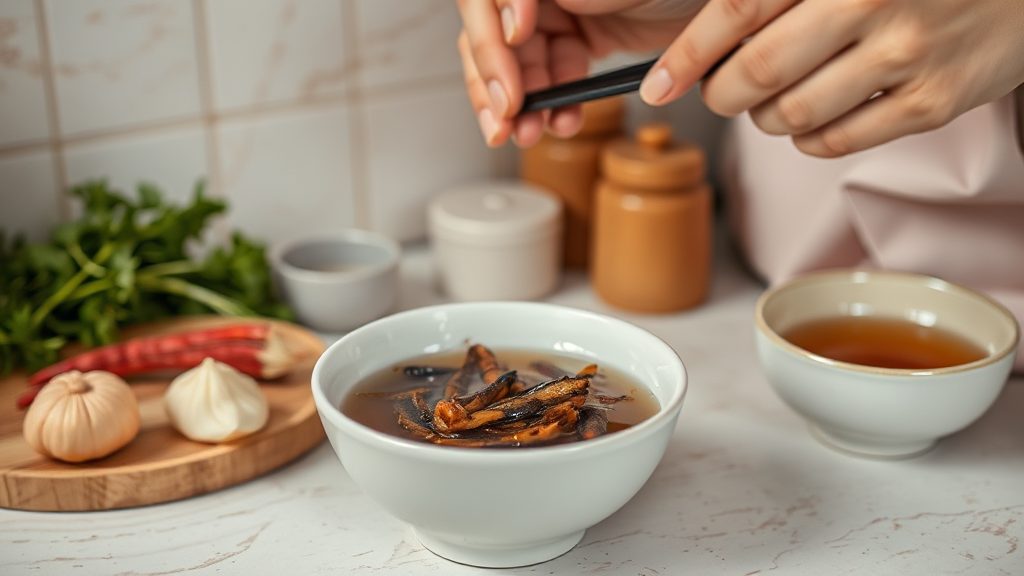
After 20 minutes of simmering, remove the pot from heat immediately. Let it sit for 5 minutes, then strain the broth through a fine-mesh strainer or cheesecloth into another pot or large bowl. Discard the solids—they’ve given all their flavor to the broth and have no further culinary use. Your korean fish stock should be clear to slightly golden, with a clean aroma that makes you want to sip it straight from the pot.
What Makes Korean Anchovy Broth Different from Japanese Dashi?
While both Korean myeolchi dashi and Japanese anchovy-based dashi share similar ingredients and purposes, they differ in preparation and final flavor profiles. Korean anchovy broth typically uses larger dried anchovies and simmers them longer than Japanese versions, resulting in a more robust, pronounced fish flavor that can stand up to bold Korean seasonings like gochugaru and doenjang. Japanese dashi, particularly niboshi dashi made with small dried sardines, tends toward a more delicate, subtle flavor that supports rather than announces itself.
🌶️ Stocking your Korean pantry? Good gochugaru is the one ingredient worth ordering online — this coarse Korean red pepper powder is the one I keep on hand →
As an Amazon Associate I earn from qualifying purchases.
The other key difference lies in usage: Korean cooks often use anchovy broth as a substantial flavor component that contributes noticeable taste to the final dish, while Japanese cuisine frequently employs dashi as a nearly invisible foundation that provides umami without distinct fishiness. This reflects broader differences in the cuisines—Korean food embraces bolder, more assertive flavors, while Japanese cooking often prizes subtlety and restraint.
Creative Uses for Your Homemade Korean Fish Stock
Once you’ve mastered making korean anchovy broth, a whole world of Korean dishes becomes accessible and more authentic. The most obvious use is as the base for Korean soups and stews—kimchi jjigae, doenjang jjigae, tteokguk, and miyeok guk all benefit tremendously from a proper anchovy broth foundation rather than water or generic stock. The broth provides the umami backbone that makes these dishes taste distinctly Korean.
Beyond soups and stews, consider using your broth for cooking rice, which will absorb the subtle savory notes and become more flavorful without tasting fishy. It’s also excellent for braising vegetables like radish or potatoes, where the anchovy flavor mingles with the vegetables’ natural sweetness. Many Korean banchan (side dishes) call for a splash of anchovy broth to add depth—seasoned spinach (sigeumchi namul), seasoned bean sprouts (kongnamul muchim), and various namul preparations all benefit from this addition.
Tteokbokki, the beloved Korean rice cake dish, traditionally uses anchovy broth as its liquid base, which balances the sweetness of the gochujang sauce and provides savory depth. When making Korean noodle dishes like kalguksu (knife-cut noodles) or janchi guksu (banquet noodles), anchovy broth creates an authentic flavor profile that commercial chicken or vegetable stocks simply cannot replicate. Even when making Korean-style ramyeon at home, substituting half the water with anchovy broth elevates instant noodles into something special.
🍜 Korean instant ramyun is the base for so many quick, cozy meals — and the good brands are worth it. Here’s the one I keep stocked →
As an Amazon Associate I earn from qualifying purchases.
🌶️ No gochujang on hand? It’s worth buying the real thing rather than substituting — this is the gochujang I use →
As an Amazon Associate I earn from qualifying purchases.
If you’re exploring more Korean recipes, you’ll find that anchovy broth appears again and again as a fundamental ingredient. It’s worth making a large batch and freezing portions for future use—your commitment to this one basic preparation will pay dividends across dozens of dishes.
Storing Korean Anchovy Broth for Maximum Freshness
Proper storage ensures you always have this essential ingredient ready when inspiration strikes. Fresh anchovy broth will keep in the refrigerator for 4-5 days in an airtight container. Make sure to cool it completely before refrigerating—leaving a pot of hot broth covered can create condensation that promotes bacterial growth. Once cooled, pour it into glass jars or food-safe plastic containers, leaving a bit of space at the top if you plan to freeze it.
Freezing is the best long-term storage solution for Korean fish stock. The broth freezes beautifully for up to three months without any loss of flavor. For maximum convenience, freeze it in various portion sizes: ice cube trays for small amounts (perfect for adding a tablespoon or two to banchan), 1-cup portions in zip-top bags for single servings of soup, and 4-cup portions for larger recipes. Label each container with the date and contents—frozen broth looks identical to frozen water, and you don’t want any confusion when you’re cooking.
When you’re ready to use frozen broth, you can thaw it overnight in the refrigerator or do what most Korean home cooks do: pop the frozen block directly into your pot and heat it gently. The broth will melt and come to temperature quickly. If you’ve frozen it in zip-top bags, run the sealed bag under cold water for a minute to release the frozen block, then add it to your pot.
Some cooks reduce their anchovy broth by half to create a concentrated stock that takes up less freezer space and can be reconstituted with water when needed. This is particularly useful if freezer space is limited. Simply simmer your finished broth for an additional 15-20 minutes until it’s reduced by half, cool, and freeze in small portions. When cooking, use half the amount of concentrated stock and add an equal amount of water to restore the original strength.
Troubleshooting Common Anchovy Broth Issues
Even with a simple recipe like myeolchi dashi, you might encounter a few issues on your first attempts. The most common problem is a bitter or overly fishy broth, which typically results from simmering too long or not removing the anchovies’ heads and guts. If your broth tastes bitter, reduce your simmering time to 15 minutes next time, and be more diligent about cleaning the anchovies. You can also try using fewer anchovies—some brands are particularly strong, and 1.5 cups might be sufficient instead of 2 cups.
If your broth lacks depth and tastes weak or watery, you’ve likely used too much water for the amount of anchovies, or your anchovies were old and had lost their potency. Increase the ratio of anchovies to water—try 2.5 cups of dried fish to 8 cups of water. Also check that your anchovies smell fresh and look silvery rather than yellowish. Another trick is to add an extra piece of dried kelp, which contributes significant umami depth without any fishiness.
Cloudy broth usually comes from boiling too vigorously or too long, which causes proteins to break down and disperse throughout the liquid. While cloudiness doesn’t affect flavor significantly, it’s aesthetically less appealing, especially in clear soups. To fix this, maintain a gentle simmer rather than a rolling boil, and stick to the 20-minute maximum simmering time. Skimming foam regularly also helps maintain clarity.
Some people worry about the sodium content in anchovy broth since dried fish are naturally salty. While the broth does contain sodium, it’s generally less than you might expect—much of the salt remains in the discarded solids. If you’re watching sodium intake, you can rinse the dried anchovies briefly before cooking (though this removes some flavor) or simply account for the broth’s saltiness when seasoning your final dish, adding less salt or soy sauce than the recipe calls for.
Making Anchovy Broth Part of Your Cooking Routine
The real value of mastering Korean anchovy broth isn’t just in having one more recipe in your repertoire—it’s in understanding how Korean cooking builds layers of flavor from the foundation up. Once you’ve made this broth a few times, you’ll start to recognize its subtle presence in restaurant dishes and appreciate how it ties together disparate ingredients into a cohesive, satisfying whole.
Consider setting aside 30 minutes once a week or every two weeks to make a large batch of broth for freezing. This small time investment means you’ll always have the foundation for authentic Korean cooking ready to go. On busy weeknights when you want comfort food quickly, having anchovy broth on hand transforms a package of rice cakes, some gochujang, and scallions into tteokbokki in fifteen minutes. It turns leftover kimchi into a satisfying stew with just tofu, broth, and a few seasonings.
As you become more comfortable with the basic recipe, experiment with variations. Try adding dried shiitake mushrooms during simmering for an earthier, more complex broth. Use a mix of different-sized anchovies for layered depth. Toast the dried anchovies in a dry pan for a few minutes before adding them to water—this extra step adds a subtle nuttiness that some cooks swear by. Korean cooking rewards this kind of thoughtful experimentation while remaining fundamentally accessible and forgiving.
Whether you’re already comfortable cooking Korean food or just beginning to explore the cuisine beyond restaurant favorites, anchovy broth is one of those fundamental skills that opens doors to countless dishes. It’s the difference between Korean food that tastes good and Korean food that tastes authentic—between meals that satisfy and meals that comfort. The best part? Unlike many foundational cooking techniques that require years to master, you can make excellent Korean anchovy broth on your very first try, and it only gets better from there.