As an Amazon Associate I earn from qualifying purchases. This post contains affiliate links, which means I may earn a small commission — at no extra cost to you — if you buy through them. I only recommend things I believe are genuinely worth your time.
There are certain foods that just make everything feel okay. A mug of hot coffee on a slow morning. A bowl of soup when you’re sick. And then there’s Korean stew — jjigae — which takes that feeling and turns it up to eleven. Bubbling, fiery red, served straight from the stovetop in the same stone pot it was cooked in. The first time I had kimchi jjigae, I was genuinely confused by how something so simple could taste so layered and deep.
I’ve been working through a Korean cookbook recipe by recipe, and Korean stew has become one of my favorite categories to explore. Every version of jjigae I’ve tried has been different — some are mellow and earthy, some hit you with fermented funk, and some are loaded with enough spice to clear your sinuses. If you’re new to Korean cooking or just looking for something warm and satisfying, Korean stew is one of the best places to start.
What Makes Korean Stew Different From Other Soups
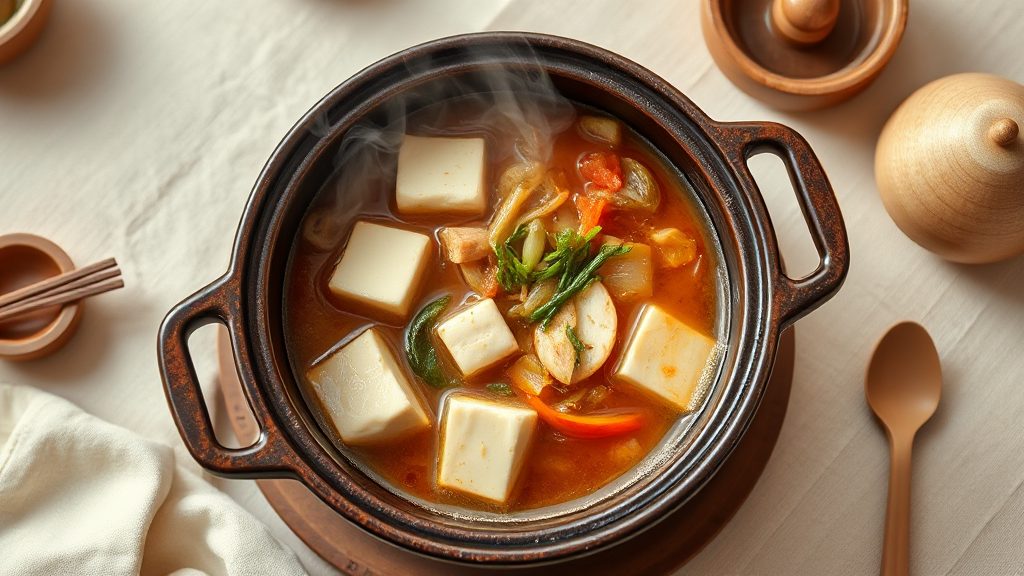
Korean stew isn’t really like Western stew. It’s not thick and gravy-like. It’s more like a cross between a soup and a braise — deeply flavored broth with chunks of vegetables, tofu, or meat, served at a rolling boil. That’s one of the things that makes jjigae so iconic: it arrives at the table still bubbling. The stone or earthenware pot (called a ttukbaegi) retains heat so well that your Korean stew stays hot through the entire meal.
The other big difference is context. Korean stew is almost never eaten alone. It’s part of a spread — a bowl of rice, several banchan (side dishes), maybe some kimchi on the side. You take a spoonful of stew, a bite of rice, a piece of pickled radish, and everything works together. It’s communal and balanced in a way that feels really intentional. Coming from a background where meals are often one big plate, learning how Korean meals come together has been one of the most interesting parts of this whole cooking journey for me.
Kimchi Jjigae: The Most Popular Korean Stew
If you only try one Korean stew, make it kimchi jjigae. It’s probably the most well-known jjigae both inside and outside Korea, and for good reason — it’s bold, tangy, spicy, and incredibly satisfying. The base is fermented kimchi, ideally kimchi that’s been aging for a while and has gotten really sour and funky. That aged, fermented flavor is what gives kimchi jjigae its depth.
I’ve been making my own kimchi — multiple kinds, actually — and the moment I realized that overripe, super-sour kimchi is actually ideal for cooking was a game-changer. Instead of feeling bad about kimchi that’s gotten too fermented to eat as a side dish, I now get excited because it means kimchi jjigae night. The stew usually includes pork belly or shoulder, tofu, scallions, and gochugaru (Korean red pepper flakes). You cook everything together in a pot, and within about 20 minutes you’ve got this incredible, deeply flavored Korean stew that tastes like it simmered for hours.
🌶️ Pantry note: real Korean gochugaru makes a noticeable difference here. This is the bag I reach for →
As an Amazon Associate I earn from qualifying purchases.
A little tip I picked up: adding a small spoonful of gochujang (fermented red pepper paste) along with the kimchi gives the broth extra body and richness. It’s not traditional in every recipe, but it rounds things out beautifully.
🌶️ Pantry staple: a good gochujang lasts months in the fridge and elevates everything. Grab the one I reach for →
As an Amazon Associate I earn from qualifying purchases.
Doenjang Jjigae: The Earthy, Savory One
If kimchi jjigae is loud and bold, doenjang jjigae is its quieter, deeper sibling. Doenjang is Korean fermented soybean paste — think miso’s more intense, earthier cousin. Doenjang jjigae is made by dissolving this paste into a broth along with vegetables like zucchini, potato, onion, tofu, and sometimes mushrooms or peppers. The result is a Korean stew that’s savory, umami-rich, and almost nutty.
🫙 Need doenjang? This fermented soybean paste is the soul of Korean stews and ssamjang. Here’s the tub I use →
As an Amazon Associate I earn from qualifying purchases.
I’ll be honest: doenjang jjigae took me a couple tries to appreciate. The fermented soybean paste has a strong, funky aroma that can be surprising if you’re not used to it. But once I stopped comparing it to anything I already knew and just let it be what it is, I fell in love. It’s the kind of Korean stew that warms you from the inside and feels nourishing in a way that’s hard to describe. Koreans often consider doenjang jjigae the ultimate everyday comfort food — the stew equivalent of a home-cooked hug.
The anchovy or kelp broth base matters a lot here. Since the stew is simpler in flavor than kimchi jjigae, the quality of the broth really shines through. I use dried anchovies and a piece of dashima (dried kelp) simmered for about 15 minutes, then strain it. That little step makes a noticeable difference.
🐟 For real Korean broth: dried anchovies (myeolchi) are the traditional base for savory stock. Here’s the bag I use →
As an Amazon Associate I earn from qualifying purchases.
🌊 Making Korean stock? Dashima (dried kelp) is the base of clean, umami-rich broth. Here’s the dried kelp I use →
As an Amazon Associate I earn from qualifying purchases.
Sundubu Jjigae and Budae Jjigae: More Korean Stew Worth Knowing
Sundubu jjigae is a Korean stew built around sundubu — extra-soft, silky tofu that’s almost custard-like. The broth is spicy and often includes seafood like clams or shrimp, and it’s typically finished with a raw egg cracked right into the bubbling pot. That egg cooks from the residual heat and adds a creamy richness to every spoonful. If you’ve been to a Korean restaurant, you’ve probably seen sundubu jjigae on the menu — it’s one of the most commonly ordered Korean stews at restaurants for a reason. It’s warming, protein-packed, and incredibly flavorful.
Then there’s budae jjigae, which translates to “army stew” or “army base stew.” This one has a fascinating history. It originated after the Korean War when food was scarce, and people combined surplus American processed foods — spam, hot dogs, American cheese, baked beans — with Korean ingredients like kimchi, gochugaru, and ramyeon noodles. The result sounds like it shouldn’t work, but it absolutely does. Budae jjigae is funky, spicy, cheesy, and completely addictive. It’s one of those dishes that shows you how creative people are when resources are limited, and it’s become a beloved Korean stew in its own right.
I haven’t made budae jjigae at home yet, but it’s near the top of my list. The ingredient combination is wild enough that I know it’s going to be an experience.
Tips for Making Korean Stew at Home
Making Korean stew at home is genuinely one of the easiest entry points into Korean cooking. Most jjigae recipes are forgiving, come together quickly, and don’t require fancy equipment. Here’s what I’ve learned so far:
Stock up on a few key ingredients. Gochugaru (Korean red pepper flakes), gochujang (fermented red pepper paste), doenjang (fermented soybean paste), soy sauce, sesame oil, and garlic are the building blocks of most Korean stew recipes. You can find all of these at an H-Mart or Korean grocery store, and they last a long time. Once you have these in your pantry, you’re set to make several different types of jjigae.
🥢 One upgrade that matters: cheap sesame oil tastes flat — a real toasted one is nutty and fragrant. This is the toasted sesame oil I use →
As an Amazon Associate I earn from qualifying purchases.
Use the right pot if you can. A Korean stone pot (ttukbaegi) is inexpensive and makes a real difference. It retains heat beautifully and keeps your Korean stew bubbling at the table. You can find them online or at Korean grocery stores for around $10-15. That said, any small pot works in a pinch.
Don’t skip the broth base. Anchovy-kelp broth is the foundation of so many Korean stews, and it’s dead simple to make. Simmer dried anchovies (heads and guts removed) and a piece of dried kelp in water for 15 minutes, strain, and you’re done. It adds a subtle depth of flavor that water alone just can’t replicate.
Let your kimchi get old. For kimchi jjigae especially, older kimchi is better. If your kimchi has gotten really sour and you’re not loving it as a side dish anymore, that’s exactly when it’s perfect for Korean stew. The fermentation adds incredible depth to the broth.
Serve it with rice. Always. Korean stew is meant to be eaten with a bowl of steamed white rice. The mild, starchy rice balances out the bold, salty, spicy broth perfectly. It’s one of those pairings that just makes sense.
Why Korean Stew Has Become a Staple in My Kitchen
I came into Korean cooking as a complete outsider. I’m Russian-born, living in Florida, with zero Korean heritage. But there’s something about Korean stew that transcends cultural boundaries. Maybe it’s the emphasis on fermented flavors, which I already love from making kimchi and sourdough. Maybe it’s the communal aspect of Korean meals — the way food is meant to be shared and experienced together. Or maybe it’s just that a bubbling pot of jjigae on a Wednesday evening makes the whole week feel more manageable.
Korean stew has taught me that comfort food doesn’t have to be complicated. Some of the best jjigae recipes have fewer than ten ingredients and take less than 30 minutes. What they rely on instead is quality fermented ingredients, a good broth, and the patience to let those flavors meld together in a hot pot.
If you’re curious about Korean cooking, start with a stew. Pick up some aged kimchi, grab a block of tofu, and make kimchi jjigae. Or simmer some doenjang with vegetables for a quieter, earthier experience. Either way, you’ll understand pretty quickly why Korean stew is one of the most beloved categories of food in Korean cuisine — and why it’s become one of my favorites too.