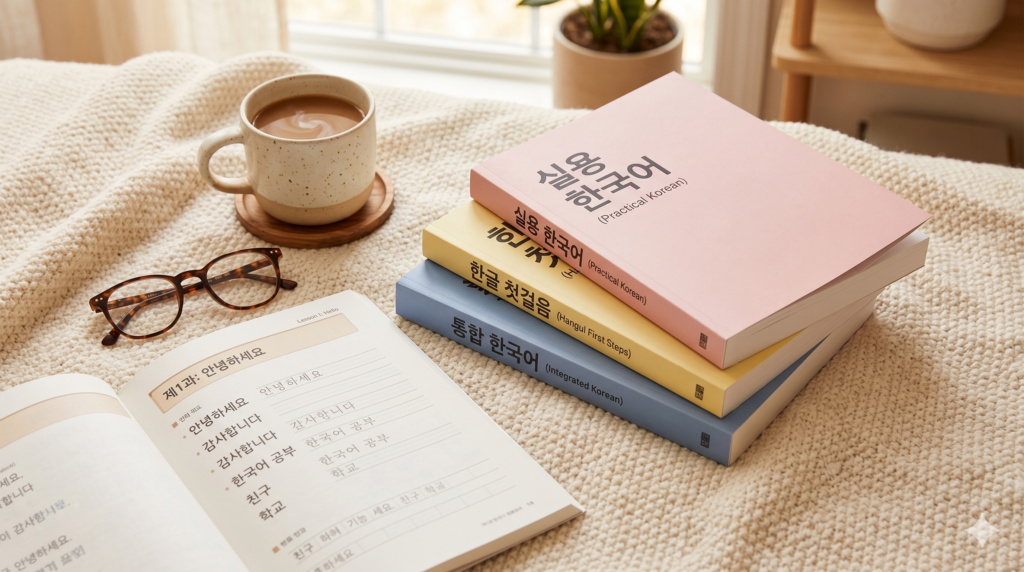
There’s no shortage of Korean textbooks available in 2026, but not all of them are built for self-study. Some assume you have a teacher. Others skimp on answer keys. A few are genuinely excellent for learning Korean on your own — here’s the shortlist of textbooks that work best when you’re your own teacher.
This guide covers physical textbooks and workbooks — if you’re looking for free digital resources instead, that guide has every app and course that’s genuinely free.
What Makes a Korean Textbook Good for Self-Study?
A good self-study Korean textbook needs clear explanations, audio support, practice exercises with answer keys, and a logical progression from simple to complex. Without a teacher to ask questions, the book needs to anticipate your confusion and address it on the page. Here’s what to look for:
- Grammar explanations in English — some textbooks are written for Korean-immersion classrooms and explain grammar in Korean. Avoid these if you’re a beginner.
- Audio recordings — pronunciation is critical and you can’t learn it from text alone.
- Answer keys — sounds obvious, but several popular textbooks don’t include them, making self-checking impossible.
- Practice exercises — reading grammar rules isn’t enough. You need to apply them.
Best Korean Textbooks for Absolute Beginners
1. Korean Made Simple by Billy Go
This is the book most self-learners recommend as their very first Korean textbook. Billy Go (a popular Korean teacher on YouTube) wrote it specifically for English-speaking self-learners with zero prior knowledge. The explanations are clear, conversational, and don’t assume you know any linguistics terminology.
- Pros: Written entirely for self-study. Starts with Hangul. Clear, friendly tone. Affordable. Practice exercises included.
- Cons: No audio (use Billy Go’s YouTube channel as a companion). Covers roughly A1 level only.
- Best for: True beginners who want a gentle, non-intimidating start.
There’s also Korean Made Simple 2 and 3 for continuing your progress.
2. Integrated Korean (KLEAR Textbook Series)
This is the textbook used in most university Korean programs in the United States. It’s rigorous, well-structured, and covers all four skills (speaking, listening, reading, writing) systematically.
- Pros: Comprehensive. University-level quality. Companion workbooks with answer keys. Audio available online. Covers from beginner through advanced across multiple volumes.
- Cons: Designed for classroom use — some exercises assume a partner or teacher. More academic tone than casual self-study books. Can feel dense for absolute beginners.
- Best for: Disciplined self-learners who want a thorough, structured curriculum. Start with “Integrated Korean: Beginning 1.”
3. Talk To Me In Korean (TTMIK) Textbooks
TTMIK’s physical textbooks are separate from their now-paid online courses and are still worth buying. They break grammar into bite-sized lessons with natural example sentences and cultural context.
- Pros: Modern, conversational Korean. Each lesson is short and digestible. Companion audio and workbooks available. 10 levels covering beginner through advanced.
- Cons: Less rigorous than Integrated Korean. The physical books are an investment if you buy the full series. Some learners find the progression too slow in early levels.
- Best for: Learners who prefer short, manageable lessons over dense chapters.
Best Korean Textbooks for Intermediate Learners
4. Korean Grammar in Use: Beginning to Early Intermediate
This isn’t a traditional textbook — it’s a grammar reference organized by pattern rather than by chapter. Each grammar point gets a clear explanation, example dialogues, and practice exercises. Think of it as a dictionary of Korean grammar.
- Pros: Perfect for looking up specific grammar points. Clear format. Available in Beginning, Intermediate, and Advanced editions. Includes answer key.
- Cons: Not designed to be read cover-to-cover. Works best as a supplement to a main textbook or course.
- Best for: Anyone who wants a grammar reference to use alongside free resources like How To Study Korean or Duolingo.
5. Ewha Korean Textbooks
Published by Ewha Womans University (one of Korea’s top universities), these textbooks are used in their Korean language programs for international students. They’re thorough, well-designed, and cover cultural context alongside language.
- Pros: High production quality. Includes cultural notes. Strong listening and speaking components. Covers six levels (1-1 through 3-2).
- Cons: Assumes classroom setting for some activities. Can be hard to find outside Korea (check online Korean bookstores). More expensive than some alternatives.
- Best for: Learners who want a polished, immersive textbook experience.
Free Textbook Alternatives
Not ready to buy a textbook? Several excellent options are completely free:
- King Sejong Institute textbooks — the Korean government publishes the official Sejong Korean textbooks as free eBook downloads on their companion site. These are the same textbooks used in Sejong Institutes worldwide.
- How To Study Korean — not a textbook per se, but the site functions like one, with structured lessons, vocabulary lists, workbooks, and quizzes. All free forever.
- Yonsei University’s Coursera course — audit it for free and get university-level instruction with no cost.
For the full list, the free Korean learning resources guide covers every genuinely free option available in 2026.
How to Get the Most Out of a Korean Textbook
- Don’t skip the exercises. Reading grammar explanations feels productive but doesn’t build skill. Do every exercise, even if it feels tedious.
- Pair your textbook with a free app — use Duolingo or Anki for daily review, and the textbook for deep study sessions.
- Read the dialogues out loud. Korean is a spoken language. Silent reading builds recognition but not fluency.
- One chapter per week is a sustainable pace. Rushing through a textbook means nothing sticks. Go slow and review often.
The best textbook is the one you’ll actually open every week. Pick one that matches your learning style, pair it with free digital tools, and show up consistently. That’s the whole formula.