As an Amazon Associate I earn from qualifying purchases. This post contains affiliate links, which means I may earn a small commission — at no extra cost to you — if you buy through them. I only recommend things I believe are genuinely worth your time.
Once you know the regular verb λύω, you will meet a family of verbs that look slightly different in a way that puzzles beginners — until you learn the one simple rule behind them. These are the contract verbs, and they are not irregular at all. They are extremely regular; they just follow a sound rule when two vowels bump into each other.
I spend a focused lesson on them in Volume II, because they are so common that reading the Gospels without them is impossible.
The problem contract verbs solve
Some verb stems end in a vowel — ε, α, or ο. When you add the ordinary endings (which also begin with vowels), you get two vowels right next to each other. Greek does not like to leave them sitting there; it contracts them into a single sound. Think of how English speakers say “gonna” instead of “going to” — the vowels blend for smoothness. That is exactly what Greek does, but with tidy, predictable rules.
The three contract families
There are three, named by the vowel that ends the stem:
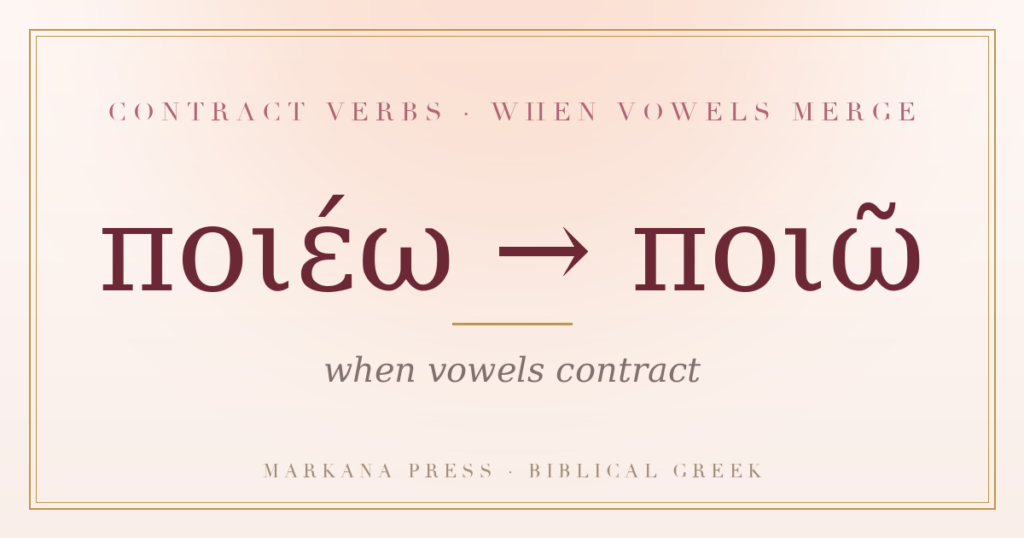
- Epsilon (ε) verbs — like ποιέω (“I do, I make”). The uncontracted ποιέω contracts to ποιῶ.
- Alpha (α) verbs — like τιμάω (“I honor”), which contracts to τιμῶ.
- Omicron (ο) verbs — like δηλόω (“I make clear”), which contracts to δηλῶ.
Notice the little circumflex accent (the ῀) that appears over the contracted vowel — ποιῶ, τιμῶ, δηλῶ. That accent is your visual flag that a contraction has happened. Spot the circumflex on the ending, and you are probably looking at a contract verb.
Why you don’t have to memorize endless charts
Here is the relief: you do not memorize hundreds of contracted forms. You learn a handful of contraction rules (ε + ο becomes ου, α + ε becomes α, and so on) and apply them. Better yet, in your dictionary these verbs are always listed in their uncontracted form (ποιέω, not ποιῶ), so the lexicon shows you the stem plainly. You just learn to recognize the contracted shape when you meet it in the text. It is pattern recognition, not brute memory.
How common are they? Very.
Contract verbs are everywhere in the New Testament because they include some of the most important words in the faith: ἀγαπάω (“I love”), λαλέω (“I speak”), ζητέω (“I seek”), προσκυνέω (“I worship”). When Jesus asks Peter, “Do you love me?” the verb is ἀγαπάω, a contract verb. You simply cannot read the Gospels without these, which is why it is worth taking an afternoon to get comfortable with the pattern.
The big picture
Contract verbs are a perfect example of something that looks scary on the surface and turns out to be one of the most orderly parts of Greek underneath. A sound rule, a circumflex flag, a stem you can always find in the dictionary. Add them to your toolkit and a huge slice of the New Testament’s vocabulary opens up. Next, the third declension does for nouns what contract verbs do for verbs — turns an apparent mess into a learnable pattern.
From Markana Press
Read the New Testament in the language it was written in
Everything in this post is exactly how I teach it in Biblical Greek: A Self-Study Textbook — a four-volume course I publish through my Christian imprint, Markana Press. It assumes no background in Greek and takes you from the alphabet to reading the Gospels in their original words.
📚 All four volumes are free to read on Kindle Unlimited right now — and also available in paperback and hardcover.
 Free on Kindle Unlimited
Get the complete four-volume series:
Start with Volume I if you’re new — each volume builds on the one before it.