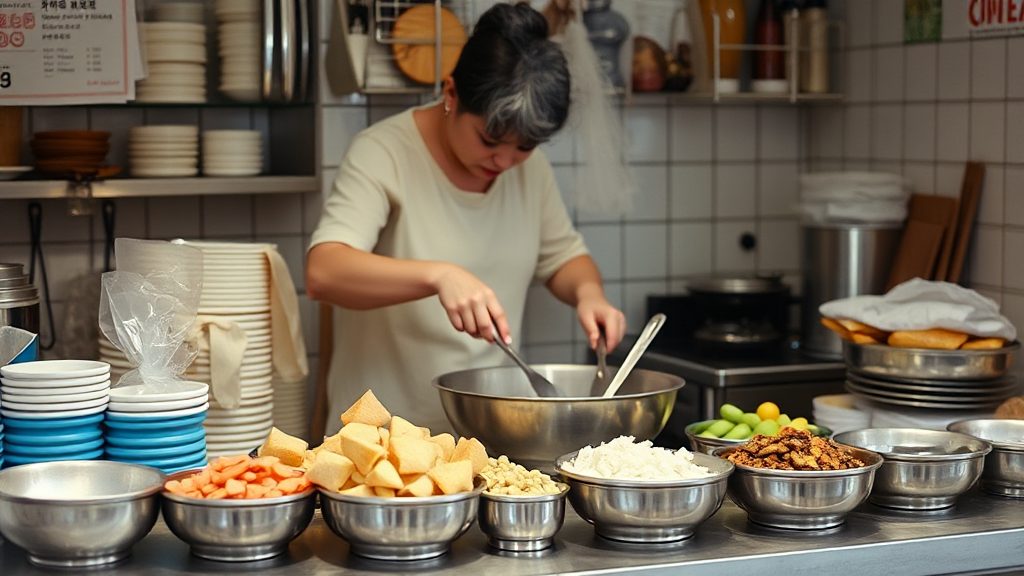
If you’re craving authentic Korean flavors without emptying your wallet, a budget Seoul food tour is the perfect way to experience the city’s legendary street food scene. Seoul’s sidewalks, markets, and late-night pojangmacha (street tents) serve up some of the most delicious and affordable meals you’ll find anywhere in the world—with most items costing under $2. You don’t need an expensive guided tour or fancy restaurant reservations to taste the real Seoul; you just need to know where the locals eat.
This guide will walk you through the exact locations, vendor names, ordering tips, and best visiting times for over ten must-try street food stops across Seoul. Whether you’re planning your first trip to Korea or you’re a seasoned visitor looking to eat like a local, these spots will give you an unforgettable culinary experience without breaking the bank.
The Essential Street Food Map for Your Budget Seoul Food Tour
The best cheap eats Seoul has to offer are concentrated in a few key neighborhoods that are easy to navigate by subway. Start your food adventure in Myeongdong, where the streets between exits 6 and 8 of Myeongdong Station (Line 4) transform into a food paradise after 5 PM. Here you’ll find Myeongdong Tteokbokki (명동떡볶이), a tiny corner stall that’s been serving spicy rice cakes for over 20 years at just ₩3,000 ($1.80). The stall is located directly across from the Lotte Department Store entrance and operates from 4 PM to midnight daily.
🍡 Need rice cakes (tteok)? Chewy Korean rice cakes are the star of tteokbokki and tteokguk. Here’s the tteok I use →
As an Amazon Associate I earn from qualifying purchases.
Next, head to Gwangjang Market near Jongno 5-ga Station (Line 1), one of Seoul’s oldest traditional markets operating since 1905. The bindaetteok (mung bean pancakes) at Grandma Yu’s stall (할머니 유씨 빈대떡) in the northern section of the market have been featured in countless food documentaries. Two pancakes cost ₩4,000 ($2.40), and they’re best enjoyed standing at the counter with a small cup of makgeolli. The market opens at 9 AM, but the food stalls really come alive after 11 AM.
For evening eats, Mangwon Market near Mangwon Station (Line 6, exit 1) offers a more local experience away from tourist crowds. The kimbap lady at stall #23, known simply as “Mangwon Kimbap Ajumma,” makes fresh rolls starting at ₩2,500 ($1.50) that are stuffed with more ingredients than you’d think physically possible. She operates Tuesday through Sunday from 10 AM to 7 PM.
What to Order and How to Say It in Korean
Navigating street food Seoul vendors becomes infinitely easier when you know a few key phrases. At most stalls, you can simply point and hold up fingers to indicate quantity, but locals appreciate when you try to order in Korean. Here’s your essential vocabulary with pronunciation guides:
- Tteokbokki (떡볶이, “ttock-bok-ee”): Spicy rice cakes in gochujang sauce. Order by saying “Tteokbokki hana juseyo” (떡볶이 하나 주세요) for one serving, which usually costs ₩3,000-4,000 ($1.80-2.40).
- Hotteok (호떡, “ho-ttock”): Sweet pancakes filled with brown sugar, cinnamon, and nuts. Simply say “Hotteok hana” (호떡 하나). Price: ₩1,500-2,000 ($0.90-1.20).
- Kimbap (김밥, “kim-bop”): Rice and vegetables rolled in seaweed. Specify the type: “Chamchi kimbap” (참치 김밥) for tuna, “Cheese kimbap” (치즈 김밥) for cheese. One roll: ₩2,500-3,500 ($1.50-2.10).
- Eomuk (어묵, “uh-mook”): Fish cake skewers in hot broth. Order with “Eomuk du gae juseyo” (어묵 두개 주세요) for two skewers at ₩2,000 ($1.20).
- Gyeran-bbang (계란빵, “gye-ran-bbang”): Egg bread with a whole egg baked inside. Say “Gyeran-bbang hana” (계란빵 하나). Price: ₩2,000 ($1.20).
🌶️ Need gochujang for this? This sweet-savory fermented chili paste is the heart of so many Korean dishes — here’s the tub I keep in my fridge →
As an Amazon Associate I earn from qualifying purchases.
At pojangmacha (포장마차), the covered tent stalls that pop up at night, you’ll find more substantial offerings. Try ordering “Sundae” (순대, blood sausage, “soon-dae”) or “Tteokbokki set-eu” (떡볶이 세트, a combo platter with rice cakes, fish cake, fried dumplings, and vegetables) for ₩5,000 ($3.00). Most pojangmacha owners are incredibly friendly and will help you navigate the menu even with minimal Korean skills, especially if you’re learning the language through structured Korean study.
How Much Money Should You Budget for a Day of Street Food?
A full day exploring Seoul on a budget through its street food scene requires surprisingly little money. With ₩20,000-30,000 ($12-18), you can easily eat five to six different items throughout the day and never feel hungry. If you’re seriously committed to Korea on a budget travel, you could actually survive on ₩15,000 ($9) per day by strategically choosing filling options like kimbap, tteokbokki, and free broth that comes with fish cakes.
Here’s a realistic breakdown for a day of eating: Breakfast kimbap (₩3,000), mid-morning hotteok (₩2,000), lunch tteokbokki with fish cake (₩5,000), afternoon gyeran-bbang (₩2,000), evening bindaetteok at Gwangjang Market (₩4,000), and a late-night pojangmacha snack (₩5,000). That’s six satisfying food experiences for ₩21,000 or about $12.60 total.
Most vendors accept cash only, so hit up a convenience store ATM before your food tour. Some newer stalls in Myeongdong accept card payments, but don’t count on it elsewhere.
Legendary Vendor Recommendations and Their Specialties
Beyond the major markets, Seoul hides incredible street food gems in unexpected places. Near Sinchon Station (Line 2, exit 3), there’s a tiny hotteok cart that parks outside the Hyundai Department Store every day from 2 PM to 11 PM. The owner, an ajumma who’s been there since 2018, makes a special version with seeds and chopped peanuts for ₩2,000 that develops a perfect crispy edge. There’s often a line of university students, which is always the best sign.
For the best late-night eats, head to the pojangmacha alley behind Dongdaemun Design Plaza. The red tent in the middle, “Halmoni’s Tent” (할머니 포차), serves incredible rabokki (라볶이)—a combination of ramen noodles and tteokbokki for ₩5,000. The owner keeps it open until 3 AM on weekends, making it perfect for night owls. The combination of chewy rice cakes, springy noodles, fish cake, boiled eggs, and vegetables in spicy broth is comfort food at its finest.
In Hongdae, near exit 9 of Hongik University Station (Line 2), the weekend street market features a rotating cast of food trucks, but one permanent fixture is the tornado potato vendor on the corner of the main walking street. These spiral-cut potatoes on a stick, deep-fried and seasoned, cost ₩3,000 and are mesmerizing to watch being made. The vendor operates Friday through Sunday from 3 PM to 10 PM.
Don’t skip the bungeoppang (붕어빵, fish-shaped pastries) stalls that appear throughout Seoul during autumn and winter months. While seasonal, they’re an essential part of any budget Seoul food tour. The filling varies—red bean, custard, or pizza—and they cost just ₩1,000-1,500 per piece. Look for them near subway exits from October through March.
When Is the Best Time to Visit Seoul’s Street Food Stalls?
Timing your visits strategically can mean the difference between long waits and immediate service, plus you’ll catch vendors when their food is freshest. Traditional markets like Gwangjang and Namdaemun are best visited between 11 AM and 2 PM for lunch when everything is freshly prepared and the breakfast rush has cleared. Avoid arriving right at opening (9 AM) when vendors are still setting up.
For street stalls in areas like Myeongdong and Hongdae, the prime time is 5 PM to 8 PM on weekdays. You’ll get fresh batches of hotteok, tteokbokki, and other items as vendors prepare for the evening rush, but you’ll beat the worst crowds that descend after 8 PM. Weekends get significantly busier, especially in tourist areas, so if you’re on a mission to try multiple spots efficiently, stick to weekday evenings.
Pojangmacha come alive after 7 PM and hit their stride around 9 PM when locals finish work. These late-night spots are cultural experiences as much as culinary ones—you’ll see groups of coworkers, couples on dates, and solo diners all sharing communal tables under plastic tarps. The atmosphere peaks between 9 PM and midnight. Many pojangmacha close around 2-3 AM, though some near university areas stay open until dawn on weekends.
Weather matters too. Rain doesn’t stop Korean street food culture—vendors simply add more tarps—but heavy rain or extreme cold (below -10°C/14°F) will close down all but the most dedicated stalls. Summer monsoon season (July-August) can disrupt outdoor vendors, though covered market stalls operate regardless of weather.
Hidden Gems and Local Favorites Beyond the Tourist Trail
While researching cheap eats Seoul online will point you to Myeongdong and Gwangjang Market repeatedly, some of the best value and most authentic experiences happen in residential neighborhoods. Mangwon Market, already mentioned, deserves extra emphasis because it represents real local life. Beyond the famous kimbap stall, try the mandu (dumpling) vendor near the entrance who makes everything by hand each morning. Six steamed dumplings cost ₩3,000 and are substantially larger than what you’ll find in tourist areas.
Tongin Market near Gyeongbokgung Palace offers a unique “dosirak cafe” (lunchbox cafe) concept where you buy ₩5,000 worth of old-fashioned coins and exchange them at various stalls for small portions of different foods, building your own lunchbox. It’s interactive, fun, and exposes you to traditional Korean dishes you might not try otherwise—things like japchae, various jeon (pancakes), and tteokgalbi (grilled short rib patties). The concept operates Tuesday through Sunday from 10 AM to 2 PM.
For a completely local experience, visit the street food stalls around any university campus. Ewha Woman’s University has an entire underground shopping area with cheap food stalls serving students. The kimbap places here charge ₩2,000-3,000 for enormous rolls stuffed with cheese, kimchi, tuna, or bulgogi. Similarly, the streets around Korea University and Yonsei University are packed with budget-friendly options designed for students watching their won.
If you’re interested in the broader context of Korean food culture and want to eventually recreate some of these flavors at home, exploring Korean recipes and cooking techniques can deepen your appreciation for what you’re tasting on the streets. Understanding the fundamentals of gochujang (red pepper paste), doenjang (soybean paste), and other core ingredients helps you recognize the complexity in seemingly simple street foods.
🫙 Need doenjang? This fermented soybean paste is the soul of Korean stews and ssamjang. Here’s the tub I use →
As an Amazon Associate I earn from qualifying purchases.
Practical Tips for Maximizing Your Street Food Experience
Successfully navigating a budget Seoul food tour requires more than just knowing where to go. Bring your own wet wipes or small tissue packets—most street vendors don’t provide napkins. Convenience stores sell pocket-sized tissue packs for ₩1,000 that’ll last your entire trip.
Eating etiquette at street stalls is refreshingly casual. At pojangmacha with seating, it’s normal to share tables with strangers. At standing stalls, eat quickly and move aside for the next person. Don’t walk around eating in residential areas—it’s considered impolite. Instead, eat near the stall or find a small seating area.
Most street food is designed to be eaten immediately while hot. Tteokbokki gets gummy when cold, hotteok loses its crispy exterior, and fish cakes are best enjoyed steaming. Don’t plan to save these items for later unless you’re okay with significantly diminished quality. The exception is kimbap, which travels well and makes an excellent snack for later in the day.
If you have dietary restrictions, street food can be challenging. Vegetarian options exist—vegetable kimbap (yachae kimbap), hotteok, and some types of jeon—but cross-contamination is common as vendors use the same utensils for everything. Vegan options are extremely limited since fish-based ingredients appear in most dishes. Those with gluten sensitivities should know that soy sauce (containing wheat) and wheat flour appear in nearly everything, including tteokbokki sauce and pancake batters.
Stay hydrated while eating spicy food. Most convenience stores sell drinks for ₩1,000-2,000, or you can get free water at any cafe if you ask politely. The free broth at fish cake stalls is also a good palate cleanser between spicy items.
Finally, don’t be intimidated by language barriers. Pointing works universally, and most vendors are patient with foreigners. Learning just the phrase “Juseyo” (주세요, “give me please”) combined with holding up fingers for quantity will get you through 90% of ordering situations. Your efforts to engage with local food culture, even imperfectly, are what transform a simple meal into a memorable travel experience.
Making the Most of Seoul’s Affordable Food Culture
Seoul’s street food scene represents one of the world’s best examples of how extraordinary food doesn’t require extraordinary prices. For less than the cost of a single meal at a Western fast-food chain, you can spend an entire day tasting authentic Korean flavors prepared by vendors who’ve perfected their craft over decades. The accessibility of this food culture—both in terms of cost and physical availability throughout the city—makes Seoul an ideal destination for budget travelers who refuse to compromise on culinary experiences.
Start your budget Seoul food tour with the vendors mentioned here, but don’t be afraid to venture into stalls that look busy with locals. Lines of Korean customers are always the most reliable indicator of quality and value. Bring cash, come hungry, and embrace the adventure of eating where real Seoul residents eat. Your taste buds and your wallet will both thank you, and you’ll return home with food memories that rival any expensive restaurant experience—plus you’ll have actually saved money in the process.