As an Amazon Associate I earn from qualifying purchases. This post contains affiliate links, which means I may earn a small commission — at no extra cost to you — if you buy through them. I only recommend things I believe are genuinely worth your time.
If you’ve ever wondered how to make Korean stock from scratch, you’re about to discover the secret foundation that transforms everyday Korean dishes into something truly memorable. Korean stock, or 국물 (gungmul), isn’t just an ingredient—it’s the soul of Korean cooking, providing depth and umami that elevates everything from simple soups to complex stews.
Unlike Western stocks that often simmer for hours or even days, Korean broth techniques are surprisingly efficient and accessible. Whether you’re preparing anchovy stock for a weekday kimchi jjigae or a rich chicken broth for samgyetang, mastering these fundamentals will completely change how you approach Korean cooking. The best part? Once you understand the basic principles, you’ll never need to reach for bouillon cubes again.
Why Korean Stock Forms the Foundation of Korean Cuisine
In Korean cooking, stock isn’t an afterthought—it’s where flavor begins. The concept of 국물 encompasses everything from the light, clear broths served with rice to the robust bases that define iconic stews. This emphasis on quality stock reflects a culinary philosophy that values layered, natural flavors over shortcuts.
Traditional Korean broth recipes typically rely on three primary ingredients: dried anchovies (멸치, myeolchi), kelp (다시마, dashima), and chicken or beef bones. Each brings distinct characteristics to the table. Anchovies provide that characteristic savory depth that Koreans call 감칠맛 (gamchilmat)—essentially umami. Kelp contributes minerals and a subtle sweetness that balances the fish notes. Chicken and beef bones offer body and richness that make heartier dishes satisfying.
🐟 Pantry staple: dried anchovies keep in the freezer and make broth taste like home. Grab the ones I keep on hand →
As an Amazon Associate I earn from qualifying purchases.
🌊 Pantry staple: dried dashima keeps forever and is essential for real Korean soup stock. Grab the one I keep on hand →
As an Amazon Associate I earn from qualifying purchases.
What makes Korean stock particularly practical for home cooks in 2026 is its flexibility. You’re not locked into a single recipe or multi-hour commitment. A basic anchovy-kelp stock takes just 20 minutes, while a proper chicken stock requires about 90 minutes—still far less demanding than French or Chinese bone broths. This efficiency matters when you’re cooking on weeknights but refuse to compromise on authentic flavor.
How to Make Korean Anchovy and Kelp Stock
The most versatile stock in Korean cooking starts with dried anchovies and kelp. This homemade Korean broth works beautifully in virtually any soup or stew, from doenjang jjigae to tteokguk. The ratio is forgiving, but a good starting point is 15-20 medium dried anchovies and a 4-inch square of dried kelp per 6 cups of water.
🫙 No doenjang yet? It keeps for months in the fridge and there’s no real substitute. This is the doenjang I reach for →
As an Amazon Associate I earn from qualifying purchases.
Begin by preparing your anchovies. Remove the heads and guts from each anchovy—this step takes an extra five minutes but prevents bitterness. The heads and dark internal organs contain compounds that can make your stock taste metallic or overly fishy. Some cooks skip this step, but if you want restaurant-quality results, it’s worth the effort.
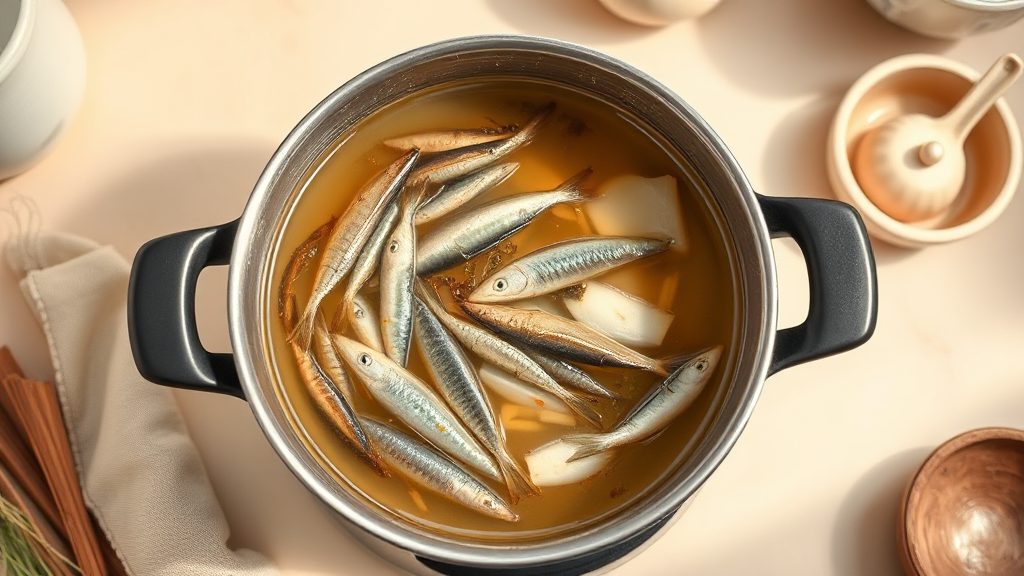
Place your cleaned anchovies in a pot with cold water. Add your kelp piece—you’ll notice it has a whitish powder on the surface, which is natural glutamate, so don’t rinse it off. You can also add aromatics at this stage: a few slices of daikon radish, a piece of onion, or dried shiitake mushrooms will deepen the flavor profile. Some cooks add a dried red chili or two for a subtle background warmth.
Bring the pot to a boil over medium-high heat, then immediately reduce to a gentle simmer. Here’s the critical timing: remove the kelp after exactly 7-8 minutes of simmering. If you leave kelp in too long, it releases a slimy texture and slightly bitter taste. The anchovies, however, should continue simmering for another 10-15 minutes. You’ll know it’s ready when the broth has turned golden and smells pleasantly oceanic without being overwhelming.
Strain the stock through a fine-mesh sieve, pressing gently on the solids to extract maximum flavor. That’s it—you’ve just created the base for countless Korean dishes. This anchovy-kelp stock keeps for 3-4 days refrigerated or up to 3 months frozen. Consider making a double batch and freezing portions in 2-cup containers for convenience.
What Are the Best Dashi Alternatives for Korean Cooking?
Korean anchovy stock and Japanese dashi serve similar functions, but they’re not identical. While both provide umami-rich bases for soups and stews, Korean stock tends to be more robust and assertive, whereas dashi is typically more delicate and refined. If you’re out of Korean anchovies, you can use dashi as a substitute, though you may want to add a pinch of fish sauce to approximate that deeper, saltier note characteristic of Korean broths.
🐟 Pantry staple: one bottle of quality fish sauce lasts ages and elevates everything. Grab the one I reach for →
As an Amazon Associate I earn from qualifying purchases.
The reverse substitution works too—Korean anchovy stock functions well as one of several dashi alternatives in Japanese recipes, particularly in heartier dishes like miso soup or nabemono (hot pot). The key difference lies in the anchovy variety: Korean cooking uses larger, more flavorful anchovies compared to the smaller niboshi sometimes used in Japanese cooking, and the fermentation process differs slightly.
For vegetarian cooks seeking plant-based options, Korean cuisine offers excellent alternatives. A stock made from kelp, dried shiitake mushrooms, and daikon radish provides substantial umami without any animal products. Simmer 2-3 pieces of dried shiitake with kelp in water for about 20 minutes, and you’ll achieve a surprisingly complex flavor that works in most applications. This vegetarian stock has become increasingly popular in 2026 as more people explore plant-forward Korean cooking.
Another excellent substitution comes from dried pollack (황태, hwangtae), which creates a lighter, slightly sweet stock particularly prized for hangover soups. While less common internationally than anchovies, dried pollack is worth seeking out from Korean grocers if you want to expand your stock-making repertoire.
Making Traditional Korean Chicken Stock
When you need a richer, more substantial base—for dishes like samgyetang, kalguksu, or dak gomtang—learning how to make Korean stock from chicken becomes essential. This isn’t the clear, refined chicken broth of French cuisine; Korean chicken stock embraces cloudiness as a sign of body and flavor extraction.
Start with a whole chicken or chicken parts with bones—backs, necks, and wings work exceptionally well because they’re rich in collagen. For 8-10 cups of finished stock, use about 2-3 pounds of chicken pieces. Place them in a large pot with cold water to cover by 2 inches. Add a whole peeled onion, 4-5 cloves of garlic, a 2-inch piece of ginger, and a few slices of daikon radish.
Bring to a boil, and you’ll see foam and impurities rise to the surface. Skim these off for the first 5-10 minutes—this initial skimming improves clarity and removes any off-flavors. Once the initial scum subsides, reduce heat to maintain a steady but gentle simmer. You want small bubbles breaking the surface, not a rolling boil.
The magic happens over the next 60-90 minutes. Unlike Western stocks where you might simmer chicken for 3-4 hours, Korean chicken stock reaches its optimal flavor sooner. Extended simmering beyond 90 minutes can actually make the broth taste flat and overcooked. You’ll know it’s ready when the meat easily falls off the bones and the broth has turned milky white with a slick of fat on the surface.
Strain the stock and let it cool slightly. You can use the cooked chicken meat for other dishes—shred it for chicken salad, use it in bibimbap, or incorporate it back into the soup you’re making. The fat that rises to the top as the stock cools can be skimmed off for a cleaner broth, or left in for richness. Traditional Korean cooks often keep some fat in the stock, as it carries flavor and provides that satisfying mouthfeel.
How Should You Store and Use Korean Stock?
Proper storage extends the life of your homemade Korean broth and ensures you always have quality stock available. Refrigerated stock lasts 3-4 days in an airtight container. For longer storage, freezing is your best option. The most practical approach is portioning stock into 2-cup containers or freezer bags, which matches the amount most recipes require.
A clever storage trick gaining popularity in 2026 is freezing stock in ice cube trays. Once frozen, transfer the cubes to a freezer bag. This gives you small portions perfect for deglazing pans, adding moisture to stir-fries, or enriching rice during cooking. Two or three stock cubes melted into your rice cooker with the water transforms plain rice into something notably more flavorful.
🍚 A reliable rice cooker here’s the rice cooker I’d recommend →
As an Amazon Associate I earn from qualifying purchases.
The applications for Korean stock extend far beyond traditional soups and stews. Use anchovy-kelp stock as the base for ramyeon instead of the seasoning packet—you’ll never want instant noodles the same way again. Cook your rice in diluted chicken stock (half stock, half water) for a subtle richness that pairs beautifully with grilled meats. Add a cup of stock to your kimchi jjigae even if the recipe doesn’t call for it; the extra depth makes a noticeable difference.
🍜 Pantry win: keep real Korean ramyun on hand for upgraded instant noodles. Grab the ones I reach for →
As an Amazon Associate I earn from qualifying purchases.
For specific dishes, certain stocks work better than others. Anchovy-kelp stock excels in fermented soybean-based soups like doenjang jjigae and cheonggukjang. Its assertive flavor stands up to the funk of fermented beans. Chicken stock better serves dishes where you want richness without competing flavors—think manduguk (dumpling soup) or kalguksu (knife-cut noodles). Beef bone stock, while less common in everyday cooking, provides the foundation for seolleongtang and gomtang, those milky-white soups simmered for hours.
Troubleshooting Common Korean Stock Problems
Even experienced cooks occasionally face issues when learning how to make Korean stock. The most common complaint is bitterness, usually caused by leaving kelp in too long or failing to remove anchovy heads and guts. If your stock tastes bitter, you can’t fully reverse it, but adding a small amount of sugar (1/2 teaspoon) or a splash of mirin can mask some of the bitterness.
🍶 Need mirin? This sweet rice wine rounds out marinades and takes the edge off strong flavors. Here’s the mirin I use →
As an Amazon Associate I earn from qualifying purchases.
Overly fishy stock typically results from using too many anchovies or simmering them too aggressively. The solution is counterintuitive: add aromatics like daikon, onion, and ginger, which balance fishiness rather than masking it. Some cooks also add a splash of rice wine during simmering to mellow intense fish flavors.
If your chicken stock turns out thin and watery rather than rich and substantial, you likely didn’t use enough chicken pieces with bones, or you diluted it with too much water. The ratio should be roughly 1 pound of chicken to 3-4 cups of water for proper body. You can also reduce thin stock by simmering it uncovered to concentrate flavors—just watch it carefully to prevent burning.
Cloudy stock bothers some cooks, though in Korean cuisine, cloudiness isn’t necessarily a flaw. If you prefer clearer stock, focus on that initial skimming period and maintain a gentle simmer rather than a boil. Straining through cheesecloth in addition to a fine-mesh sieve also helps. However, remember that many beloved Korean soups intentionally feature cloudy, milky broths—it’s a sign of extracted collagen and minerals, not a mistake.
Taking Your Korean Cooking Further
Mastering stock preparation opens doors to authentic Korean cooking that jarred bases and bouillon cubes simply can’t provide. The difference between a soup made with homemade stock versus water and seasoning packets is the difference between a meal you tolerate and one you genuinely crave. Once you experience that depth of flavor, it’s difficult to go back.
Start with the simple anchovy-kelp stock and use it for a week in various dishes. Notice how it improves everything from your morning soup to your evening stew. Then experiment with chicken stock for noodle dishes. As you become comfortable with these fundamentals, you’ll develop intuition about which stock suits which dish, and you’ll start creating your own variations based on what you have available.
The beauty of Korean stock-making is its forgiveness. Unlike some cooking techniques that demand precision, these broths tolerate variation. A few more anchovies or a slightly longer simmer won’t ruin your efforts. This flexibility makes stock-making sustainable for busy home cooks rather than something reserved for special occasions. If you’re interested in deepening your understanding of Korean culinary traditions, exploring more Korean cooking techniques can provide additional context for how these foundational elements work together.
Remember that every restaurant and home cook in Korea has their own approach to stock. There’s no single “correct” method—only techniques that work better for your palate and schedule. The recipes provided here offer reliable starting points, but feel free to adjust ratios, experiment with additional aromatics, or combine different stock types. Some cooks mix anchovy stock with a smaller amount of chicken stock for extra complexity. Others add dried squid or shrimp for additional layers of seafood flavor.
The investment you make in learning proper stock technique pays dividends with every Korean meal you prepare. Your soups will taste more balanced, your stews more satisfying, and your overall cooking more confident. In 2026, as more home cooks rediscover the satisfaction of making fundamental ingredients from scratch, mastering Korean stock puts you ahead of the curve—creating food that’s not just authentic, but genuinely delicious.